There’s a version of this article that opens with a market-size statistic and calls it a day. That’s not this one.
The real reason fintech investment is picking up right now isn’t a number on a slide — it’s that the gap between what people expect from money management and what most banks actually deliver has gotten wide enough to build a business in. Instant transfers, embedded lending, one-tap investing — none of this is experimental anymore. It’s the baseline, and the companies still running on legacy infrastructure are the ones losing customers to it.
If you’re weighing whether now is the moment to fund a fintech build, here’s the honest case for it, along with the finance development strategy that actually makes an investment pay off.

Fintech products live or die on trust in the numbers — which is exactly why the underlying architecture matters as much as the interface.
The Case for Investing Now
User Expectations Have Already Shifted
People don’t compare your app to other finance apps anymore. They compare it to whatever app they used last — food delivery, ride-hailing, messaging. That’s the bar. Clunky onboarding or a five-second loading screen doesn’t read as “normal for banking” anymore; it reads as broken.
Legacy Systems Are Becoming a Liability
Plenty of financial institutions are still running on infrastructure built decades ago, patched together rather than rebuilt. Every new regulation or feature request becomes harder to ship. That friction is exactly the opening a newer, leaner platform can walk through.
Embedded Finance Is Reshaping Who Gets to Compete
Lending, payments, and insurance are increasingly getting built directly into non-financial platforms — retail, logistics, healthcare. This means the fintech opportunity isn’t limited to standalone banking apps anymore. Practically any platform with a user base and a transaction flow can become a fintech play with the right development partner.
Automation Cuts Cost Structures That Used to Be Fixed
Manual underwriting, paper-based compliance checks, human-reviewed fraud flags — these used to be assumed costs. AI-assisted decisioning and automated compliance workflows are shrinking them fast, which changes the margin math on what used to be a slow, expensive business.
The Full Finance Development Strategy
Investing in fintech isn’t just writing a check for an app idea. It’s funding a specific set of custom Fintech software development solutions that need to work together from day one.
1. Core Banking and Ledger Architecture
Every transaction needs to be recorded, reconciled, and auditable, in real time, without error. This is the unglamorous backbone of the whole product, and it’s usually where a custom Fintech software development company earns its fee — off-the-shelf ledger systems rarely fit a specific business model cleanly.
2. Secure Payment Processing
Card payments, bank transfers, digital wallets — integrated with the gateways and rails relevant to your users, wrapped in tokenization and encryption so sensitive payment data never sits exposed.
3. Identity Verification and KYC/AML Compliance
Financial products can’t launch without knowing who’s using them. Automated identity checks, document verification, and ongoing transaction monitoring for suspicious activity aren’t optional — they’re the legal floor a product has to clear before it can touch real money.
4. Fraud Detection and Risk Scoring
Machine learning models that flag anomalous transactions in real time have become table stakes. The difference between a product that scales and one that bleeds money is usually how well this layer is tuned — too strict, and you block legitimate users; too loose, and fraud slips through.

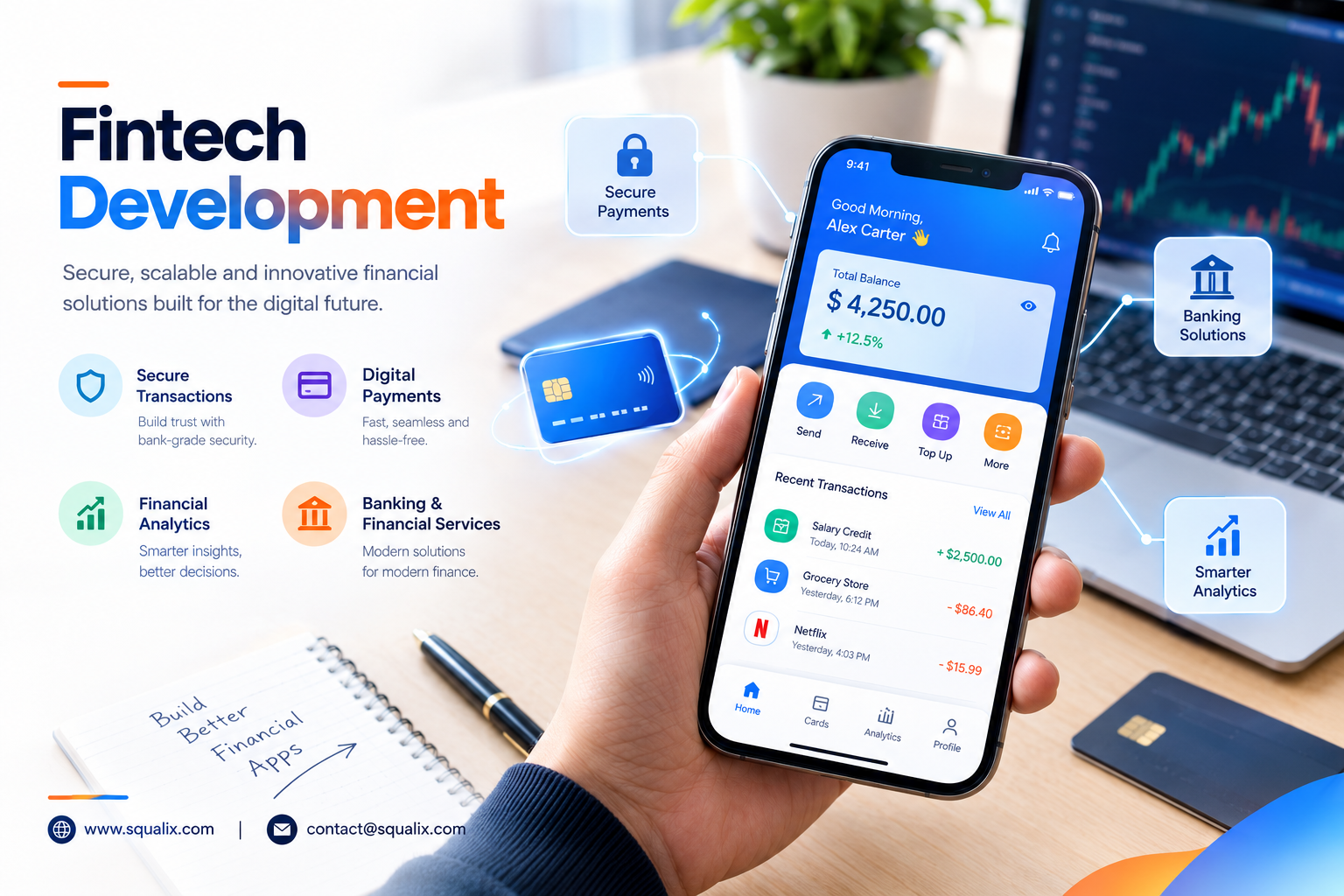
Mobile is where most fintech trust gets built or lost — the app has to feel instant and secure at the same time.
5. API Integrations and Open Banking Connectivity
Modern fintech products rarely operate in isolation. They connect to banks, credit bureaus, accounting software, and third-party data providers through APIs, which means the architecture needs to be built for interoperability from the start, not retrofitted later.
6. Lending, Investing, or Wallet Feature Sets
Depending on the product, this is where the actual value proposition lives — automated loan underwriting, robo-advisory logic, peer-to-peer transfers, or multi-currency wallet support. This is also the layer most likely to change post-launch as the business model gets refined, so it needs to be built modular.
7. Regulatory and Data Privacy Compliance
Financial data protection standards vary by product type and user base, but the underlying discipline is the same: encrypt everything sensitive, log everything auditable, and build compliance into the architecture rather than treating it as a checklist at the end.
8. Scalable Cloud Infrastructure
Transaction volume in fintech doesn’t grow linearly — it spikes around paydays, market events, and promotional pushes. Infrastructure needs to handle that unevenness without downtime, which usually means cloud-native architecture designed for elastic scaling from the first release.
9. Analytics and Financial Reporting Dashboards
Internally, the business needs visibility into transaction volume, user behavior, and risk exposure in something close to real time. This is the layer that turns raw data into decisions, and it’s frequently underbuilt in early-stage products.
10. Ongoing Security Audits and Maintenance
Fintech is a moving regulatory target. What’s compliant this year may need adjustment next year. A long-term development partner keeps auditing, patching, and updating the system rather than treating launch as the finish line.
Timing Isn’t Just About the Market — It’s About Being First to Fix the Gap
The fintech companies that win aren’t necessarily the ones with the most funding. They’re the ones that identified a specific friction point — slow settlements, opaque fees, clunky onboarding — and built the cleanest fix before someone else did. That window doesn’t stay open indefinitely.
Why Choose Web Squalix
Finding Fintech software development solutions that hold up under real regulatory and security pressure isn’t something you want to gamble on. Web Squalix approaches fintech builds the way the category actually demands: security and compliance treated as architecture decisions from the first sprint, not patched in before a launch date.
As a custom Fintech software development company, the team works across core banking systems, payment integrations, fraud detection, and KYC/AML workflows — not as isolated modules, but as one connected system built around how your specific business actually moves money. That cross-industry experience, spanning fintech alongside healthcare, logistics, and on-demand platforms, means the architecture decisions come from pattern recognition, not a template pulled off a shelf.
Post-launch, the relationship doesn’t end at deployment. Ongoing audits, compliance updates, and scaling support are part of the build, because a fintech product that stops evolving after launch is a fintech product that starts losing ground.
The market timing is right. The harder question is who builds it with you — and that’s the decision worth spending real time on.
learn more:https://www.squalix.com/fintech-app-development-company