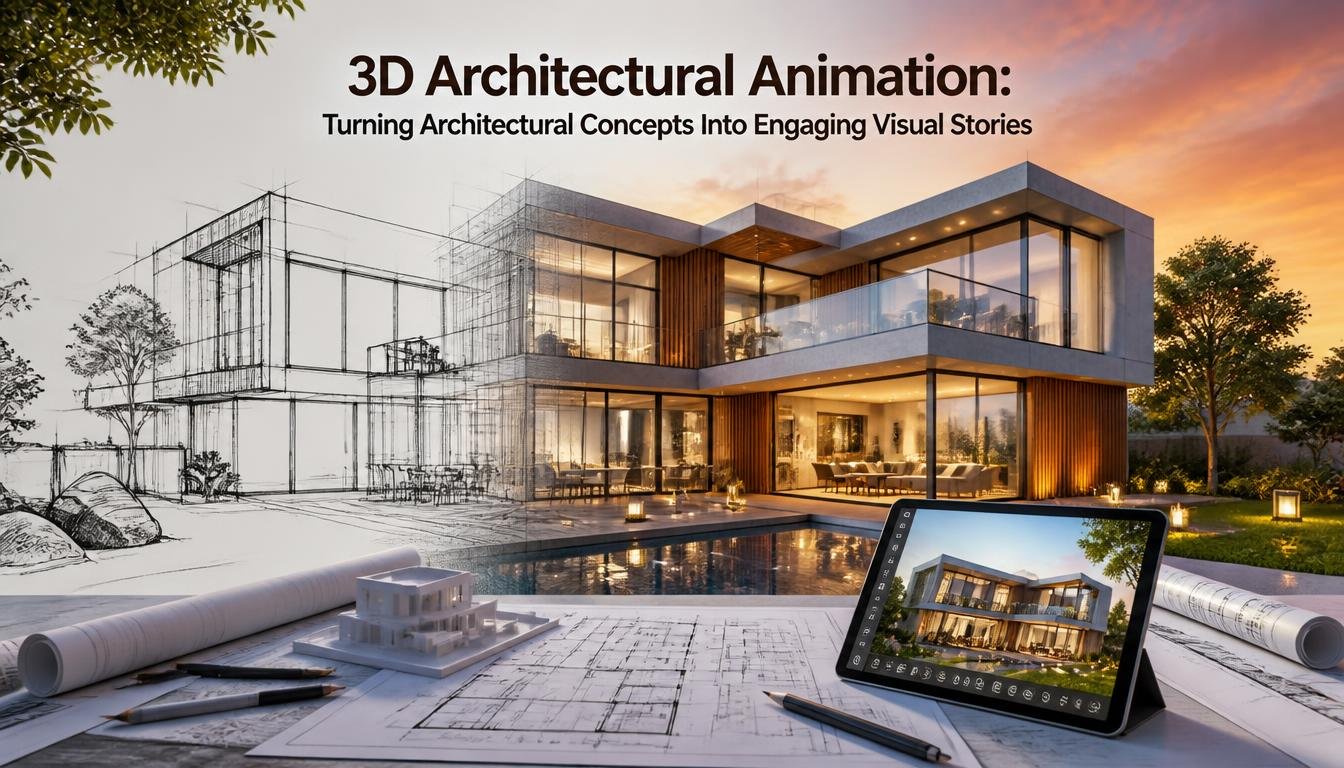
In real events, video and virtual content have become a part of a buyer’s buying process and evaluation of a property, even before visiting it in real life. It is even more applicable to buildings that have yet to be constructed. 3D architectural animation serves to fill the gap in such cases, showcasing not only the visual appeal of the structure but its spatial characteristics in a way that a walk around the place or through an apartment could. A walkthrough has the ability to demonstrate the connections between spaces, their arrangement in relation to one another, and the view from one room to the other that would be difficult to estimate from a plan or photo.
This means that buyers would understand what they are buying before the building is finished. Secondly, there are decisions that must be made on a more informed basis than what the blueprint or picture may suggest.
What Should You Expect From Architectural Animation Services?
Accuracy should be derived from the actual design rather than an appealing but unrealistic image that presents the finished product in better light than it is likely to appear. SMA Archviz offers top-notch 3D architectural animation services, creating every image with the exact sizes, structures, and materials, not a concept of the design.
A good 3D design presentation should not look like a sales pitch but a real walk-through of the project. The client should be able to look at it side by side with the completed construction and know that what they are seeing is an accurate reflection of what was built.
Why Does Video Content Matter So Much In How People Evaluate Spaces?
Static images continue to require viewers to use their imaginations to experience motion, scale, and sequencing. According to NAR’s 2025 Generational Trends report, 41% of home buyers found virtual tours were extremely helpful, while 83% said having photos of the property was essential, compared to 79% who wanted more information about the property and 57% for floor plans (NAR, 2025).
That data covers existing homes that buyers can visit in person. For a building that has not been built yet, video and animation serve a different purpose. There is no finished property to walk through. 3D architectural animation can provide you with this pre-construction experience by illustrating how the space will interact with the environment; how the owner will navigate the property; and finally, the completed property.
What Makes 3D Architectural Animation Different From A Static Rendering?
A static image contains only a single element of a picture at a single moment in time. However, with the animation, a viewer can actually go inside the building and walk around in the first person, as though they were in the building itself. This is more informative in terms of layout than a still image would be since the viewer can experience the connections between rooms.
|
Format |
What It Communicates |
|
Static rendering |
A single, carefully chosen viewpoint |
|
3D architectural animation |
Sequence, scale, and spatial flow over time |
|
Technical elevation drawing |
Dimensions, with no sense of experience |
That difference matters most for buildings with genuine spatial complexity. A lobby that opens into a soaring atrium reads completely differently in motion than it does in a single frozen frame.
Where Does 3D Animation Add The Most Value For Architects And Developers?
3D building animation is most advantageous when a client, investor, or review board needs to see the entire project, rather than from just one perspective. It provides a greater sense of the scale and relationships between elements that a still image cannot. A few situations where animation is especially useful:
- Investor and lender presentations, where the project needs to communicate its scale, quality, and overall design.
- Public design review meetings, where community members need to understand the project’s full context.
- Pre-construction marketing, in which realistic architectural visualization provides buyers with an idea of a building that does not yet exist.
-
Sequential spaces, such as lobbies, atriums, and multi-level structures, in which a single rendering cannot convey the relationships between spaces.
Conclusion
Video already plays a great role in forming the image of places that a person can visit for real. What if there’s a building that doesn’t yet exist? This is where 3D architectural animation ensures the rescue. It becomes the main source of information regarding the building’s size, with a significant contribution to communicating its scale and the level of project development. SMA Archviz supports architecture and development teams with accurate, dimensionally grounded animation. This helps communicate a project’s true potential clearly, rather than simply illustrating it.