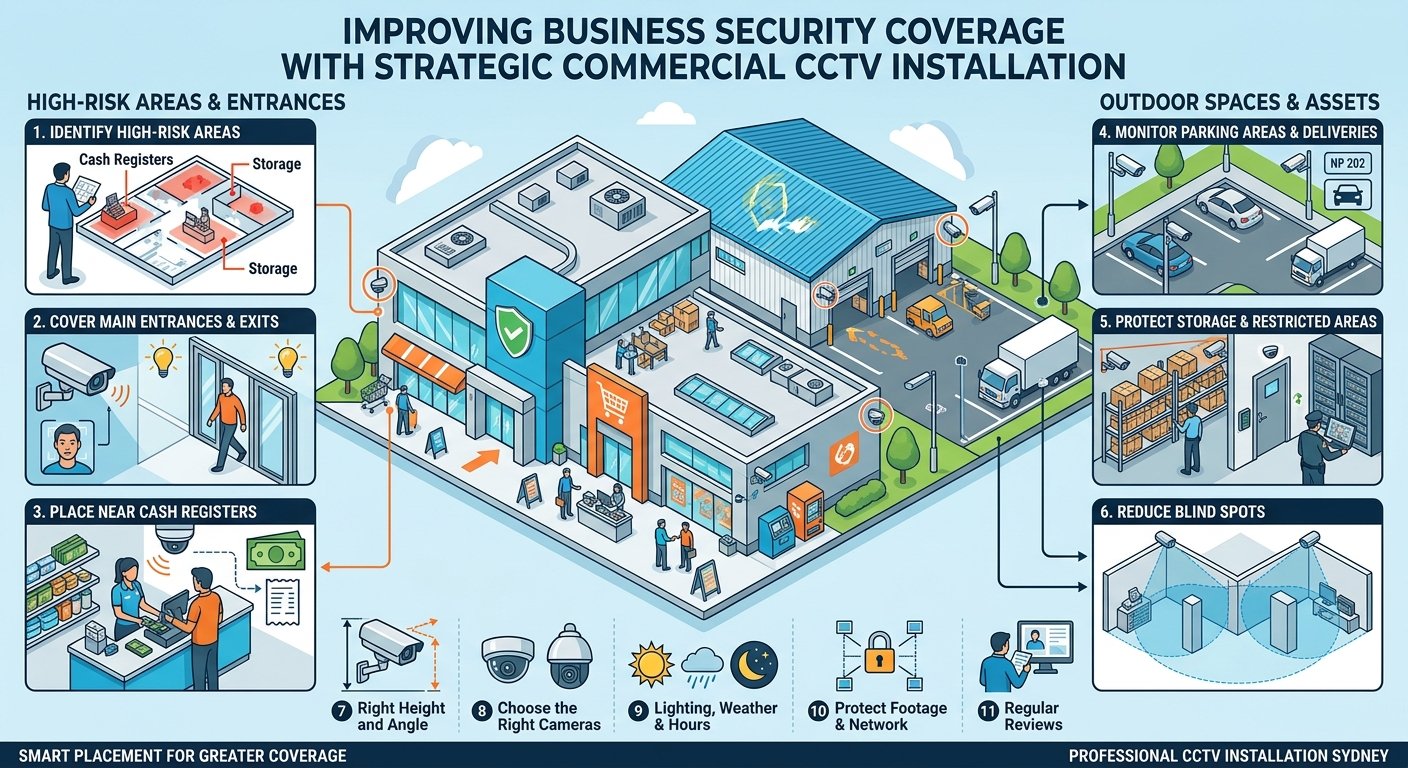
Businesses can improve security coverage by placing cameras at entrances, exits, parking areas, loading zones, storage rooms, and other important locations. The goal is to monitor areas where theft, unauthorised access, or safety problems may occur. A well-planned commercial cctv installation helps business owners reduce blind spots, monitor daily activities, and protect employees, customers, and valuable equipment. Instead of installing cameras everywhere, businesses should focus on the areas that need the most attention. Strategic camera placement also helps businesses use their security budgets wisely. The right positions can provide clear footage, improve incident investigations, and make it easier for security staff to monitor the property. By understanding the layout of a building and its possible risks, businesses can create a reliable security system that meets their needs.
- Identify High-Risk Areas Before Installing Cameras
The first step is to identify the areas where security problems are most likely to happen. Every business has different security needs. A retail store may need to monitor cash registers and product displays, while a warehouse may need cameras near loading docks and storage areas. Business owners should walk through their premises and look for areas where valuable items are kept, people enter and leave, or employees handle payments. They should also consider places that are difficult to see from the main office or reception area. A professional commercial cctv installation plan should consider these risks before deciding where each camera will go. This approach helps businesses focus on important locations instead of wasting money on unnecessary coverage.
- Cover All Main Entrances and Exits
Entrances and exits are among the most important places for security cameras. These areas show who enters and leaves the property and can help businesses investigate suspicious activity. Cameras should cover the main entrance, employee entrances, emergency exits, and delivery doors where appropriate. Businesses should position them to capture useful details, such as faces, clothing, and movement. Lighting is also important. A camera placed near a bright window or entrance may struggle to capture clear images because of strong sunlight or changing light conditions. Cameras with suitable wide dynamic range features can help manage these differences. Businesses should also consider how people approach the doors. A camera that only records the back of someone’s head may provide limited evidence. The camera angle should capture faces as clearly as possible without blocking normal movement or creating privacy concerns.
- Reduce Blind Spots Across the Property
Blind spots are areas that cameras cannot properly monitor. They may appear behind large shelves, walls, pillars, staircases, or pieces of equipment. These gaps can allow suspicious activity to happen without being recorded. To reduce blind spots, businesses should review their floor plans and identify areas hidden from existing cameras. They can then adjust camera angles or add cameras where necessary. Overlapping coverage can be useful in important areas. For example, two cameras positioned at different angles may provide better coverage of a large entrance or busy corridor. If one camera captures a person’s overall movement, another may record clearer details. During CGF commercial cctv installation, businesses should test camera views from different positions before fixing the equipment permanently. This simple step can prevent costly adjustments later. However, overlapping cameras should be used where they add real value. The goal is to achieve useful coverage without unnecessary equipment or excessive monitoring.
- Monitor Parking Areas and Outdoor Spaces
Parking lots, delivery yards, and outdoor storage areas can present security challenges. Vehicles, equipment, and stored materials may be valuable targets for theft. Poor lighting and large open spaces can make these locations harder to monitor. Businesses should position cameras to cover vehicle entrances, parking rows, pedestrian routes, and outdoor storage areas. Cameras with suitable weather protection should be used in exposed locations. Lighting should support clear footage at night. Security lights can improve visibility, while infrared cameras can help record activity in low-light conditions. Business owners should check whether nearby lights create glare or deep shadows that affect image quality. For large parking areas, wide-angle cameras may help monitor general movement. However, they may not capture enough detail to identify faces or vehicle number plates from a distance. Additional cameras with narrower views may be needed at vehicle entrances or other important points. A carefully planned commercial cctv installation can help businesses monitor outdoor activity more effectively during both working hours and after closing.
- Place Cameras Near Cash Registers and Payment Areas
Cash registers and payment counters are important locations for retail stores, restaurants, offices, and other businesses that handle money. Cameras can help investigate missing cash, payment disputes, and suspicious transactions. These cameras should provide a clear view of the payment area without interfering with employees or customers. The position should allow investigators to understand what happened during a transaction. Businesses should avoid placing cameras at angles that hide employees’ hands or block important parts of the counter. At the same time, cameras should not unnecessarily capture sensitive information, such as payment card details or personal identification numbers. Access to recorded footage should also be restricted to authorised staff. Clear policies can help protect customer privacy while allowing businesses to use recordings for legitimate security purposes.
- Protect Storage Rooms and Restricted Areas
Storage rooms, stockrooms, server rooms, and equipment areas often contain valuable items. Unauthorised access to these locations can lead to financial losses, data risks, or operational problems. Businesses should place cameras near the entrances to restricted areas and at points where people handle valuable goods. Warehouses may also benefit from cameras covering shelving aisles, loading zones, and stock transfer points. Camera placement should support other security measures rather than replace them. Access cards, secure locks, alarms, and visitor records can work alongside video monitoring to improve protection. For example, if an access control system records a door opening outside normal working hours, security staff can review the relevant camera footage to understand what happened. A reliable commercial cctv installation should support the business’s wider security plan and provide useful footage when an incident needs investigation.
- Choose the Right Camera Height and Angle
Camera height and angle affect the quality of recorded footage. A camera placed too high may capture the tops of people’s heads instead of their faces. A camera placed too low may be easier to damage or obstruct. The best position depends on the purpose of the camera. Cameras used to monitor general movement may need a wider view, while those intended to identify people may require a more focused angle. Businesses should also consider nearby objects, such as signs, trees, shelves, and decorative features. These objects should not block the camera’s view. Before finalising the position, test the footage under normal operating conditions. Check whether faces, movements, and other important details are visible at different times of the day. Professional planning helps ensure that cameras are positioned to capture meaningful evidence instead of simply recording activity from a distance.
- Use Suitable Cameras for Different Locations
Not every area requires the same type of camera. Choosing the right equipment helps businesses achieve better coverage without spending more than necessary. Dome cameras are often suitable for offices, shops, and indoor public areas. Their compact design can make it difficult for people to tell exactly where the lens is pointing. Bullet cameras are commonly used outdoors because their visible design can act as a deterrent. Depending on the model, they may also provide a focused view of entrances, gates, and driveways. Pan-tilt-zoom cameras allow operators to change the viewing direction and zoom in on selected areas. They can be useful for monitoring large spaces, but they should not be the only source of coverage for critical locations because the camera may be pointing elsewhere when an incident occurs. Businesses should compare resolution, night vision, weather protection, storage capacity, and compatibility with existing systems before choosing equipment.
- Consider Lighting, Weather, and Operating Hours
Even a well-positioned camera may produce poor footage if lighting conditions are unsuitable. Businesses should check how sunlight, shadows, artificial lighting, and darkness affect each camera’s view. Outdoor cameras need protection from rain, dust, heat, and other environmental conditions. The equipment should have an appropriate weather protection rating for its location. Businesses that operate at night may need infrared cameras or suitable low-light models. They should also test whether headlights, reflective surfaces, or bright security lights affect image quality. A professional commercial cctv installation should include checks at different times of the day and, where possible, during the actual conditions in which the system will be used. This helps confirm that the cameras provide useful footage when the business needs it most.
- Protect Camera Footage and Network Access
Camera placement is only one part of an effective security system. Businesses must also protect the footage and prevent unauthorised access to their cameras. Network-connected cameras should use strong, unique passwords and updated software. Businesses should change default login details and limit access to authorised employees. Recorded footage should be stored securely, with retention periods based on business needs and applicable laws. Important recordings should be protected from accidental deletion or unauthorised changes. Remote viewing can help managers monitor their premises when they are away. However, remote access should be configured securely, using appropriate authentication and network protections. Businesses should also establish clear procedures for reviewing, exporting, and sharing recordings. These steps help protect sensitive information while ensuring that footage remains available when needed.
- Review Camera Coverage Regularly
Security needs can change as a business grows. New shelves, partitions, equipment, entrances, or storage areas may create blind spots that did not exist before. Business owners should review camera views regularly and check whether all important areas remain visible. They should also inspect camera lenses, cables, mounts, and recording equipment for signs of damage or failure. Recorded footage should be tested to confirm that cameras are saving usable images and that the system’s date and time settings are correct. Businesses should also check storage capacity and ensure that important recordings are not being lost because of system errors. If an incident reveals a coverage gap, the business should investigate why the camera failed to capture the necessary details and adjust the system accordingly. Regular maintenance helps keep the security system useful over time.
Conclusion
Businesses can improve security coverage by identifying high-risk areas, monitoring entrances and exits, reducing blind spots, protecting outdoor spaces, and placing cameras at suitable heights and angles. They should also choose appropriate equipment, account for lighting conditions, and protect recorded footage from unauthorised access. A carefully planned commercial cctv installation focuses on clear images and useful coverage rather than simply increasing the number of cameras. By reviewing security needs regularly and making adjustments when necessary, businesses can create a more reliable system that protects their property, employees, customers, and valuable assets.