The sheet metal dies manufacturer is indispensable in the manufacturing process to produce high-quality and precise metal parts with high repeatability for today’s ever-evolving industries. In all types of manufacturing, the manufacturing process for metal parts is all too familiar. Sheet metal dies, or metalworking dies, are used to cut, shape, and punch sheets of metal into various types of shapes, helping manufacturers ensure that their products’ dimensions and quality are consistent each time they are produced.
When high-volume manufacturing is needed for your custom components, the quality of your tooling provider is just as important as the quality of the product. Working with an experienced sheet metal die maker, you will be able to source customized tooling products based on material strengths, product detail and manufacturing application. Design, machining and quality control inspections can all be combined to assure reliable performance for a variety of uses.
What Are Sheet Metal Dies?
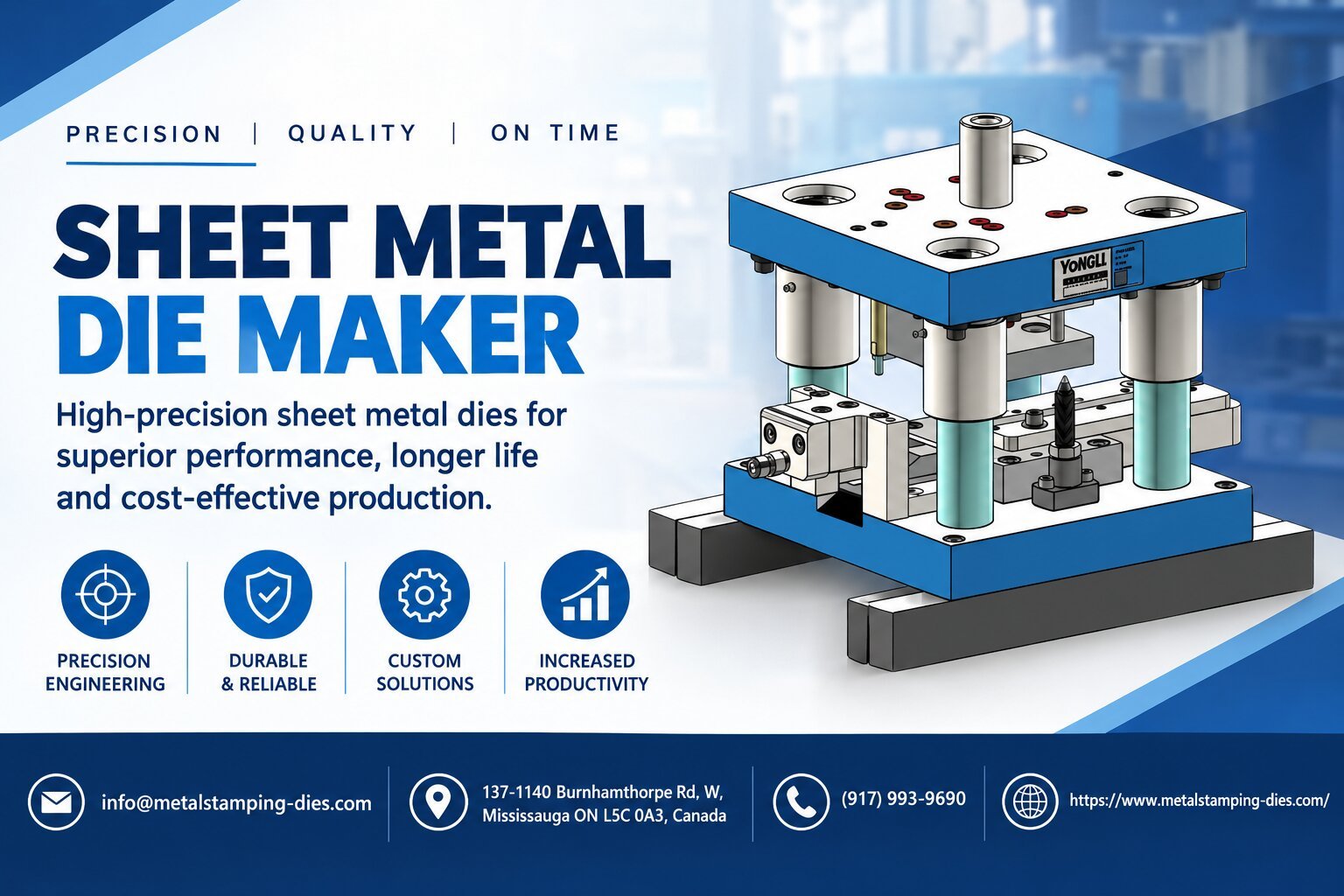
Dies are tools used to cut and form sheet metal. This tool is placed in a press and used to cut and form the metal sheets into finished or semi-finished products. The tooling consists of sections which draw, cut and form the parts into the specified dimensions. A die will blank, punch, bend, draw or do all of those operations in a single operation. Die dimensions are determined by thickness and strength of the metal, as well as the size, tolerances, and volume of the product being produced.
Industries employ tooling to produce intricate components with consistent accuracy. Well-designed dies can lower the number of manual steps needed and facilitate more rapid manufacturing cycles, leading to the consistency of mass-producing similar products in industrialized quantities. Companies that make quality investment in tooling may see benefits from repeatability, less waste, and more consistent results in different production runs.
Benefits of Working With a Professional Sheet Metal Die Maker
Working with a sheet metal die maker ensures they are creating tooling designed to meet your production needs. Skilled die makers analyze your component drawings, material needs, press size and load, and production volume needs before proposing a tooling option to ensure consistent operation and avoid potential design issues.
The major benefits include:
Dies will be manufactured to extremely high standards, resulting in parts that are uniform in both dimensions and shape.
- Improved output: properly conceived tooling sustains a speedier creation cycle and comprises of the inevitable genuine product handling.
- Less Material waste: Cutting layouts and clearances can be optimized for best material usage.
- High Quality: Correct tooling maintenance can help provide repeatability from batch to batch.
- Hard tooling can minimize unnecessary downtime, repairs, and manufacturing processes.
When selecting a tooling supplier, a company must weigh technical competency, quality control systems, customization, and communication. A good partner will be interested in both the present and future manufacturing needs of the company.
Understanding Progressive Die Manufacturing
Progressive die makes up the most common process for producing metal parts in medium and high volume. A progressive die has numerous stations that work sequentially as a strip of metal feeds through the press. Each station has an operation, such as forming, cutting, piercing, or bending, to get to the final part.
Experts in progressive die production make it so that you can synchronize all of the desired functions. In the end, you get an increase in cycle production, with fewer shipments of individual parts to another machine. Progressive die tooling is also used to make clips, electrical terminals, brackets, automotive fittings, and other precision hardware.
Important factors considered during progressive die development include:
- Strip layout and material utilization.
- Station sequencing and component geometry.
- Die clearance and cutting accuracy.
- Press compatibility and operating speed.
- Tool durability, maintenance, and expected production volume.
With appropriate design, a progressive die is able to produce part batches without needing handling. The ideal tooling solution for a part will vary based on the part’s complexity, batch size, material properties and cost of tooling.
The Role of Product Design in Die Development
When designing a new part that will require tooling, an engineer uses product drawings, dimensions, tolerances, and material requirements to determine what the part will be used for. Using this information, a design evaluation at the earliest stages can warn of a feature that may be difficult to form or may cause extra material to be used.
Working with professional progressive die company allows businesses to develop component ideas and work through the process of designing parts to be manufactured. Alternatively, a product design company can offer engineering drawings, prototype creation, 3D visualization, and CAD modeling of a new product, along with design iterations, if that is your need. Die engineering and product design collaborate to produce a workable end component.
The design partnership is particularly valuable for new automotive parts, industrial brackets, electronic enclosures and custom-metal components. Early contact with your design team and tool engineer can reduce costly revisions, facilitate manufacturing and help the transition from product design to volume production.
Applications of Sheet Metal Dies Across Industries
Sheet Metal Tooling For Industrial Manufacturing Bending machines Cutting tools and dies are just some of the tools that can be supported by sheet metal tooling. Factors like the size of the part, the working environment, the material, and the overall quality desired are put into each solution.
Typical uses are:
- Automotive: Mounting plates, brackets, structural parts, clips and precision fitting.
- Electrical Industry: Connector components, terminal parts, housings, and metallic contact members.
- Electronics Manufacturing: Fine scale precision parts, shielding components, and housings.
- Other: Arresting bar holders, blocks, and bases. Mounting plates, support plates, machine covers, and fabricated parts.
- Consumer Products: Special fastener and appliance components, metals, and fittings.
Every application demands optimization of tolerances, volume of production, behavior of material, and finishing requirements. Using custom-made tooling, manufacturers are able to accommodate those needs and ensure that the components’ quality is maintained each time.
How to Select the Right Tooling Partner
There are many considerations when selecting a tooling supplier, not just comparing quotes. Do they know your component type? Can they offer local technical support in the design and manufacture phases?
Keep the following in mind before selecting:
- Technical Experience: Have exposure with similar components, materials, and manufacturing processes.
- The necessary CAD software and engineering skillset should be available.
- Manufacturing Equipment: Think about machining equipment, inspection instruments and services.
- It has quality assurance: inquire about the dimensional checks, trials, and validation.
- Communication: Select a partner who communicates project updates and answers to technical inquiries.
- After-Sales Support: Confirm that services like maintenance, fault troubleshooting and tooling modifications are accessible.
A systematic process is used for choosing a supplier that will be best suited to meet your company’s production needs, financial considerations and future operations.
Improving Manufacturing Efficiency Through Better Tooling
There are several factors that can have an impact on both good tooling and good manufacturing, such as tooling design, material, settings on the press, skills of operator, and maintenance. It is essential, however, that a well-designed die should be installed, inspected and maintained to ensure continuous production. Carrying out routine maintenance can detect wear, breakage or damage to cutting edges and improper die alignment prior to any major production failure.
Manufacturers can explore the option of optimising by keeping an eye on tool life, good production records and planning preventive maintenance. Investigate rejected parts and downtime in production to help identify areas to improve. When the product designers, die makers and production personnel team up, manufacturers will be able to make some tangible changes to increase output and lower hours of operating cost.
Conclusion
Selecting the appropriate sheet metal dies manufacturer is essential for precision, efficiency, and consistent manufacturing quality. From the design and fabrication of custom tooling, through to partial and progressive die development, the various manufacturing processes all impact on the overall quality of the final component. Manufacturers should focus on engineering and quality support, design and partial dies, and the creation of progressive dies.
A pro tooling partner can take your production to the next level by reducing waste and controlling part specification. From new stamping dies or specialized forming tools to high-volume production tooling, any part or component needs can be filled with the right tooling.
Need dependable sheet metal tooling? Share your component drawings, material types, volumes, and our team will be happy to set up a consultation with you! Do you have more questions about our tooling? Reach out today!
Frequently Asked Questions (FAQs)
- What Does a Sheet Metal Dies Manufacturer Do?
A sheet metal dies manufacturer is a fabrication shop that specializes in building or fabricating tools such as dies, which are used to cut, bend, punch, and form sheet metal into the required parts and pieces. Dies help manufacturers attain accurate dimensions and repeatability in their production.
- What Is the Difference Between Standard Dies and Progressive Dies?
Standard dies generally perform one or a limited number of operations per press cycle. Progressive dies perform multiple operations at different stations as a metal strip advances through the tooling, making them suitable for many high-volume applications.
- Which Industries Use Sheet Metal Dies?
Sheet metal dies are used by manufacturers of automotive, appliances, electrical equipment, consumer goods, industrial machinery, and other industries to manufacture precise metal parts.
- How Do I Choose the Right Sheet Metal Die Maker?
Learn about the engineering background, design ability, manufacturing facilities, quality control, customization ability, delivery preparation, and post-sales support of the supplier prior to choosing a partner.
- Why Is Product Design Important Before Die Manufacturing?
Product design is used to determine the size of components, material requirements, tolerances and functional features. Good design review prior to tooling can improve producability, reduce revisions and support better manufacturing efficiencies.