A replacement machine part and a box of online orders might fit inside similar packaging, but they can need very different delivery services. One may be holding up an entire production shift. The other may have a customer who is happy to receive it within two working days.
Choosing between a dedicated courier and a parcel network starts with understanding that difference.
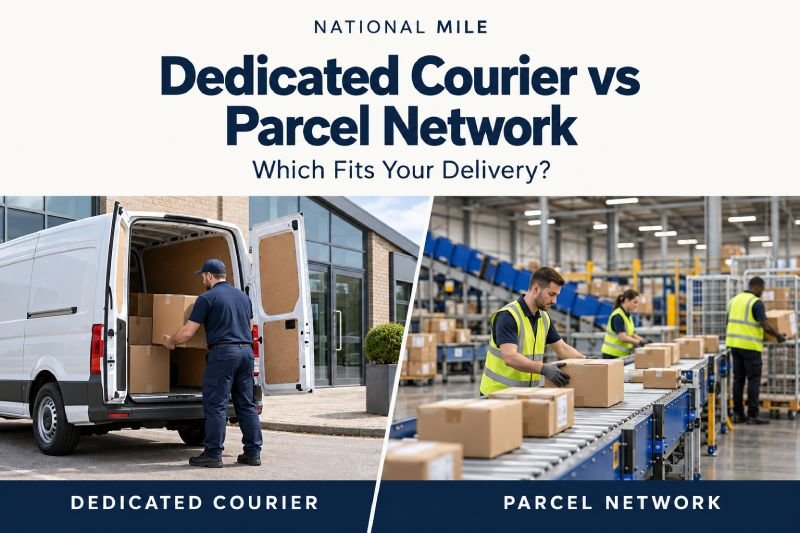
A dedicated courier allocates a vehicle to your consignment. A parcel network combines shipments from many customers and moves them through a shared collection, sorting and delivery system. Each model has advantages, and neither suits every booking.
The right choice depends on your deadline, the goods you are sending, your budget and what would happen if delivery went wrong. Before comparing prices, it helps to understand exactly how each service works.
1. What Is a Parcel Network?
A parcel network is a transport system designed to move large numbers of individual packages efficiently. Your shipment travels alongside parcels from other businesses and private senders.
A typical journey can include collection, processing at a local depot, transport between sorting facilities and a final delivery route. The exact process varies by provider and service.
That shared structure allows operators to spread transport costs across many customers. For businesses sending standard parcels regularly, it can make delivery practical and affordable.
Where parcel networks work well
Parcel networks often suit goods that are easy to package, fall within the carrier’s size and weight limits, and can arrive within a defined service window.
Examples include clothing orders, books, accessories, boxed household products and routine business supplies.
If an online shop sends dozens of similar packages to different customers each day, booking a separate vehicle for every order would usually make little commercial sense. A network gives the business access to an established distribution system.
What senders need to understand
Your parcel is part of a wider operation. Collection cut-offs, sorting schedules and delivery routes influence its journey.
A next-day service may work well when the item is ready before collection and the recipient can accept it during the stated delivery window. It may be less suitable when a consignment must reach a particular person within the next few hours.
Always check the booked service’s terms. Delivery estimates, timed options, exclusions and guarantees differ between carriers.
2. What Is a Dedicated Courier?
A dedicated courier provides a vehicle allocated to your delivery. Instead of entering a shared sorting network, your consignment is collected and transported according to the agreed booking.
For a direct, exclusive-use service, the vehicle carries your goods from the collection address to the destination without unrelated deliveries along the route.
National Mile’s dedicated van courier UK service describes this arrangement as one vehicle carrying your load directly, without shared freight or depot transfers. The appropriate van and collection arrangements depend on the shipment’s dimensions, weight, route and availability.
Dedicated transport is about control
Speed is one reason to book a dedicated courier, but it is not the only reason.
You might need fewer handling stages, a specific collection appointment or a delivery that fits a narrow receiving window. Some goods also need more space than a standard parcel service can offer.
An exhibition supplier, for example, may need several pieces of equipment delivered together to one venue. A dedicated vehicle can keep the consignment together and follow a booking planned around the event’s access arrangements.
Dedicated does not automatically mean immediate
The term describes how the vehicle is allocated. It does not, by itself, confirm when collection will happen.
A dedicated delivery can be scheduled for tomorrow or requested urgently today. Ask the operator to confirm collection availability, expected journey time and the agreed delivery arrangement.
3. The Main Differences at a Glance
Both services move goods between addresses, but their operating models create different benefits.
| Factor | Dedicated courier | Parcel network |
|---|---|---|
| Vehicle use | Allocated to your consignment under an exclusive-use booking | Shared across shipments from multiple customers |
| Routing | Direct transport can be agreed | Usually follows a depot and distribution structure |
| Handling | Typically fewer transfers | Can involve several handling and sorting stages |
| Pricing | Usually reflects the booked journey, vehicle and requirements | Often based on parcel characteristics and service level |
| Collection | Arranged around availability and the booking | Often follows collection schedules and cut-offs |
| Delivery timing | A specific plan can be discussed | Depends on the selected network service |
| Typical fit | Urgent, bulky, sensitive or appointment-based consignments | Routine, standard-sized parcels sent at scale |
These are general differences, not promises about every operator. Some networks offer timed and specialist services. Some courier bookings involve shared transport.
Read the actual service description and ask questions before paying.
4. Which Service Fits Your Deadline?
Start with the latest acceptable arrival time. “Urgent” means different things to different people, while “the engineer needs it before 2 pm” gives a courier something specific to assess.
Parcel networks can be suitable when delivery tomorrow or within several working days is acceptable. A dedicated courier may be more appropriate when the goods need to move directly after collection.
Consider the whole delivery window
A business may advertise a next-day service, but your recipient might need the item early in the morning. Those requirements are not necessarily the same.
Check whether the booked service offers:
-
A delivery date or a specific time window.
-
Collection before a stated cut-off.
-
Suitable weekend or out-of-hours arrangements.
-
A clear process if delivery cannot be completed.
For a dedicated journey, ask for a realistic collection estimate and expected arrival time.
Road distance still matters. A vehicle travelling directly cannot remove traffic, loading delays or the time needed to cover several hundred miles.
Explain why the deadline matters
If a customer is waiting for a routine replacement, there may be flexibility. If a team cannot begin work until the item arrives, the consequences are different.
Give the operator enough context to recommend an appropriate service.
5. Compare the Total Cost of the Decision
Parcel networks generally have a cost advantage for standard packages because many customers share the transport operation.
Dedicated transport usually costs more for an individual shipment because the vehicle and journey are allocated to that booking.
The useful question is whether the extra control solves a problem worth paying for.
Look beyond the delivery charge
Imagine an engineer waiting at a customer’s premises for a component. A cheaper delivery tomorrow may mean another site visit, additional travel and a disappointed customer.
In that situation, a higher transport charge today could be the more sensible business decision.
Now consider a well-packed retail order placed with a flexible delivery expectation. Paying for an exclusive vehicle may add little value.
Neither decision needs an expensive calculation. Compare the shipping charge with the likely effect of delay.
Check what the quote includes
Ask about charges that could apply to your booking, including waiting time, additional handling, access costs or an unsuccessful delivery.
For parcel services, check the declared dimensions and weight carefully. For dedicated deliveries, explain any loading assistance or specialist vehicle requirements.
A clear quote is easier to compare than a low headline price followed by extras.
6. Think About Handling and Packaging
Every additional transfer creates another point at which goods must be moved, sorted or loaded.
A dedicated vehicle can reduce these stages. That can be useful for fragile equipment, awkwardly shaped items or consignments that need to remain together.
It does not remove the need for protective packaging.
Parcel packaging must suit the journey
A box that looks strong on a desk may not provide enough protection during transport.
Choose suitable outer packaging, protect vulnerable parts and prevent the contents from moving inside. Follow the carrier’s packaging requirements, particularly for fragile goods.
If you are sending several items, make sure each package can be identified correctly.
Direct transport still involves movement
Dedicated deliveries face normal road conditions, including braking, bends and uneven surfaces. Goods need appropriate protection and secure loading.
Explain whether an item must remain upright, cannot be stacked or has sensitive components. The driver should know these requirements before collection.
For valuable or difficult-to-replace items, discuss both handling and applicable cover rather than assuming fewer transfers make damage impossible.
7. Match the Vehicle or Service to the Load
Parcel networks have limits for dimensions, weight and acceptable contents. An item outside those limits may need a different service, even if it looks like a parcel.
Dedicated couriers can offer different vehicle sizes, but capacity must still be checked accurately.
Measure the packed consignment
Provide the length, width, height and weight after packaging. Include pallets, crates and protective materials.
Also explain:
-
How many separate items are being sent.
-
Whether they can be stacked.
-
Whether the load needs securing in a particular position.
-
How goods will be loaded and unloaded.
Weight matters as much as space. A load fitting inside a van does not establish that the vehicle can carry it.
Check access and equipment
A larger van is useful only if it can reach the collection and delivery points.
Restricted entrances, low structures and limited loading space can affect vehicle choice. Heavy goods may require equipment or assistance at either end.
Confirm these arrangements when booking. A driver arriving without the required loading equipment can delay the job before the journey begins.
8. Decide How Much Communication You Need
Tracking is helpful, but different deliveries need different kinds of information.
For routine parcels, a tracking page showing collection, transit and delivery events may provide everything the sender needs.
For a delivery tied to a production restart or installation appointment, the business may need a more detailed update.
Ask how changes will be communicated
A dedicated courier may provide updates through an operations team, driver contact or tracking system. The arrangement varies.
Find out who will tell you if the expected arrival time changes and how to contact someone during the journey.
A tracking link alone may not explain a delay at a security gate or an issue locating the recipient.
Keep the recipient informed
Send the receiving contact the expected delivery window and any information they need to accept the goods.
Make sure someone will answer the telephone and that the address includes the correct entrance, department or unit.
Good communication at the destination can prevent a straightforward delivery from becoming an unsuccessful attempt.
9. Assess Value, Confidentiality and Proof of Delivery
A consignment’s value is not always reflected in its size. A small envelope may contain original documents, while a compact box may hold expensive electronic equipment.
Consider the replacement difficulty and handover requirements alongside the item’s price.
Check cover before booking
Ask the provider what cover applies to the specific goods, including relevant limits, exclusions and packaging conditions.
Do not assume that a service described as insured covers every item for its full replacement value.
Declare valuable goods and obtain any necessary confirmation before collection.
Specify the handover
If goods must reach a named person, make that part of the booking. Explain whether reception can accept them or whether direct handover is required.
Ask what proof of delivery will be provided. Depending on the service, it might include a recipient name, timestamp, signature or photograph.
For confidential materials, discuss the practical handling arrangement. An exclusive vehicle may reduce shared handling, but confidentiality also depends on people, procedures and the instructions given.
10. Choose Around Your Delivery Volume
Businesses sending large numbers of standard parcels usually benefit from a repeatable process.
A parcel network can support regular dispatches to many destinations without requiring the sender to plan a separate journey for each package.
Dedicated transport becomes more attractive when the load or timing needs a different approach.
Several consignments going to one destination
A business might need to send multiple cartons, equipment cases and a small pallet to the same customer.
Depending on the load and quote, a dedicated vehicle may keep everything together and simplify the receiving arrangement.
Compare the complete shipment cost with the available alternatives.
Multiple destinations need a different discussion
If your deliveries go to several addresses, ask whether the requirement suits a parcel network or a planned multi-drop route.
A vehicle dedicated to your business can still make several stops for your consignments if that is the agreed service.
What matters is understanding the route and timing. Do not book a direct delivery while expecting the driver to add unplanned addresses later.
11. Use Real Delivery Situations to Make the Choice
The distinction becomes clearer when you look at the job itself.
Routine online orders
A shop dispatching boxed products to customers across the UK will often find a parcel network suitable. Standard packaging, repeat collections and a delivery window agreed with buyers support that approach.
A replacement component needed today
If equipment cannot run without a part, direct delivery may justify the higher charge. The sender should confirm collection availability and whether the destination can receive the item when it arrives.
Event equipment with restricted access
A venue may allow unloading only during a short appointment. A dedicated booking can be planned around that requirement, provided the operator confirms the schedule and access details.
A non-urgent fragile item
Fragility alone does not settle the choice. Consider packaging, the carrier’s acceptance conditions, available cover and how much handling the item can tolerate.
A suitable specialist service may also deserve consideration.
12. Build a Delivery Approach That Uses Both
Many businesses do not need to choose one model for every shipment. They need a sensible rule for deciding when to use each.
Routine parcels can follow the standard dispatch process. Deliveries with a fixed deadline, unusual load or higher need for control can receive a separate assessment.
Keep the process simple enough for staff to use under pressure.
Before booking, record the packed dimensions and weight, collection and delivery addresses, receiving contact and latest acceptable arrival time. Then compare services against those requirements.
For repeat urgent deliveries, review completed jobs. Look at collection accuracy, communication, goods condition and whether the final invoice matched the quote. Those details provide a better basis for choosing a courier than a broad promise of reliability.
The right delivery service is the one that fits the consignment and the deadline at a cost the business can justify. A parcel network can handle routine distribution efficiently. A dedicated courier can provide direct transport when timing, handling or access needs closer attention.