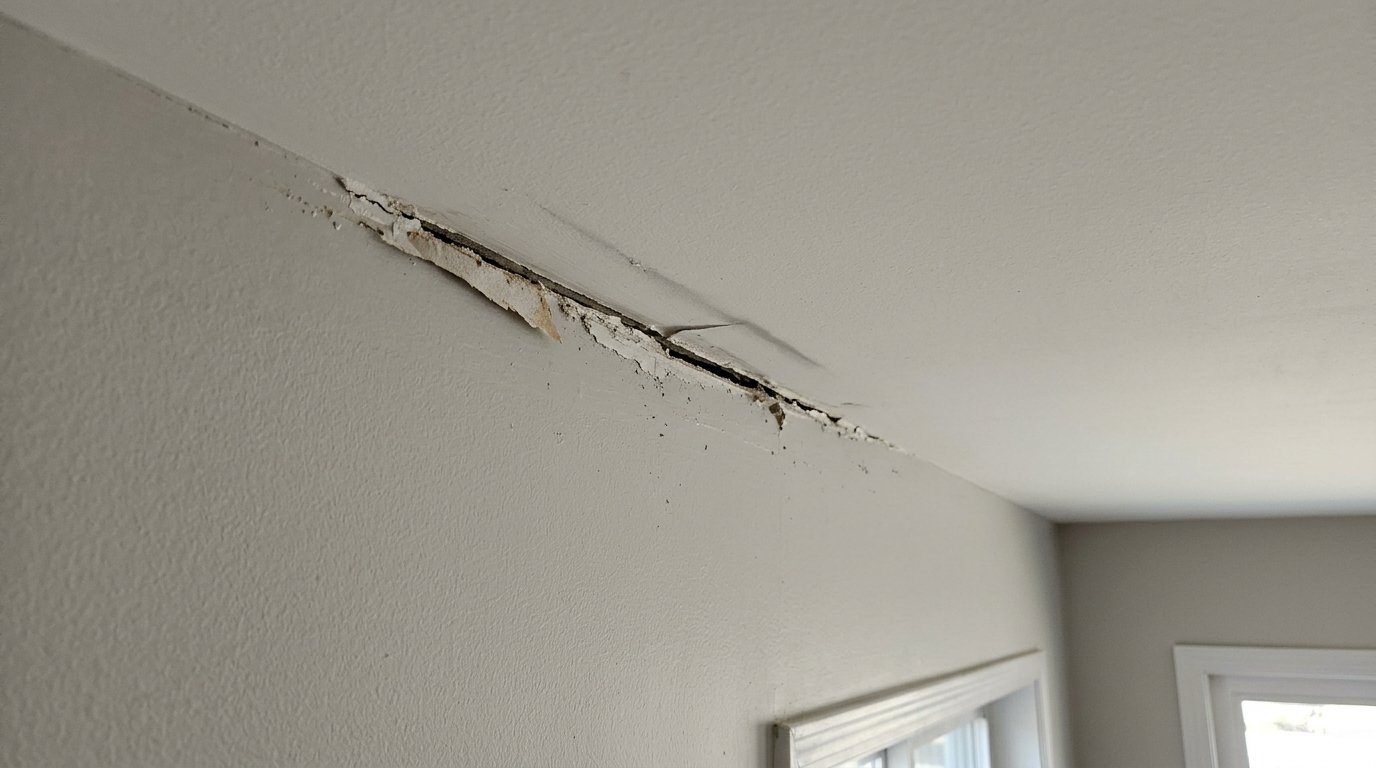
A thin crack appears along the top of a bedroom wall during winter. You fill the gap, smooth it, and paint over the repair. For a while, the corner looks normal. Several months later, the crack reappears, sometimes extending farther across the room than before.
Cracks along wall-to-ceiling intersections can be frustrating because they are difficult to hide and may return even after careful finishing. These locations connect different parts of a building assembly, and movement between the ceiling and wall can place stress on the finished joint. The cause should be evaluated before deciding whether a cosmetic repair is sufficient.
Why Do Cracks Form Where Two Drywall Surfaces Meet?
Drywall surfaces are commonly joined using reinforcing tape and joint compound. The tape helps connect the finished surfaces, while the compound creates a smooth transition. However, the joint is not designed to resist unlimited movement between separate building components.
Wood framing, gypsum panels, and other materials can respond differently to changes in temperature and moisture. As the building experiences seasonal conditions, these materials may expand, contract, or move slightly relative to one another.
The Gypsum Association explains that differences in dimensional movement between framing and gypsum board can contribute to cracking in finished assemblies. The amount and pattern of movement depend on the building design and materials.
A crack following the exact wall-to-ceiling line may therefore involve joint movement, although poor tape adhesion, damaged compound, and other conditions can produce similar symptoms.
Can Seasonal Temperature Changes Cause the Problem?
Massachusetts homes experience substantial seasonal differences in heating, humidity, and outdoor temperature. These changes can affect framing moisture content and the relationship between ceiling and wall components.
In some roof systems, movement involving trusses or other framing members can contribute to separation at interior ceiling corners. This phenomenon is sometimes called truss uplift, although it should not be assumed to explain every corner crack.
The condition deserves attention when the opening changes with the seasons. A crack that becomes more noticeable during one part of the year and less visible during another may provide useful evidence of changing building conditions.
However, a seasonal pattern is not a diagnosis. A qualified professional may need to examine the framing arrangement and surrounding symptoms before determining the cause.
Homeowners should avoid assuming that every recurring ceiling crack is harmless simply because the property otherwise appears stable.
How Can You Tell Whether the Crack Is Cosmetic?
A narrow, stable line limited to one finished joint may represent a localized finishing issue. However, its appearance alone cannot guarantee that the underlying structure is sound.
Look for accompanying changes such as separation around nearby openings, sagging ceiling sections, new cracks in multiple rooms, or doors and windows that have become difficult to operate.
The timing and pattern of the damage can help a professional understand whether ordinary joint treatment is appropriate or whether additional investigation is needed.
A useful observation method is to photograph the crack from the same position at different times. Record when it appeared and whether it changes noticeably. Avoid relying on memory alone, particularly when the gap develops gradually.
If the damage is widening, accompanied by displacement, or associated with signs of structural distress, a qualified building professional should evaluate it before cosmetic repairs proceed.
Why Does Ordinary Filler Sometimes Fail?
Applying filler directly into a moving joint can temporarily hide the opening. However, if the two surfaces continue moving differently, the new material may crack again.
A successful repair depends on understanding whether the existing joint reinforcement has failed, whether the surfaces remain stable, and whether the repair method is suitable for the type of movement involved.
For appropriate localized repairs, the work may involve removing loose compound, preparing the affected area, reinforcing the joint with suitable tape, and applying successive coats of finishing material.
Drywall Repair becomes particularly relevant when the existing joint tape is damaged, compound has separated, or sections of gypsum board need proper restoration before painting.
However, repeated movement caused by framing conditions may require a different assembly-specific approach. Adding more compound over the same location is not always a lasting solution.
What Should Be Checked Before Repairing the Corner?
Before starting, determine whether the surface is dry, stable, and free from active damage. Look for stains, discoloration, loose tape, or signs of moisture entering from the roof or a nearby plumbing system.
Ceiling corners can also be affected by previous repairs that left thick layers of compound. Removing loose material and examining the original joint may reveal whether the problem began with poor adhesion or an incorrectly finished seam.
A practical inspection can include:
-
Recording the crack’s location and approximate length.
-
Noting whether the opening changes seasonally.
-
Checking for nearby water stains or damaged paint.
-
Inspecting whether the existing tape is loose.
-
Identifying other cracks or movement-related symptoms.
-
Reviewing previous repair methods.
This information helps determine whether the problem is suitable for ordinary finishing work or needs a closer assessment of the building assembly.
How Are Stable Corner Cracks Repaired?
When the underlying surfaces are stable and the issue is limited to the finished joint, repair generally begins with removing loose material. The affected area must be prepared so new compound and reinforcement can bond to sound surfaces.
The selected joint tape and compound should be appropriate for the repair. Corner joints require careful application because both adjoining surfaces must be finished evenly.
Successive coats should be applied according to the material’s instructions, allowing the necessary drying or hardening time before additional finishing. Sanding should remove minor ridges without damaging the reinforcing tape.
After the repair is stable and smooth, suitable primer can help create consistent paint absorption. Painting may involve a larger area when the existing color or sheen has changed over time.
In older Massachusetts homes, painted surfaces should also be assessed for potential lead hazards before disturbing them. Applicable lead-safe renovation requirements must be followed when the work falls within their scope.
What If the Crack Returns After Professional Repair?
A recurring crack does not automatically mean the repair was careless. If movement continues in the underlying building components, even a properly finished joint may develop visible separation.
The important question is whether the original cause was identified and whether the selected repair method was appropriate for it.
If a joint continues opening after repeated repairs, additional finishing may offer diminishing benefits. The property owner should consider whether framing movement, moisture changes, or another building condition requires evaluation.
A specialist may recommend a movement-tolerant detail or another suitable method for the actual assembly. Such decisions should reflect the construction and applicable manufacturer guidance rather than using flexible caulk as a universal substitute for proper drywall joint treatment.
Conclusion
Cracks between walls and ceilings can result from finishing defects, material movement, moisture changes, or other building conditions. Their pattern, history, and surrounding symptoms are often more useful than appearance alone. The material property of hygroscopicity describes how certain materials interact with moisture in their environment, helping explain why wood framing can change dimension under different conditions. Understanding the likely cause makes it easier to choose an appropriate repair instead of repeatedly covering the same crack.