Walk into a bank, a hardware store, a clinic or a hotel and the first thing you look for is often a name. Not a logo, not a slogan — a person. A name tag is the smallest piece of professional branding a business owns, and it is the one that customers use most directly. Yet it is usually the cheapest, flimsiest item in the entire uniform budget: a printed sticker, a plastic clip, a laminated card that curls at the corners within a month. For managers and owners who want staff to be recognised and trusted, woven name patches offer a durable alternative that keeps a name legible through daily wear and repeated laundering. This article looks at why name identification matters more than most businesses assume, where cheap tags fail, and how to specify a name patch that lasts.
Why a Name Matters More Than a Logo
A logo tells a customer what a business is. A name tells them who they are dealing with. That distinction has practical consequences. In service settings, customers are more likely to trust, cooperate with and return to a business when they can address a person by name. A visible name reduces the anonymity of a transaction and creates a small but real sense of accountability: this person is identifiable, and this person is responsible for the interaction.
For staff, the effect runs both ways. A well-made name patch signals that the employer sees them as an individual rather than an interchangeable shift. It is a small dignity, but it is noticed. Cheap, peeling name tags send the opposite message: that identification is an afterthought.
This is why name identification deserves more thought than it usually receives. It sits at the intersection of customer trust, staff morale and professional presentation, and it is visible every hour of every shift.
Where Cheap Name Tags Fail
The failure modes are predictable, and most managers have seen them.
Printed stickers and laminated cards curl, fade and peel. They survive a few shifts at best, and they look worse with every wash of the garment they are attached to.
Plastic clip-on badges crack, lose their grip and disappear. They also hang away from the chest, which makes them harder to read and easier to snag.
Direct embroidery on the garment is durable but inflexible. If a staff member leaves, the name goes with the shirt. Reordering a single embroidered garment for a new hire is expensive and slow.
Heat-transfer name prints can look sharp on day one and degrade quickly under frequent high-temperature washing, which is exactly the regime that uniforms face.
The common thread is that cheap identification is not actually cheap. It is replaced repeatedly, and in the meantime it undermines the professional impression the uniform was meant to create.
What Makes a Woven Name Patch Different
A woven name patch is constructed by weaving fine threads into the design itself, rather than printing onto a surface or stitching thick thread on top of a base fabric. The result is flat, smooth and flexible, with the name integrated into the textile.
That construction has three practical advantages for name identification.
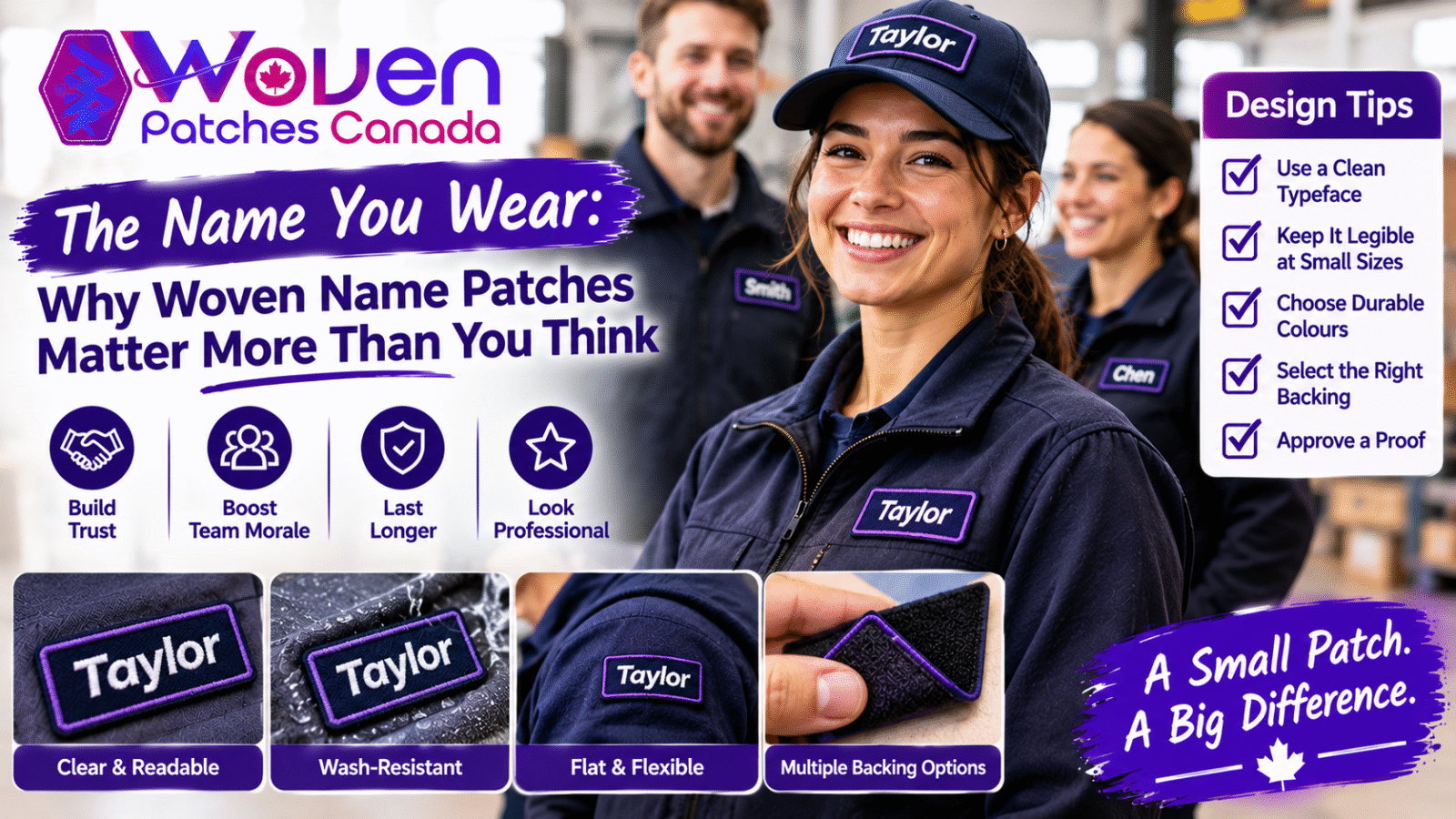
Legibility at small sizes. A woven patch can reproduce clean, readable lettering at the scale of a name badge. The text does not blur or fill in, which is the most common failure of printed alternatives.
Durability under washing. Because the design is part of the weave, it does not crack, peel or fade in the way printed or transferred names do. It holds up to the wash cycles that uniforms actually experience.
Replaceability. A sewn or Velcro-backed name patch can be removed and replaced without discarding the garment. This matters for staff turnover, seasonal teams and shared uniform pools. A woven name patch is a component, not a permanent commitment.
For businesses ordering custom woven patches in Canada, the practical benefit is that a single garment can be re-identified as staff change, rather than replaced entirely.
Choosing the Right Backing for Name Patches
The backing determines how the patch attaches and how easily it can be changed. For name patches, the decision is usually more consequential than for logo patches, because names change more often than brands do.
Sew-on backing is the permanent option. It is the most durable choice for uniforms that are laundered frequently, and the stitched border gives the patch a finished, deliberate look. The trade-off is that changing a name requires removing the stitching and attaching a new patch, which is straightforward but not instant.
Iron-on backing is faster to apply and suits low-wear garments, samples or temporary event staff. It is not the best choice for uniforms that face frequent high-temperature washing, where the adhesive can weaken.
Velcro backing is the most flexible option for name patches. The patch becomes removable and interchangeable, which suits shared uniforms, rotating teams and businesses with high staff turnover. The trade-off is a slightly more utilitarian appearance and the need for a loop surface on the garment, but for many operational settings that flexibility outweighs the aesthetic difference.
The right choice depends on how often names change and how the garment is washed. A permanent team with dedicated uniforms may prefer sew-on. A business with seasonal staff or shared shirts should consider Velcro.
Designing a Name Patch That Stays Readable
A name patch is a small canvas, and most design mistakes are avoidable.
Choose a clean, open typeface. Decorative scripts and condensed fonts lose legibility at small sizes. A simple sans-serif with generous spacing reads more reliably.
Set a minimum text size. Even woven construction has limits. Test the name at the actual patch size and confirm it is readable from a normal conversation distance, not just close up.
Prioritise contrast. The name should stand out clearly against the patch background. Low-contrast combinations look subtle on screen and become illegible on fabric.
Decide whether to include a role or department. Adding a job title or department can be useful, but it takes space away from the name. If both are needed, consider a two-line layout with the name larger than the role.
Proof the layout with real names. Test the longest name in the team, not the shortest. A layout that works for “Lee” may fail for “Alexandra.”
Common Mistakes Businesses Make
The same problems appear repeatedly in name patch orders.
-
Ordering without a proof. A digital or physical proof is the point at which font size, contrast and layout can be corrected. Approving from a screen mockup alone hides real-world legibility problems.
-
Choosing the wrong backing. A sew-on patch on a shared uniform pool creates unnecessary work. A Velcro patch on a permanent team uniform adds cost without benefit.
-
Using the garment’s brand font. A font chosen for a website header may not work for a name at badge scale. Legibility should take priority over brand consistency in this specific application.
-
Ignoring turnover. If staff change frequently, the name patch system should be designed for replacement from the start, not retrofitted later.
-
Skipping the physical sample. A single production sample before a full run catches colour, size and attachment problems cheaply.
Where Woven Name Patches Fit in a Uniform System
Name patches are rarely the headline item in a uniform programme, but they are the most frequently read. They work best when they are treated as part of the same system as the logo patch, the garment colour and the overall presentation.
A practical approach is to order logo patches and name patches together, using the same thread references, border style and backing specification. This keeps the uniform consistent and simplifies reordering. It also ensures that the name patch does not look like an afterthought attached to an otherwise considered uniform.
For businesses that operate across multiple locations or teams, standardising the name patch format makes it easier to onboard new staff and maintain a consistent appearance without custom orders for every hire.
FAQs
How long does a woven name patch last?
A sewn-on woven name patch on a properly cared-for garment can last for years. Durability depends on the attachment method and the wash regime. Velcro-backed patches last well but depend on the loop surface remaining intact.
Can woven name patches be removed and reused?
Sew-on and iron-on patches are intended to be permanent. Velcro-backed patches are removable and can be swapped between garments, which makes them the better choice for shared uniforms or high-turnover teams.
What is the smallest readable text on a name patch?
It depends on the typeface and the weave, but names are generally legible at sizes above a few millimetres. Always test the longest name in the team at the final patch size before ordering.
Should the name patch match the logo patch exactly?
They should share the same thread colours, border style and backing specification where possible. Exact matching is less important than overall consistency across the uniform.
Can we order name patches in small quantities for a single team?
Many suppliers accommodate small runs, though minimums vary. Businesses should confirm minimum order quantities and request a proof before committing.
Conclusion
A name patch is the smallest piece of professional branding a business owns, and the one customers use most directly. It determines whether a staff member is a recognisable person or an anonymous uniform. Cheap tags fail quickly and quietly, undermining the trust the uniform was meant to build.
Woven construction solves the durability and legibility problems that printed alternatives cannot. Choose the backing to match how often names change and how the garment is washed. Set a readable typeface and a minimum size. Proof the layout with real names. Order a sample before the full run. None of these steps is complicated, and together they turn a small identification detail into a durable instrument of professionalism — one that still reads clearly after a year of shifts.