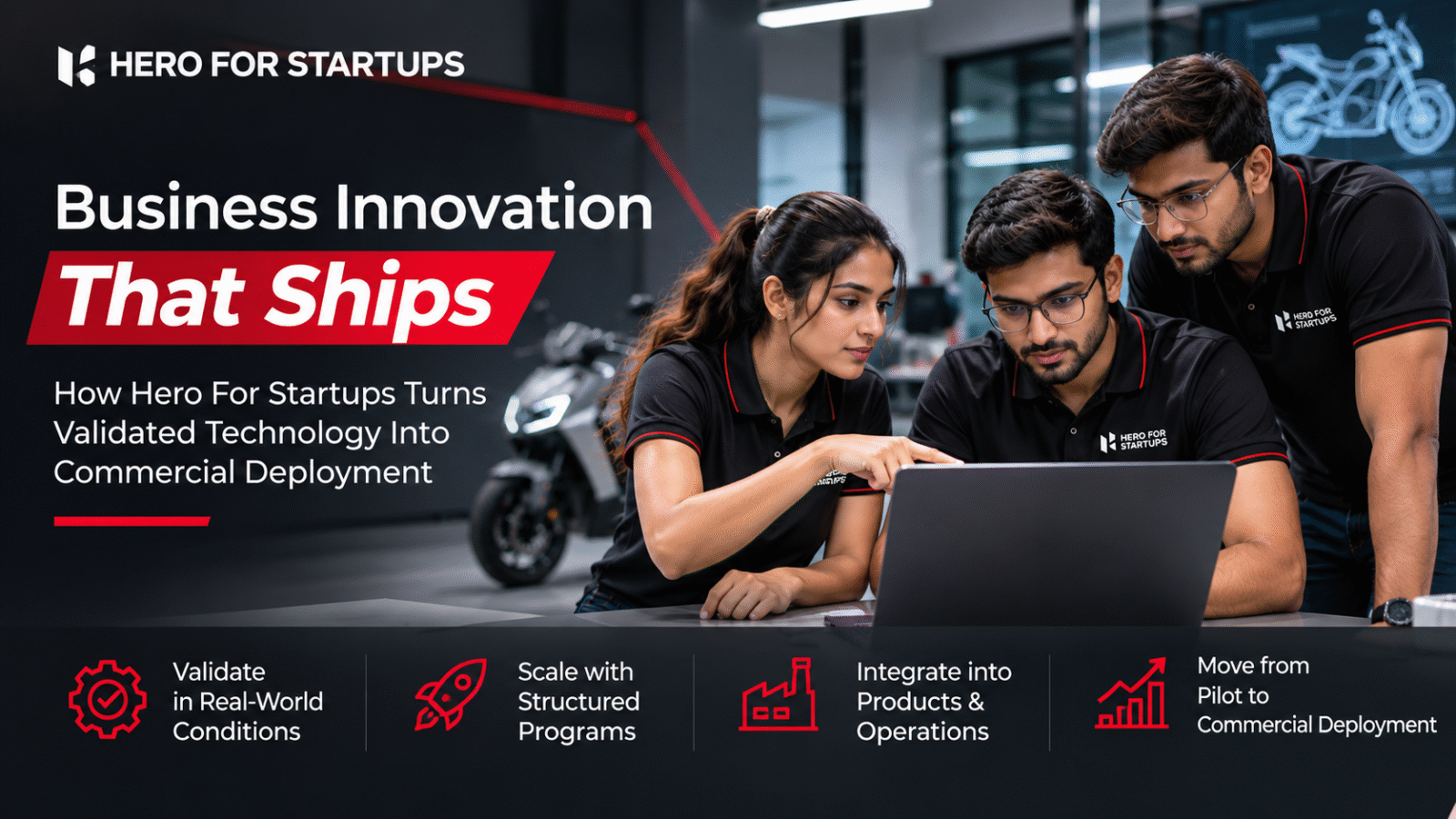
A pilot goes well, and the demo impresses everyone in the room. Then months pass and nothing gets integrated, rolled out or bought. Founders have a name for this: pilot purgatory.
It’s a frustrating place to be, especially when the technology genuinely works. Hero For Startups, Hero MotoCorp’s program for startups in automotive technology, EV and mobility, is built around getting out of it.
Proving and Shipping Are Different Jobs
Most programs focus on proving an idea: you build a prototype, show it off and collect feedback. Hero For Startups picks up later in the story. It’s meant for growth-stage startups that already have traction, revenue and product funding, so the proving is largely done.
The question here is what it takes to get a validated solution into a real, commercial-scale operation. Real business innovation is judged less by the demo than by what changes inside a company’s products and processes.
Three Questions That Decide Whether Technology Ships
- Is it ready to scale? Before the technical work begins, startups go through a bootcamp with three tracks: technology readiness, capacity and capability building, and a sustainability roadmap. Scalability is also tested earlier, during selection. The second of the three evaluation levels looks at technology scalability and alignment with Hero’s priorities.
- Does it hold up in the real world? Hero fully funds the Proof of Concept. Startups build it with continuous guidance from Hero’s technical teams and can use Hero’s R&D facilities in India and Germany. The aim is to test your solution against real conditions rather than assumptions on a slide.
- Where does it go next? When a PoC succeeds, it’s evaluated for integration into Hero’s product line and/or its business and operational processes, with potential for large-scale deployment. Two tracks support this stage. The Accelerator Program is for rapidly scaling validated technology, and the Commercialisation Program is a structured pathway into commercial-scale operations.
More Than a Place to Meet People
The phrase “innovation hub” tends to bring shared desks and networking evenings to mind. Hero For Startups works differently. It’s closer to an innovation platform with a defined route: you arrive with validated technology, move through a structured set of stages over roughly a year, and finish with a showcase where you present your solution and discuss next steps with Hero MotoCorp.
That structure is useful for founders. You can see what’s coming and who you’ll be working with, and what a successful result looks like.
Where Operations Come Into It
One detail is easy to miss. Hero says successful PoCs can be integrated into its business and operational processes, as well as its product line. That opens the program to more than vehicle components.
Among the 18 focus areas are Industry 4.0 / Digital Factory, Digital Twin Technology and Customer and Market Intelligence. Others, such as battery technology, charging infrastructure and connected vehicles, are closer to the product itself. If your technology improves how vehicles are made, tested or understood, it has a place in the program too.
Who This Suits, and Who It Doesn’t
The program isn’t built for idea-stage teams, and it’s better to say that plainly. It suits startups that can answer yes to three questions:
- Do we have real traction and revenue, with funding behind the product?
- Does our solution fit one of Hero’s 18 focus areas, mainly in automotive technology, EV and mobility?
- Could our technology scale beyond a single pilot?
If so, the three-level selection process is the next hurdle. It begins with a screening on relevance, team structure and product stage, then moves to the scalability review, and ends with a jury pitch on innovation, sustainability and impact.
The Short Version
A technology may be proven, but its real value lies in what it can achieve beyond a successful pilot. Turning innovation into business impact requires the right technical expertise, the resources to validate solutions in real-world conditions, and a clear pathway to commercial deployment. Hero For Startups brings these elements together, helping growth-stage startups move from validated technology to solutions that can be integrated into products, processes and large-scale operations.
Curious How It Works in Practice?
If your startup has a validated solution with the potential to scale, Hero For Startups offers an opportunity to explore how that technology could translate into real-world business impact.
Visit the Hero For Startups website to discover the 18 focus areas, understand the program journey and learn how to apply.