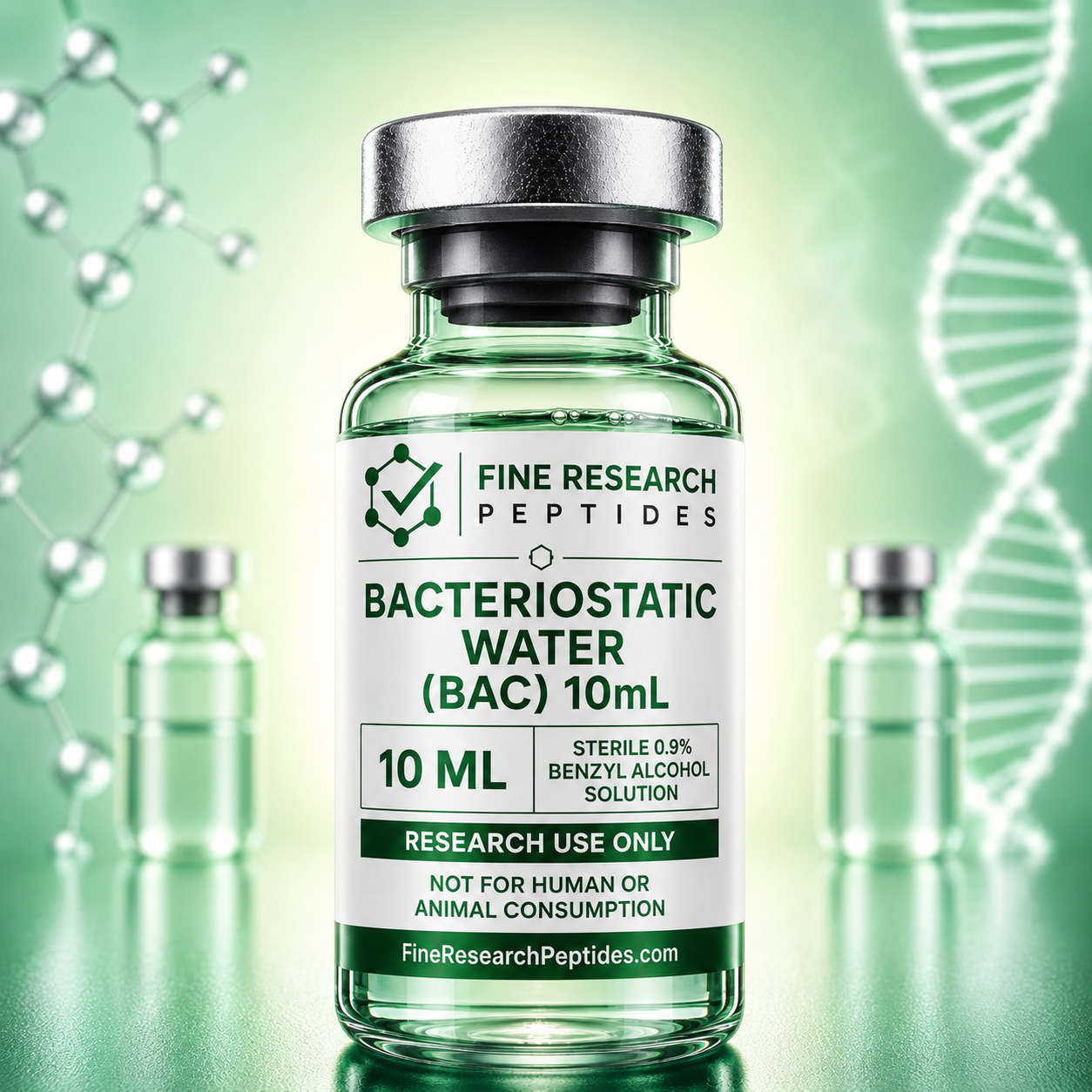
Bacteriostatic water is a specialized sterile water preparation containing benzyl alcohol as a preservative to help inhibit the growth of certain bacteria. It is commonly used in specific pharmaceutical applications where a multidose preparation is permitted by the product labeling. In laboratory environments, researchers may encounter bacteriostatic water when investigating peptide formulations, solvent compatibility, and sample-handling procedures. However, its suitability depends on the chemical characteristics of the material being studied and the manufacturer’s instructions. Understanding its composition and limitations is essential for maintaining appropriate research standards.
The importance of bacteriostatic water for reconstituting peptides extends beyond simply providing a liquid medium. Researchers must consider how the preservative interacts with the peptide, whether the formulation supports the intended analytical purpose, and how the prepared material should be handled. Not every peptide is compatible with benzyl alcohol, and some formulations require a different manufacturer-specified diluent. Selecting an inappropriate solvent may affect sample stability, introduce unwanted variables, or compromise experimental interpretation.
Another important distinction is that bacteriostatic water is not interchangeable with every type of sterile water or laboratory solvent. Different preparations have different compositions, intended uses, and storage requirements. Researchers should examine the product label and technical documentation before selecting a diluent for any investigation. Following product-specific guidance helps prevent avoidable handling errors and supports consistent laboratory practices.
Proper Storage Conditions for Bacteriostatic Water
Storage conditions play an important role in maintaining the quality and integrity of bacteriostatic water. Although benzyl alcohol helps inhibit the growth of certain bacteria, it does not make the preparation immune to contamination or environmental damage. Researchers should follow the manufacturer’s labeled storage instructions and protect containers from inappropriate temperature conditions, excessive heat, and other environmental factors that could affect product quality. Proper storage begins with understanding the specific requirements of the supplied preparation.
Container integrity is another important consideration. Bacteriostatic water should remain in its original, appropriately labeled container unless a validated procedure specifies otherwise. Damaged seals, compromised closures, visible contamination, or unclear product identification should be treated as potential quality concerns. Researchers should inspect containers before use and maintain an organized storage area that allows laboratory personnel to identify products easily. These basic precautions help reduce the possibility of handling unsuitable materials.
Laboratories should also separate unopened products from containers that have already been accessed. Clear labeling and inventory records make it easier to monitor product condition and follow the manufacturer’s instructions for multidose use. Storage areas should be organized to prevent accidental exposure, product mix-ups, and unnecessary handling. Consistent inventory management supports laboratory accountability and makes it easier to identify materials that have reached their expiration dates.
Understanding Shelf Life and Expiration Dates
Shelf life refers to the period during which a product is expected to maintain its specified quality under the storage conditions established by its manufacturer. For bacteriostatic water, the labeled expiration date is an important reference because it indicates the manufacturer’s supported period of product stability when stored appropriately. Researchers should never assume that a preparation remains suitable indefinitely simply because it appears clear. Visual appearance alone cannot establish sterility, preservative effectiveness, or overall product integrity.
It is also important to distinguish between the expiration date of an unopened container and the permitted period of use after the container has been accessed. These are separate considerations and may be governed by different instructions. Multidose containers may have specific requirements concerning access, storage, and disposal after opening. Researchers should follow the exact product labeling and applicable institutional procedures rather than applying a universal timeline to every preparation.
Environmental conditions and handling practices can influence product quality throughout its shelf life. Repeated handling, compromised closures, inappropriate storage, and contamination risks may affect whether a preparation remains suitable for its intended application. Laboratories should record relevant opening dates and monitor inventory regularly. If the container’s history is uncertain or its integrity is questionable, researchers should follow established quality-control procedures instead of assuming that the material remains acceptable.
Best Practices for Handling and Reconstituting Peptides
Handling peptide materials requires attention to aseptic practices, chemical compatibility, and product-specific instructions. Before beginning any preparation, researchers should verify the identity of the peptide and review its technical documentation. The selected diluent must be appropriate for the specific formulation and intended research application. Bacteriostatic water should only be considered when the relevant manufacturer instructions or validated laboratory protocol permit its use.
Maintaining a suitable laboratory environment is equally important. Researchers should use appropriate protective equipment and follow established procedures designed to minimize contamination during material handling. Containers should be inspected before access, and any compromised packaging should be evaluated according to laboratory quality requirements. These precautions are important because the presence of a preservative does not eliminate contamination risks or replace appropriate aseptic techniques.
Prepared peptide solutions may have different stability characteristics from their original materials. Their storage requirements can depend on the peptide sequence, formulation, solvent, concentration, and container. Consequently, researchers should not assume that the shelf life of bacteriostatic water automatically determines the stability period of a reconstituted peptide. The manufacturer or a qualified laboratory professional should provide the applicable guidance. Accurate preparation records and appropriate storage controls help maintain traceability throughout the research process.
Understanding 5-Amino-1MQ and Its Research Context
5-Amino-1MQ is a small-molecule compound that has attracted scientific interest because of its relationship with nicotinamide N-methyltransferase, commonly abbreviated as NNMT. NNMT is an enzyme involved in cellular metabolism and the methylation of nicotinamide and other substrates. Research involving this enzyme has contributed to broader investigations into metabolic regulation and cellular biochemical pathways. Understanding the compound’s scientific background requires distinguishing between experimental findings and claims made in commercial product descriptions.
Although the keyword 5 amino 1mq peptide may appear in online research-material searches, 5-Amino-1MQ is not technically a peptide. It is a small molecule, and its chemical classification should not be confused with amino acid-based peptide compounds. This distinction matters because peptides and small molecules can have different chemical properties, formulation requirements, analytical characteristics, and storage considerations. Researchers should verify the actual identity of a material rather than relying exclusively on the terminology used in a commercial listing.
Researchers interested in 5-Amino-1MQ should examine the available scientific literature and relevant analytical documentation before evaluating any research material. Its compatibility with bacteriostatic water should not be assumed simply because the compound appears alongside peptide products in online catalogs. Solvent selection must be based on the compound’s documented chemical properties and validated formulation requirements. Accurate classification and product identification help prevent confusion and support more reliable experimental planning.
Documentation, Quality Control, and Product Verification
Reliable documentation is an essential part of responsible laboratory procurement and material management. A Certificate of Analysis, or COA, can provide information about a product’s identity, batch number, and analytical testing results. Researchers should verify that the document corresponds to the actual batch being supplied rather than accepting a generic certificate without traceable product information. Clear documentation helps establish confidence in the material’s reported characteristics and supports internal quality reviews.
Analytical methods may provide additional information about product composition and identity. High-performance liquid chromatography is commonly used to examine sample composition, while mass spectrometry can help investigate molecular mass and support compound identification. These methods provide different types of information and should be interpreted according to their intended analytical purpose. Researchers should review the testing details carefully instead of treating an advertised purity percentage as complete evidence of quality.
Laboratory records should also include relevant storage and handling information. Useful details may include supplier information, purchase dates, product identifiers, batch numbers, expiration dates, opening dates, and applicable storage instructions. Maintaining organized records makes it easier to identify discrepancies and investigate unexpected experimental outcomes. Consistent documentation is particularly valuable when several researchers share laboratory materials or work across different projects.
Common Storage and Handling Mistakes to Avoid
One common mistake is assuming that bacteriostatic water can be stored under identical conditions regardless of the manufacturer or formulation. Different products may have specific storage instructions that should always take priority over generalized online recommendations. Ignoring these requirements can create unnecessary quality concerns. Researchers should consult the original product labeling and maintain storage conditions consistent with the manufacturer’s specifications.
Another mistake is assuming that bacteriostatic water can be used with every peptide or research compound. Its benzyl alcohol content may affect compatibility with certain formulations, and its preservative properties do not guarantee that a prepared solution will remain stable. Researchers should verify solvent suitability before preparation and avoid substituting one diluent for another without appropriate technical justification. This is especially important when working with compounds that have limited stability information.
Finally, laboratories should avoid relying on appearance alone when assessing material quality. A clear solution does not necessarily indicate that a product remains sterile, chemically stable, or suitable for research. Expired materials, compromised containers, and preparations with uncertain handling histories require appropriate evaluation. Following documented procedures and maintaining accurate inventory records provide a more dependable approach than informal visual checks.
Conclusion
Proper storage, shelf-life management, and careful handling are essential when using bacteriostatic water in peptide research. Researchers should understand its preservative properties, verify compatibility with individual compounds, and follow manufacturer-specific storage and handling instructions. They should also distinguish between peptides and small molecules such as 5-Amino-1MQ when evaluating research materials. By prioritizing analytical documentation, product verification, organized inventory management, and validated laboratory procedures, research teams can maintain stronger quality-control practices and support more consistent scientific investigations.