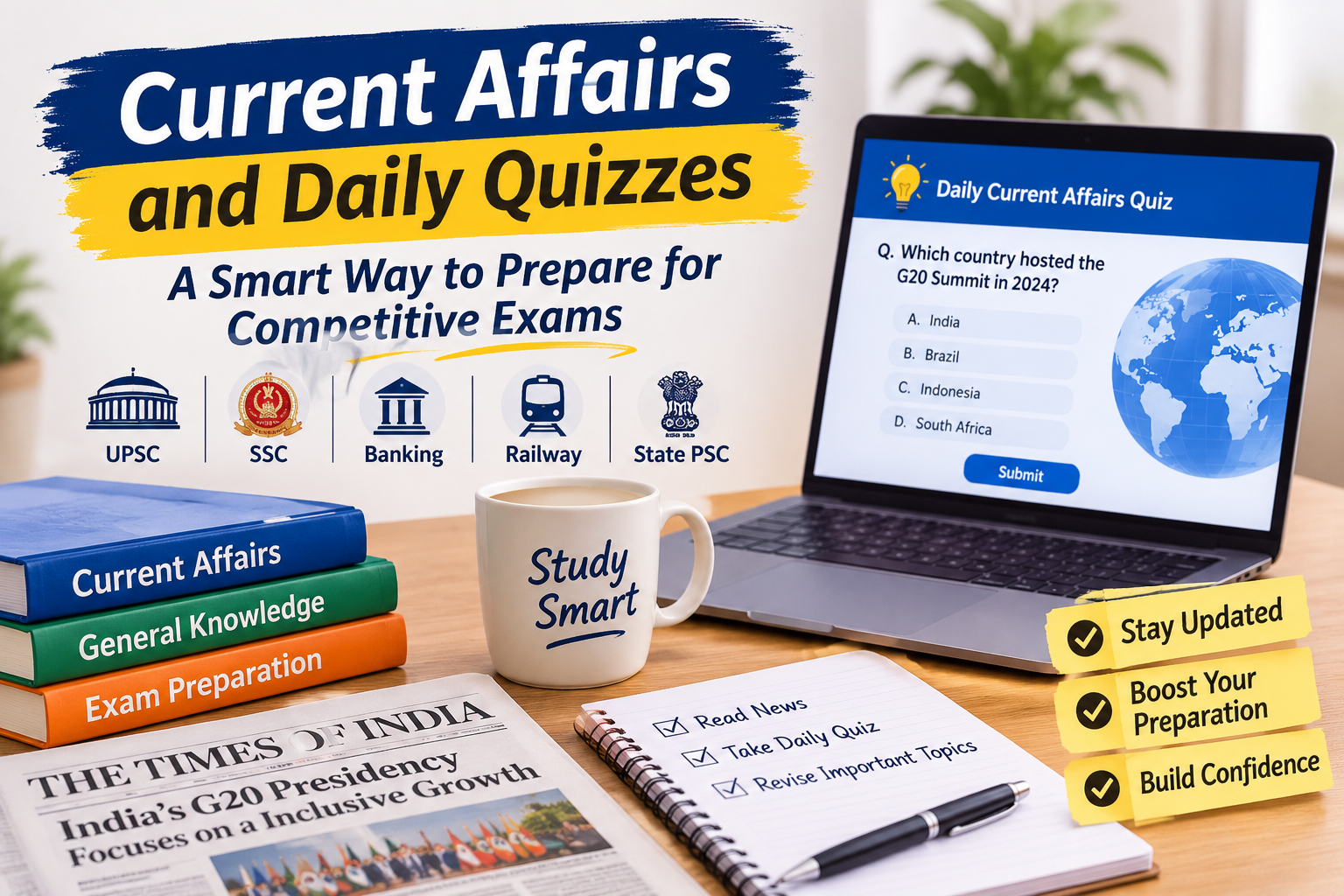
Preparing for competitive exams requires more than reading textbooks and completing the syllabus. Aspirants also need to stay updated with national and international developments, government policies, economic changes and important scientific discoveries. This is why current affairs and daily quizzes have become an important part of preparation for examinations such as UPSC, SSC, Banking, Railways and State PSC.
Regularly following the news helps students understand what is happening around them, while practising quiz questions improves their ability to recall important facts and apply their knowledge in examinations.
Why Are Current Affairs Important for Competitive Exams?
Current affairs cover important developments that can influence different sections of competitive examinations. Questions related to government schemes, international relations, economic policies, environmental issues and science often require candidates to have a clear understanding of recent events.
For UPSC aspirants, current affairs are particularly useful for connecting contemporary developments with static subjects such as History, Geography, Polity and Economics. Similarly, SSC and Banking candidates benefit from keeping up with general awareness, financial developments and important national events.
Instead of collecting information from multiple sources without a clear plan, students should follow a consistent study routine and focus on exam-relevant updates.
How Daily Quizzes Improve Your Preparation
Reading information is important, but testing what you have learned is equally necessary. Daily quizzes provide an opportunity to revise important topics and identify areas that need more attention.
Here are some benefits of including quizzes in your daily study routine:
1. Better Information Retention
Attempting questions after reading the news encourages active recall. It helps students remember important facts, dates, events and concepts for longer.
2. Identifying Knowledge Gaps
Quiz results help aspirants recognise topics they have not understood properly. They can revisit those subjects and improve their preparation.
3. Improved General Awareness
Regular practice exposes students to different subjects, including economics, politics, international relations, science and the environment.
4. Consistent Study Habits
Solving a small set of questions every day makes preparation more organised and prevents current affairs from becoming a last-minute burden.
How to Build a Daily Current Affairs Study Routine
A simple and practical routine can make current affairs preparation easier to manage.
-
Read important news: Spend 20–30 minutes reviewing relevant national and international developments.
-
Focus on important topics: Give priority to government schemes, economic updates, science, environment and international relations.
-
Make short notes: Record important facts and explanations for future revision.
-
Attempt daily quizzes: Test your understanding through multiple-choice questions.
-
Review incorrect answers: Understand why an answer was incorrect instead of simply memorising the correct option.
Students can also use current affairs updates and exam-focused digests to organise their reading and connect important developments with competitive exam preparation.
Practise Current Affairs Questions Online
Online practice makes it easier for students to test their knowledge whenever they have free time. Rather than waiting for weekly or monthly revision sessions, aspirants can solve short quizzes regularly and track their understanding of important subjects.
Platforms such as Improvam provide current affairs practice questions with answers and explanations. Students can also explore its free current affairs quiz to test their understanding of topics such as economics, environment, international relations and science.
This kind of practice can be useful for UPSC, SSC, Banking, Railways and State PSC aspirants who want to strengthen their general awareness.
Common Mistakes to Avoid During Current Affairs Preparation
Many students spend several hours reading news but struggle to recall important information during examinations. This often happens because their preparation lacks regular revision and practice.
Avoid these common mistakes:
-
Reading every news story without considering its exam relevance.
-
Depending entirely on social media updates.
-
Ignoring explanations after attempting quiz questions.
-
Collecting too many study materials without revising them.
-
Postponing current affairs revision until the examination approaches.
A balanced combination of reading, note-making, quizzes and revision is more effective than simply consuming large amounts of information.
Final Thoughts
Current affairs preparation becomes more manageable when students follow a regular routine and test their knowledge frequently. Reading relevant news, understanding important developments and attempting daily quizzes can gradually improve general awareness and confidence.
Whether you are preparing for UPSC, SSC, Banking or another government examination, consistency is the key. Make current affairs a part of your everyday study schedule, practise questions regularly and use your mistakes as opportunities to improve.