
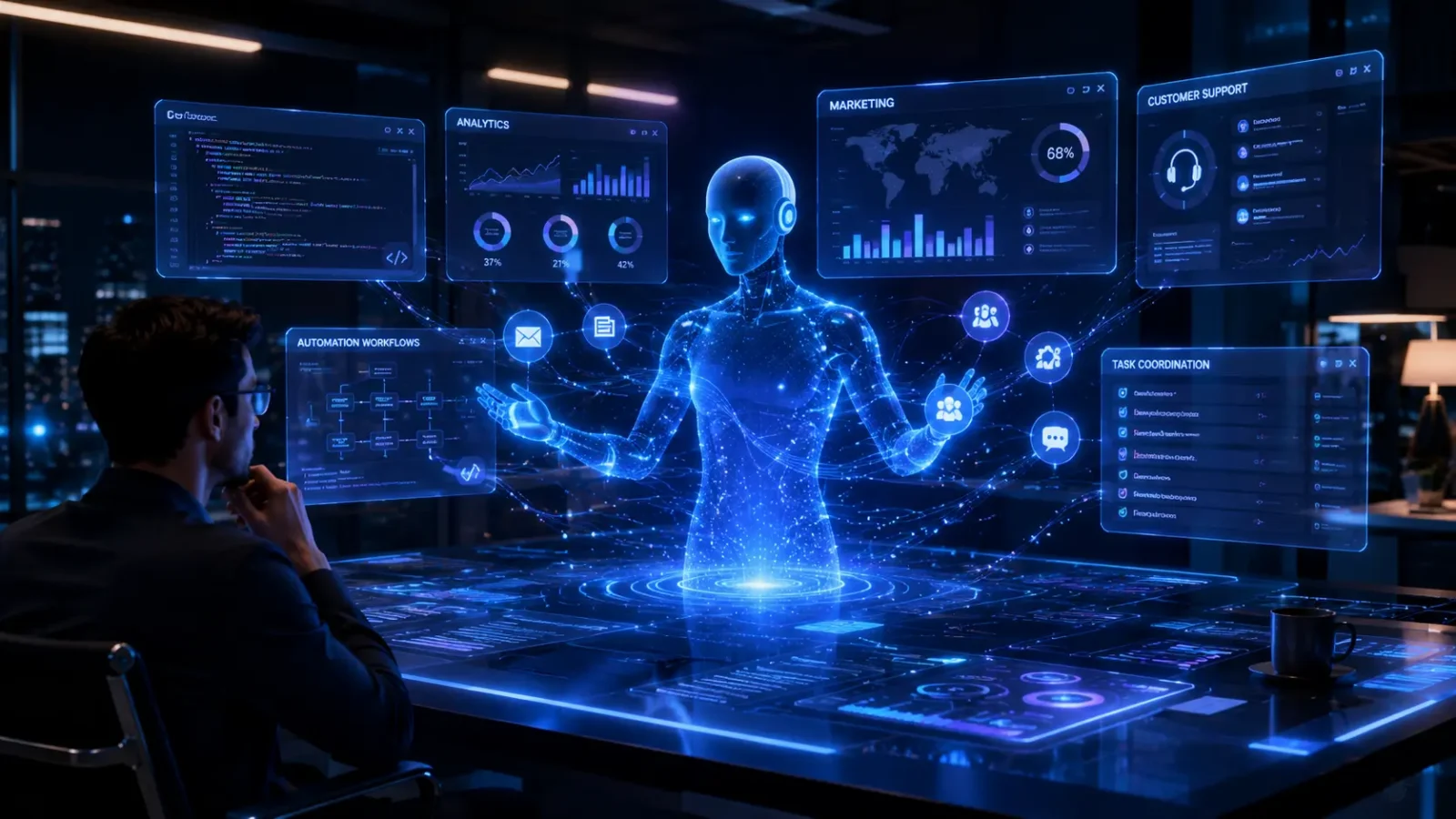
Artificial Intelligence has spent the last few years learning how to talk to us.
Now, it is learning how to work for us.
That is the major shift happening in technology in 2026.
Traditional AI assistants became popular because they could answer questions, generate text, summarize documents, create images, and help users solve problems. But the newest generation of AI systems is moving beyond simple conversations.
AI Agents can take action.
Instead of simply telling a user how to complete a task, an AI Agent can potentially plan the task, use connected software, analyze information, make decisions within defined boundaries, and complete multiple steps on the user’s behalf.
This transition from AI that responds to AI that acts is becoming one of the most important developments in technology.
At the same time, another major trend is developing alongside agentic AI: on-device and local AI, where more intelligence can run directly on computers, smartphones, and other devices rather than relying entirely on cloud servers.
Together, these technologies could significantly change how we work, communicate, create, and use software.
What Are AI Agents?
An AI Agent is a software system designed to pursue a specific goal by reasoning through tasks and taking actions.
A traditional chatbot might respond to:
“Write an email to my customer.”
An AI Agent could potentially go further:
- Understand the purpose of the email.
- Review relevant customer information.
- Draft the message.
- Check the customer’s previous communication.
- Personalize the response.
- Prepare the email for sending.
- Wait for human approval before completing the final action.
The important difference is execution.
AI Agents are designed around workflows rather than individual prompts.
AI Assistants vs AI Agents
The difference can be explained simply.
Traditional AI Assistant
User → Prompt → AI → Answer
AI Agent
User → Goal → AI plans → AI uses tools → AI executes → AI checks result
This doesn’t mean every AI Agent operates completely independently. Human approval, permissions, security controls, and predefined boundaries remain important.
But the direction of the industry is clear: AI is becoming increasingly capable of completing multi-step work.
Why AI Agents Are Trending in 2026
The AI industry has reached a point where improving model intelligence is only part of the challenge.
Businesses now want AI to deliver measurable outcomes.
They don’t simply want:
“Give me an answer.”
They want:
“Complete this task.”
That difference is driving investment in agentic systems.
AI Agents can potentially connect large language models with:
- Databases
- APIs
- CRM systems
- Calendars
- Cloud platforms
- Business software
- Development environments
- Search systems
- Analytics tools
This creates a new model of software where the AI becomes an active participant in a workflow.
AI Agents Are Changing Business Automation
For years, businesses have used automation tools to handle repetitive processes.
Traditional automation usually follows predefined rules.
For example:
If an invoice arrives → save it → send notification.
AI Agents can introduce more flexibility.
An agent could potentially:
- Read an invoice.
- Understand its contents.
- Compare it with purchase records.
- Identify inconsistencies.
- Contact the responsible department.
- Update a system.
- Prepare a report.
The system doesn’t necessarily need every possible situation to be manually programmed in advance.
That flexibility is one of the biggest attractions of agentic AI.
AI Agents in Customer Service
Customer support is one of the areas where AI Agents could have a major impact.
Traditional chatbots generally answer frequently asked questions.
Agentic customer service systems can potentially handle more complex workflows.
For example:
A customer says:
“My order hasn’t arrived and I want a refund.”
An advanced agent could:
- Identify the customer.
- Check the order.
- Track the shipment.
- Determine whether the delivery qualifies for a refund.
- Explain the available options.
- Process the request according to company policy.
- Escalate the issue if human intervention is required.
This moves AI from customer communication toward customer resolution.
AI Agents in Software Development
Software development is another major area being transformed.
AI coding systems can already help developers generate code, explain errors, and write tests.
Agentic development takes this further.
An AI Agent may be given a goal such as:
“Fix the login issue and add tests.”
It can potentially:
- Inspect the codebase.
- Identify relevant files.
- Analyze the error.
- Modify code.
- Run tests.
- Detect failures.
- Make corrections.
- Generate documentation.
Developers still need to review the work, but the amount of manual effort required for certain tasks can decrease significantly.
AI Agents in Marketing
Digital marketing is also becoming increasingly AI-driven.
Marketing teams can use AI systems to assist with:
- Keyword research
- Content planning
- SEO analysis
- Competitor research
- Campaign optimization
- Audience segmentation
- Email marketing
- Performance reporting
- Social media workflows
Instead of asking AI to create one social media post, a marketing agent could potentially manage an entire campaign workflow.
For example:
Goal: Launch a product campaign.
The agent could help coordinate:
Research → Content → Creative Brief → Landing Page → Email → Analytics → Optimization
This is where agentic AI becomes particularly interesting for marketers.
The Rise of On-Device AI
AI Agents are not the only major technology trend.
Another important development is on-device AI.
Instead of sending every AI request to a remote cloud server, some AI processing can increasingly happen directly on devices.
This can include:
- Smartphones
- Laptops
- PCs
- Cars
- Wearable devices
- Industrial machines
The growth of specialized AI processors is making local AI increasingly practical.
Why On-Device AI Matters
Running AI locally can provide several potential advantages.
Faster Responses
Data doesn’t always need to travel to a remote server and back.
Better Privacy
Sensitive information can potentially remain on the device instead of being sent to external servers.
Offline Capabilities
Some AI features can work even when internet connectivity is limited.
Lower Cloud Dependency
Organizations can reduce reliance on cloud-based processing for certain workloads.
This doesn’t mean cloud AI will disappear.
Instead, the future may involve a combination of cloud AI + local AI.
AI Agents + On-Device AI: A Powerful Combination
The most interesting development could be the combination of these technologies.
Imagine a personal AI Agent running partly on your smartphone or laptop.
It could understand:
- Your schedule
- Your files
- Your preferences
- Your applications
- Your communication
And it could perform tasks without sending every piece of information to a remote server.
This could create a new generation of personal digital assistants that are more private, responsive, and useful.
What Does This Mean for Jobs?
One of the biggest questions surrounding AI Agents is employment.
Will autonomous AI eliminate jobs?
The answer is more complicated than a simple yes or no.
AI is likely to automate some repetitive activities.
However, it can also create demand for new skills and roles.
Potential growth areas include:
- AI engineering
- AI product management
- AI workflow design
- AI governance
- AI security
- Automation consulting
- Data management
- AI operations
The nature of many jobs may change even when the job itself doesn’t disappear.
The New Skill: Working With AI
In the past, digital literacy meant knowing how to use computers and software.
Increasingly, professionals will need to understand how to work with AI systems.
This means learning:
- How to define goals clearly
- How to evaluate AI outputs
- How to provide useful context
- How to verify information
- How to manage AI workflows
- How to protect sensitive data
The future workplace may not simply be humans versus AI.
It may be humans working alongside AI Agents.
Security and Privacy Challenges
The greater the capabilities of AI Agents, the greater the responsibility.
An AI Agent that can access email, databases, financial systems, or company software must be carefully controlled.
Important security questions include:
- What information can the agent access?
- Which actions can it perform?
- Who can approve those actions?
- Can its activity be audited?
- What happens if it makes a mistake?
- How is sensitive information protected?
Businesses will need strong permission systems and monitoring before allowing autonomous AI to operate critical workflows.
The Human-in-the-Loop Model
Despite the rapid growth of autonomous AI, humans will remain important.
For high-risk activities, organizations may use a human-in-the-loop approach.
The AI can:
Analyze → Recommend → Prepare
while the human:
Reviews → Approves → Executes
This approach can provide the productivity benefits of AI while reducing the risks associated with fully autonomous decision-making.
What Businesses Should Do Now
Businesses don’t need to automate everything immediately.
A better approach is to identify repetitive workflows where AI can provide measurable value.
Start with:
Step 1: Identify Repetitive Work
Find tasks employees perform repeatedly.
Step 2: Select Low-Risk Processes
Start with workflows where mistakes have limited consequences.
Step 3: Introduce AI Assistance
Allow AI to support employees before giving it full execution permissions.
Step 4: Measure Results
Track:
- Time saved
- Cost reduction
- Accuracy
- Customer satisfaction
- Employee productivity
Step 5: Scale Carefully
Once the workflow is reliable, expand AI’s responsibilities.
What the Future Could Look Like
The future of AI may not be a single chatbot sitting inside a website.
Instead, we could see networks of specialized AI Agents working together.
One agent could handle research.
Another could manage data.
Another could handle customer communication.
Another could monitor performance.
A human could coordinate the overall strategy.
This could create a new type of digital workforce.
Are AI Agents the End of Traditional Software?
Not necessarily.
Instead, traditional software may increasingly become the infrastructure AI Agents operate through.
Rather than manually opening ten applications, a user could tell an AI Agent what needs to happen.
The agent could interact with those applications in the background.
This could fundamentally change the user interface.
Instead of:
App → Menu → Button → Form → Action
we could increasingly see:
Goal → AI Agent → Completed Workflow
That could be one of the biggest changes in software design over the coming years.
The Biggest Technology Shift to Watch
The AI story is moving from:
Generative AI → Agentic AI → Autonomous Workflows
At the same time:
Cloud AI → Hybrid AI → On-Device Intelligence
These two trends could define the next phase of the AI industry.
The companies that successfully combine intelligent models, useful tools, strong security, and real-world workflows could become some of the most influential technology companies of the next decade.
Final Thoughts
AI Agents are becoming more than another feature inside an application.
They represent a fundamental change in how humans interact with technology.
Instead of simply asking software to perform individual actions, people may increasingly describe a goal and allow AI to coordinate the steps required to achieve it.
At the same time, on-device AI is pushing intelligence closer to users, potentially improving speed, privacy, and accessibility.
The technology is still evolving, and autonomous AI comes with genuine challenges around security, reliability, privacy, and human oversight.
But one thing is becoming increasingly clear:
The future of AI isn’t just about generating answers. It’s about getting things done.
Frequently Asked Questions
What are AI Agents?
AI Agents are intelligent software systems that can understand goals, plan tasks, use tools, and execute multi-step workflows with varying levels of human supervision.
What is Agentic AI?
Agentic AI refers to AI systems designed to take actions toward a goal rather than simply generating a response to an individual prompt.
How are AI Agents different from chatbots?
A chatbot generally responds to questions or instructions. An AI Agent can potentially plan and execute multiple actions using connected tools and systems.
What is on-device AI?
On-device AI refers to AI processing that takes place directly on a smartphone, computer, vehicle, or other device rather than relying entirely on remote cloud servers.
Will AI Agents replace human workers?
AI Agents are likely to automate some tasks and change many workflows. At the same time, they can create demand for new skills involving AI management, development, security, governance, and workflow design.
Are AI Agents safe?
Their safety depends on how they are designed and deployed. Permission controls, human oversight, monitoring, testing, and strong security practices are important when AI Agents are given access to sensitive systems.