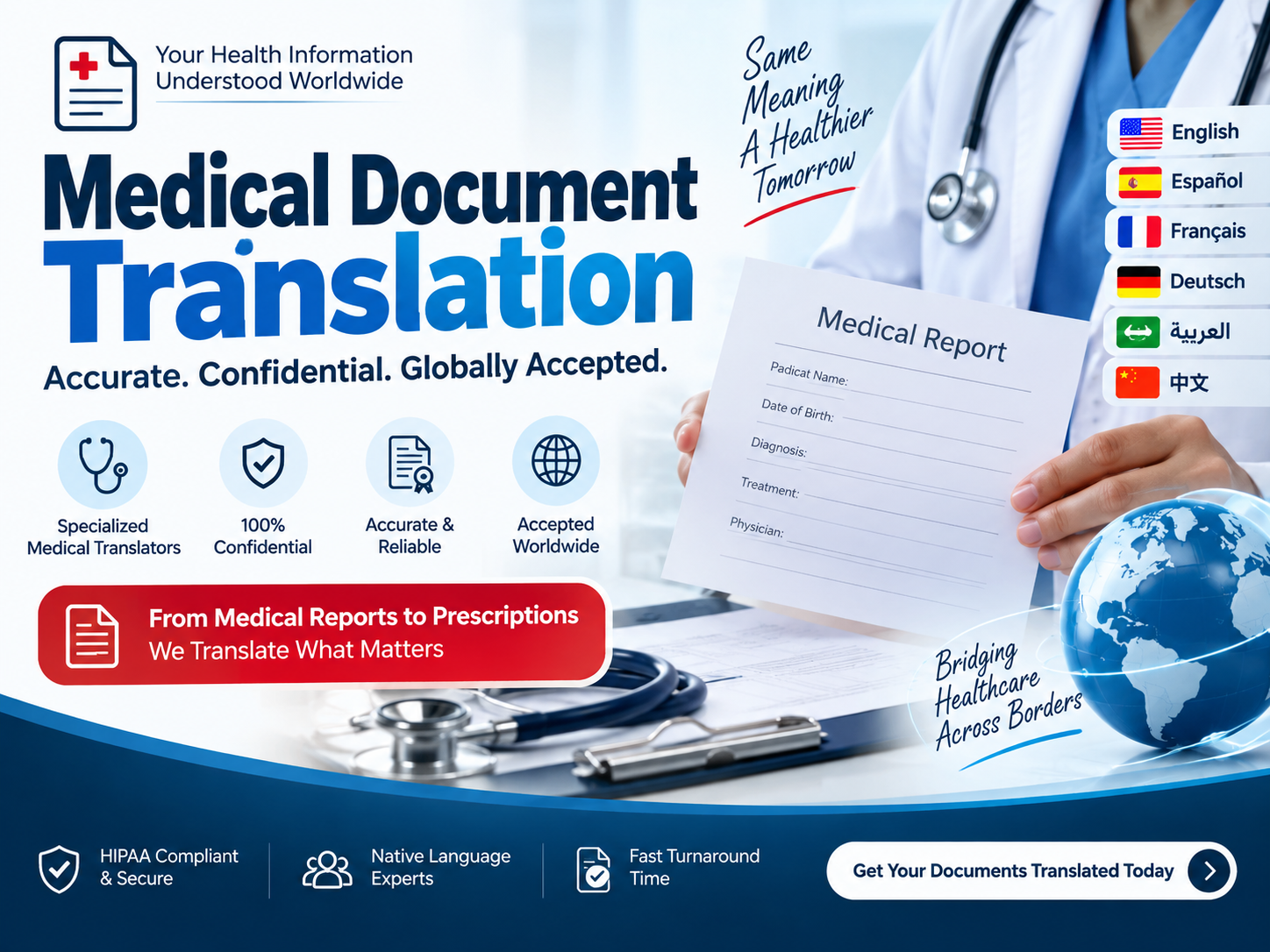
When important documents need to be used in another country, accuracy and proper preparation are essential. A document that is perfectly valid in the United States may not automatically be accepted by a foreign government, hospital, university, employer, or legal organization. Depending on the destination country and the type of document, you may need authentication, certification, an apostille, or a professional translation.
This is especially important when dealing with medical records, hospital documents, vaccination records, physician letters, prescriptions, and other health-related paperwork. If these documents are being submitted internationally, even a small translation error or missing certification can create unnecessary delays.
Understanding how Apostille Services work alongside professional translation can help individuals and organizations prepare their paperwork correctly and avoid common problems.
What Is an Apostille?
An apostille is an official certification attached to or associated with a public document so that the document can be recognized in another country that participates in the Hague Apostille Convention.
The apostille does not normally verify whether the information inside the document is true. Instead, it authenticates specific elements such as the signature, the capacity of the person who signed the document, and, where applicable, the seal or stamp on the document.
Common documents that may require an apostille include:
- Birth certificates
- Marriage certificates
- Divorce decrees
- Death certificates
- Court documents
- Educational records
- Business documents
- Powers of attorney
- Notarized documents
- Certain medical-related documents
The exact procedure depends on where the document was issued, the type of document, and the country where it will be used.
Why Medical Documents May Need Special Attention
Medical documents can contain highly technical information, abbreviations, diagnoses, medication names, treatment details, laboratory results, and specialized terminology. Translating these documents requires more than simply replacing words from one language with another.
For example, a medical record may contain terminology that has a very specific meaning in a healthcare context. A poor translation can potentially change the meaning of a diagnosis, treatment history, or physician’s statement.
This is why Medical Document Translation should be handled carefully when medical paperwork is being prepared for international use.
Documents that may require translation include:
- Medical records
- Hospital discharge summaries
- Doctor’s letters
- Vaccination records
- Laboratory reports
- Imaging reports
- Prescription records
- Insurance-related medical documents
- Disability documentation
- Surgical reports
- Medical certificates
- Treatment summaries
The receiving organization may also have specific requirements regarding translator certification, formatting, signatures, notarization, or supporting documentation.
How Apostille and Translation Work Together
One of the most common misunderstandings is assuming that every document simply needs an apostille or simply needs translation. In reality, the requirements can vary considerably.
For example, an individual moving overseas may need to submit a medical certificate to a government authority. The receiving authority might require the original document to be authenticated and a translated version to accompany it.
In another situation, a foreign hospital may request translated medical records without requiring an apostille at all.
The correct process depends on the destination country and the organization requesting the documents.
A typical document preparation process may involve:
1. Identify the Receiving Authority
Start by determining exactly who will receive the document. This could be a foreign government office, immigration authority, hospital, university, employer, court, or private organization.
2. Confirm Document Requirements
Ask the receiving organization whether it requires an original document, certified copy, notarization, apostille, authentication, translation, or a combination of these.
3. Prepare the Original Document
Make sure the document is complete, legible, and properly issued. Damaged, incomplete, or incorrectly prepared documents may cause problems during processing.
4. Arrange Authentication or Apostille
If an apostille is required, the appropriate authority must certify the document according to the applicable rules.
5. Obtain a Professional Translation
If the receiving country or organization requires another language, have the document translated accurately and completely.
6. Review the Final Package
Before submission, check names, dates, signatures, document numbers, seals, stamps, and other important information. Even a minor inconsistency can result in questions or delays.
The Importance of Accurate Medical Translation
Medical paperwork often contains information that must remain consistent with the original document. Names, dates of birth, medical terminology, test results, medication names, measurements, and physician information should be carefully reviewed.
A professional translator should understand both the source and target languages and be familiar with medical terminology.
Accuracy is particularly important when documents are being used for:
- Immigration applications
- Overseas employment
- International medical treatment
- Disability claims
- Insurance matters
- Legal proceedings
- School or university requirements
- Visa applications
- Relocation
- Medical history reviews
A professionally prepared translation should reflect the original document without adding, removing, or changing important information.
Common Mistakes People Make
Preparing documents for international use can become complicated when requirements are misunderstood. Some of the most common mistakes include:
Assuming Every Country Has the Same Requirements
Document requirements can differ from one country to another. Some countries participate in the Hague Apostille Convention, while others may require a different authentication or legalization process.
Translating the Document Without Checking Requirements
A person may order a translation without first asking the receiving authority whether it needs a certified translation, notarized translation, or a particular format.
Using an Unqualified Translator
General translation skills do not always mean that someone is experienced with medical terminology. Technical documents require appropriate knowledge and attention to detail.
Submitting an Incorrect Version
Sometimes people submit a photocopy or unofficial version when the receiving authority requires an original or certified copy.
Ignoring Names and Dates
Names and dates should be carefully checked against passports, identification documents, and other official records when applicable.
How to Choose a Document Preparation Provider
Choosing the right service provider can make the process much easier. Before selecting a company, consider its experience with document authentication, translation, and international paperwork.
Look for a provider that:
- Clearly explains the required process
- Works with different document types
- Offers accurate professional translations
- Understands certification requirements
- Communicates clearly about processing steps
- Reviews documents for completeness
- Provides transparent pricing
- Understands international document requirements
It is also useful to ask questions before sending your documents. A reputable provider should be able to explain what services are being provided and what the customer needs to supply.
Why Professional Assistance Can Save Time
International document requirements can be confusing, particularly when multiple steps are involved. Trying to determine the correct authentication procedure, translation requirements, and submission format independently can take considerable time.
Professional assistance can help identify the steps involved and reduce avoidable mistakes.
However, requirements should always be confirmed with the organization receiving the document because the final authority determines what it will accept.
Preparing Medical Documents for International Use
When preparing medical paperwork, organization is important. Keep the original documents together and make copies for your records. If multiple documents are being translated, make sure every page is included.
Before submitting your paperwork, check:
- Full name spelling
- Date of birth
- Dates of treatment
- Physician names
- Hospital or clinic names
- Medical terminology
- Document numbers
- Signatures and stamps
- Translation completeness
- Certification requirements
- Destination-country requirements
If the documents are being submitted for immigration, employment, education, or legal purposes, verify the current requirements directly with the relevant authority.
Frequently Asked Questions
1. What are Apostille Services used for?
Apostille Services help prepare eligible documents for recognition in another country that accepts apostilles under the Hague Apostille Convention. The apostille authenticates certain signatures, seals, or official capacities associated with the document.
2. Do medical documents always require an apostille?
No. Whether a medical document requires an apostille depends on the destination country and the organization requesting the paperwork. Some situations require authentication or legalization instead, while others may only require a translation.
3. Can medical records be translated for international use?
Yes. Medical records can be professionally translated when they need to be submitted to a foreign government, hospital, employer, court, insurance provider, or another organization.
4. Does an apostille translate a document?
No. An apostille and a translation serve different purposes. An apostille authenticates certain aspects of a public document, while translation converts the document’s content into another language.
5. Should I translate my document before getting an apostille?
There is no universal rule. The correct order depends on the document, issuing authority, destination country, and receiving organization’s requirements. Always confirm the required procedure before processing the document.
6. What types of medical documents can be translated?
Depending on the provider and requirements, medical translation may include medical records, physician letters, laboratory reports, vaccination records, hospital summaries, prescriptions, treatment records, and other healthcare documents.
7. How long does document processing take?
Processing times vary depending on the document type, issuing authority, destination country, authentication requirements, and translation requirements. It is best to confirm the estimated timeframe before starting.
8. Is a certified translation always required?
Not always. Some organizations accept standard professional translations, while others specifically request certified translations or additional certification. The receiving organization should provide the final requirements.
9. Can I use a translated medical document without the original?
That depends on the organization receiving the paperwork. Some authorities may require the original document or a certified copy along with the translation.
10. What should I do before sending my documents?
First, identify the organization receiving the documents and confirm its current requirements. Then determine whether you need authentication, an apostille, translation, certification, notarization, or legalization.