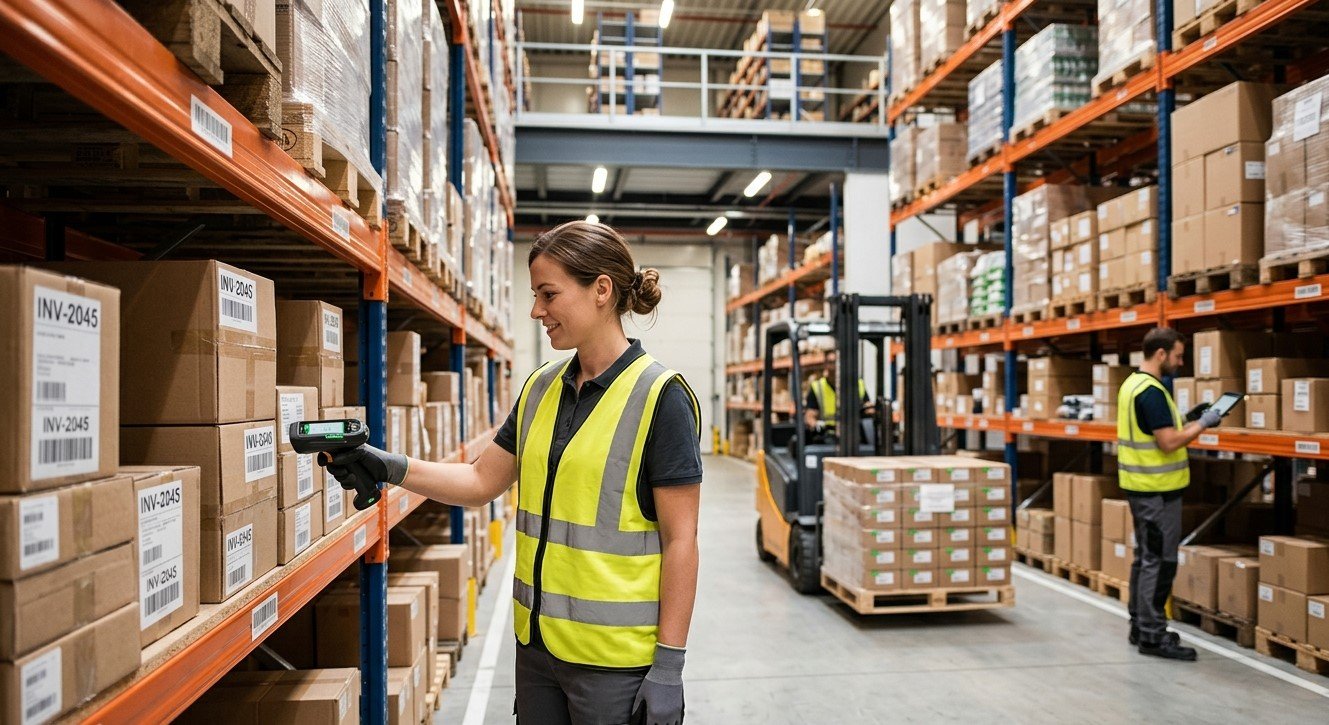
Warehouse space is one of the most valuable resources for businesses involved in retail, manufacturing, distribution, and logistics. As inventory volumes grow, companies often face challenges such as overcrowded storage areas, misplaced products, inefficient shelving, and unused space. Simply adding more racks or expanding a warehouse is not always the most practical solution. Instead, businesses can improve how they organize and use their existing space through better inventory visibility and technology.
Barcode scanning technology provides an effective way to improve warehouse space utilization by helping businesses accurately identify products, track their locations, organize inventory, and make better storage decisions. When barcode scanners, barcode labels, mobile computers, printers, and warehouse management software work together, warehouses can become more organized and efficient.
Pointus Solutions provides barcode and Auto-ID solutions that can help businesses improve warehouse and inventory operations. Companies looking to Shop Barcode scanners, printers, labels, and related Printing Products can use barcode technology to build a more structured warehouse environment while reducing unnecessary space usage.
What Is Warehouse Space Utilization?
Warehouse space utilization refers to how effectively a business uses the available physical storage area. Good space utilization does not simply mean filling every available shelf. It means using storage space efficiently while ensuring that employees can safely and quickly access inventory.
Effective space utilization involves:
- Organizing products logically
- Using appropriate storage locations
- Reducing empty shelf capacity
- Avoiding unnecessary inventory
- Improving product accessibility
- Maintaining clear aisles
- Tracking inventory locations accurately
Poor space utilization can result in wasted capacity, longer picking times, misplaced products, and increased operational costs.
Why Warehouse Space Becomes Inefficient
Several factors can cause warehouses to use space inefficiently.
Poor Inventory Organization
When products are stored without a consistent system, employees may place items wherever space is available. Over time, this can create disorganized storage.
Inaccurate Inventory Records
If system records do not match physical inventory, employees may not know where products are located or how much stock is actually available.
Excess Inventory
Holding more inventory than necessary consumes valuable storage capacity and can make warehouses difficult to manage.
Unused Storage Capacity
Some shelves may be overloaded while other areas remain partially empty because businesses lack visibility into available space.
Misplaced Products
Products that are stored in incorrect locations can occupy space inefficiently and take longer to find.
Barcode scanning helps address many of these problems.
How Barcode Scanning Supports Better Space Utilization
Barcode scanning creates a connection between physical inventory and digital inventory records. Products, storage locations, shelves, bins, and pallets can all be assigned unique identifiers.
When employees scan an item and its storage location, the warehouse management system can record where the product has been placed.
This provides greater visibility into:
- Product locations
- Available storage areas
- Inventory quantities
- Stock movements
- Storage utilization
- Picking activity
With better information, warehouse managers can make more informed decisions about how space should be organized.
1. Create Accurate Location Tracking
One of the most important ways barcode scanning improves space utilization is by tracking where products are stored.
Warehouses can assign barcode labels to:
- Racks
- Shelves
- Bins
- Pallet positions
- Storage zones
- Loading areas
Employees can scan the location barcode and the product barcode when placing inventory into storage.
This creates a digital record of where the product belongs.
Instead of relying on memory or handwritten notes, employees can use the warehouse system to identify the correct storage location.
2. Reduce Misplaced Inventory
Misplaced inventory can waste both space and employee time.
For example, if a product is placed on the wrong shelf, the system may still show it as being somewhere else. Employees may then search through multiple locations to find it.
Barcode scanning reduces this problem by providing location verification.
A worker can scan:
Product → Storage Location → Confirmation
If the selected location is incorrect, the warehouse system can alert the employee before the item is stored.
This helps maintain a more organized warehouse.
3. Improve Inventory Visibility
Warehouse space decisions depend on accurate inventory information.
Barcode scanning provides real-time or near-real-time information about inventory movement when properly integrated with warehouse software.
Managers can identify:
- Fast-moving products
- Slow-moving products
- Overstocked items
- Low-stock items
- Frequently relocated products
This information can be used to determine how much space should be allocated to different product categories.
Fast-moving items may need to be stored in easily accessible locations, while slow-moving products can be placed in less accessible storage areas.
4. Optimize Product Placement
Not every product needs the same amount of storage space.
Businesses can analyze inventory movement and organize products based on factors such as:
- Product size
- Weight
- Demand
- Picking frequency
- Product category
- Storage requirements
Barcode scanning provides the data needed to support these decisions.
For example, frequently picked products can be stored closer to packing areas, reducing unnecessary travel and making better use of convenient storage locations.
5. Support Better Shelf and Bin Management
Barcode labels can be placed on shelves and bins to create a structured location system.
Each location can have a unique identification code.
When products are moved, employees scan the product and the destination location. This helps ensure that inventory records remain accurate.
A well-designed bin-location system can make it easier to identify:
- Empty locations
- Partially occupied locations
- Full locations
- Incorrectly used locations
This allows warehouse managers to make better use of available capacity.
6. Reduce Excess Inventory
Excess inventory is one of the major causes of inefficient warehouse space utilization.
When businesses purchase more products than they need, additional storage space is required. Overstocked products can also make warehouses harder to navigate.
Barcode scanning improves inventory visibility, allowing businesses to monitor stock levels more accurately.
When connected with inventory management software, barcode data can support better purchasing and replenishment decisions.
Reducing unnecessary inventory can free valuable warehouse space.
7. Improve Receiving Processes
Warehouse space utilization begins when inventory arrives.
If receiving processes are slow or inaccurate, incoming products may be placed in temporary areas for extended periods.
Barcode scanning can speed up receiving by allowing employees to scan incoming products and verify them against purchase orders.
After verification, the system can identify the appropriate storage location.
This helps move products into their designated locations more quickly and prevents receiving areas from becoming overcrowded.
8. Improve Put-Away Efficiency
Put-away is the process of moving received products into their designated storage locations.
Barcode scanning helps employees confirm that products are placed in the correct location.
A typical process may involve:
- Scan the product.
- Scan the assigned location.
- Verify the information.
- Place the product in storage.
- Confirm the transaction.
This creates a consistent put-away process and reduces the possibility of products being stored incorrectly.
9. Make Picking Routes More Efficient
Space utilization is closely connected to employee movement.
When products are scattered throughout a warehouse without an efficient layout, workers may spend significant time walking between locations.
Barcode scanning combined with warehouse management software can provide accurate location information.
This allows businesses to organize frequently picked products in strategically convenient locations.
Shorter picking routes can improve productivity while helping warehouses make better use of their available layout.
10. Support Cycle Counting
Regular inventory counting is essential for maintaining accurate warehouse records.
Traditional physical counts can take significant time and may require employees to manually record product information.
Barcode scanning makes cycle counting more efficient.
Employees can scan products and locations while counting inventory. The captured information can then be compared with system records.
Accurate cycle counts help identify discrepancies and ensure that warehouse data remains reliable.
The Role of Barcode Labels in Space Management
Barcode scanners are only effective when products and storage locations can be identified reliably. This makes high-quality barcode labels an important part of warehouse organization.
Labels should be:
- Easy to scan
- Clearly printed
- Correctly positioned
- Durable enough for the environment
- Suitable for the storage surface
For demanding warehouse environments, businesses may require durable synthetic labels that can withstand moisture, abrasion, temperature changes, or handling.
Reliable Printing Products help businesses create barcode labels that remain readable throughout their expected use.
Choosing the Right Barcode Scanning Equipment
Different warehouses have different requirements, so businesses should select equipment according to their operational environment.
Handheld Scanners
Useful for general warehouse scanning and inventory operations.
Wireless Scanners
Suitable when employees need freedom of movement across large warehouse areas.
Mobile Computers
Combine scanning capabilities with a display and computing functions, making them useful for receiving, picking, counting, and put-away.
Industrial Scanners
Designed for demanding environments where equipment may be exposed to dust, heavy use, or challenging operating conditions.
Barcode Printers
Used to create product, pallet, shelf, bin, and location labels.
Selecting the right equipment can improve scanning reliability and operational efficiency.
Best Practices for Improving Warehouse Space Utilization
Businesses can get better results from barcode technology by following several best practices:
- Create a standardized warehouse location system.
- Assign unique barcodes to storage locations.
- Label racks, shelves, bins, and pallets clearly.
- Use consistent product identification.
- Integrate barcode scanning with warehouse software.
- Analyze inventory movement regularly.
- Store fast-moving products strategically.
- Conduct regular cycle counts.
- Remove obsolete inventory.
- Maintain barcode printers and scanners.
- Replace damaged or unreadable labels.
- Train employees on scanning procedures.
Technology works best when supported by consistent processes.
Benefits of Better Warehouse Space Utilization
When barcode scanning is used effectively, businesses can achieve several benefits:
Lower Storage Costs
Better use of existing space can reduce the need for additional storage capacity.
Faster Operations
Employees spend less time searching for products and locations.
Better Inventory Accuracy
Digital records are more closely aligned with physical inventory.
Reduced Product Misplacement
Location scanning helps ensure products are stored correctly.
Improved Productivity
Employees can complete receiving, put-away, picking, and counting tasks more efficiently.
Better Customer Service
Accurate inventory information helps businesses fulfill orders more reliably and provide customers with better product availability information.
Conclusion
Efficient warehouse space utilization requires more than simply adding shelves or increasing storage capacity. Businesses need accurate information about what inventory they have, where it is stored, and how frequently it moves. Barcode scanning technology provides the visibility needed to make better storage and inventory decisions.
By combining barcode scanners with location labels, mobile computers, barcode printers, and warehouse management software, businesses can reduce misplaced inventory, improve put-away, optimize product placement, reduce excess stock, and create more efficient picking processes.
Pointus Solutions can help businesses explore barcode and Auto-ID technologies designed to improve warehouse and inventory operations. Whether you want to Shop Barcode scanners and equipment or need dependable Printing Products for product and location identification, the right barcode solution can help businesses make better use of existing warehouse space.
As inventory volumes continue to grow and operational efficiency becomes increasingly important, barcode scanning provides a practical foundation for creating organized, accurate, and productive warehouse environments.