Introduction
Maintaining a controlled surgical environment is essential for modern gynaecology operation theatres. Surgical procedures require appropriate air filtration, environmental control, hygienic surfaces, organized equipment placement, and carefully planned clinical workflows. These elements work together to support infection prevention and reliable OT operations.
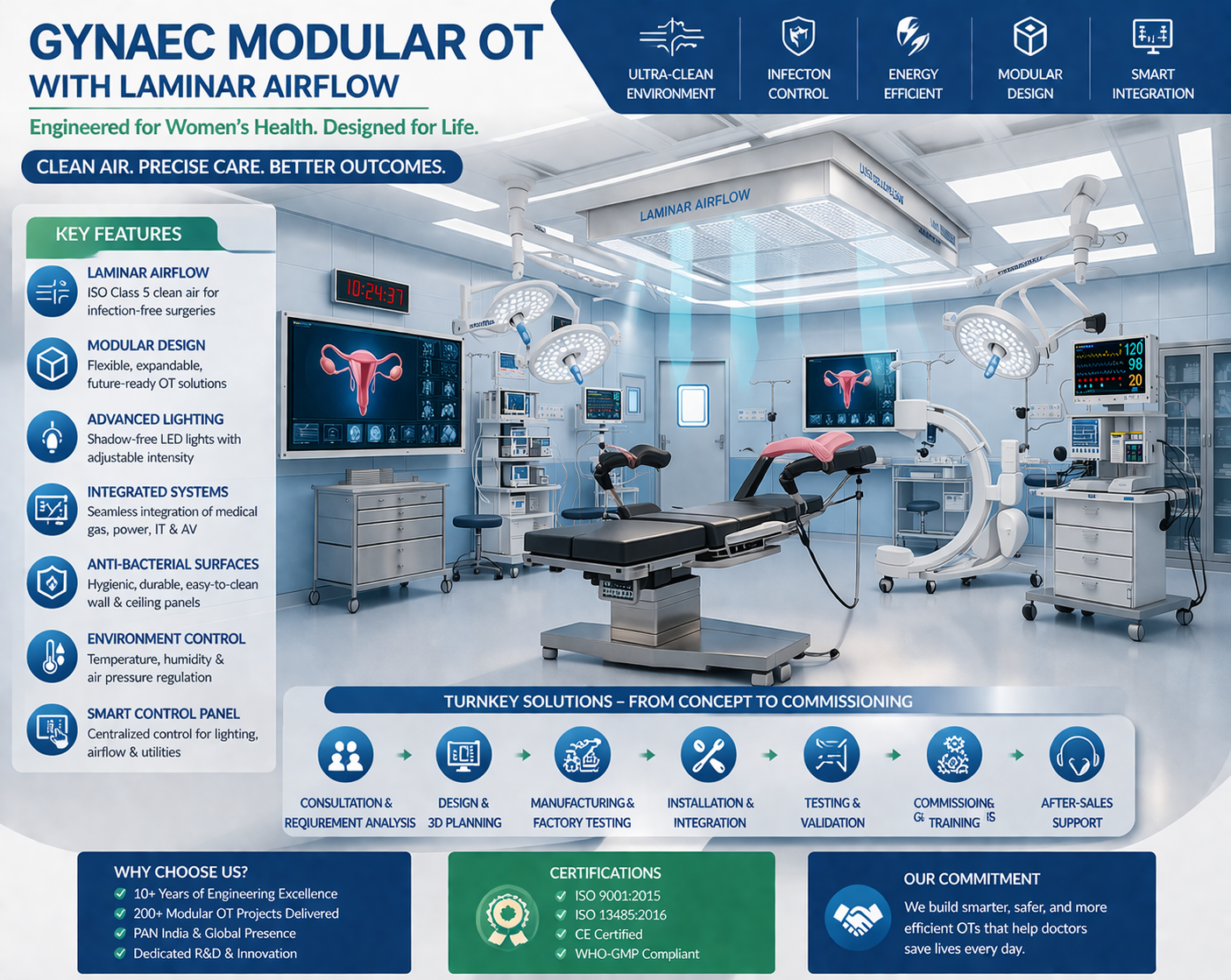
A Gynaec Modular OT With Laminar Airflow combines modular construction with an engineered air-management system to help control airborne particles around the surgical area. The design can integrate modular wall and ceiling panels, HVAC, HEPA filtration, pressure management, surgical lighting, medical gases, electrical infrastructure, and clinical equipment.
For hospitals in India in 2026, this approach provides a structured way to develop an operating theatre around specific clinical and engineering requirements. The effectiveness of the environment depends on correct design, installation, testing, maintenance, and compliance with applicable healthcare guidelines.
What Is a Gynaec Modular OT With Laminar Airflow?
A gynaec modular OT is a specially designed operating theatre intended for gynaecological surgical procedures. It uses modular construction components to create an organized, cleanable interior while allowing technical services to be coordinated within the walls and ceiling.
Laminar airflow refers to a controlled, predominantly unidirectional movement of filtered air over a designated area. When appropriately engineered, it can help reduce airborne particle contamination around the surgical field.
The complete system may include:
- Modular wall and ceiling panels
- HVAC and air handling units
- HEPA filtration
- Air distribution components
- Pressure monitoring
- Temperature and humidity controls
- Surgical lights
- Medical pendants
- Medical gas outlets
- Electrical systems
- OT control panels
The final configuration should reflect the hospital’s clinical requirements and approved engineering design.
1. How Does Laminar Airflow Help Control the Surgical Environment?
Laminar airflow is designed to move filtered air in a defined direction across the critical surgical area. This movement helps manage airborne particles and supports the removal or dilution of contaminants from the controlled zone.
People, clothing, equipment, and routine movement can introduce particles into an operating theatre. An appropriately designed ventilation system helps manage these airborne contaminants through filtration, airflow distribution, and exhaust or return-air arrangements.
The Indian Ministry of Health and Family Welfare’s National Guidelines for Infection Prevention and Control in Healthcare Facilities discuss the role of HVAC, HEPA filtration, airflow direction, and pressure control in healthcare environments. These systems form part of a broader infection-prevention strategy rather than providing a standalone guarantee against surgical infections.
2. HEPA Filtration for Cleaner Supply Air
HEPA filtration is an important component of many controlled OT air-management systems.
These filters are designed to remove very small airborne particles from the air passing through them. Their performance depends on the specified filter efficiency, correct installation, housing integrity, and appropriate maintenance.
A well-planned filtration system considers:
- Filter efficiency
- Filter location
- Airflow volume
- Filter housing and sealing
- Pressure drop
- Access for inspection
- Replacement requirements
- Performance testing
HEPA filters should be integrated with the air handling unit, ductwork, ceiling arrangement, and airflow strategy. Routine monitoring and timely replacement are also important to maintain the intended performance.
3. HVAC and Air Handling Unit Integration
The HVAC system helps establish the operating theatre’s environmental conditions. It should be designed to meet the requirements for ventilation, temperature, humidity, filtration, and pressure relationships.
An air handling unit may incorporate multiple filtration stages and the components needed to condition and distribute air throughout the OT.
The engineering design should consider:
- Room dimensions and volume
- Required airflow
- Fresh-air supply
- Filtration stages
- Temperature control
- Humidity control
- Duct routing
- Air distribution
- Pressure relationships
- Control and monitoring systems
Correct system sizing is important. An undersized system may not deliver the required conditions, while inappropriate oversizing can create unnecessary operational demands.
4. Pressure Management and Airflow Direction
Pressure relationships between the OT and adjacent spaces can help limit the entry of air from less-clean areas when positive pressure is required by the approved design.
The system may coordinate supply air, return or exhaust air, room sealing, doors, and pressure monitoring.
Important considerations include:
- Supply and return airflow balance
- Door sealing
- Room integrity
- Pressure monitoring
- Airflow direction
- Commissioning
- Routine maintenance
Pressure control should be designed according to the OT classification, applicable guidelines, and hospital requirements. It must work together with filtration and airflow distribution rather than being treated as an independent feature.
5. Modular Walls and Hygienic Surfaces
Modular wall systems help create an organized interior with surfaces selected for cleaning, durability, and compatibility with healthcare operations.
The design should consider smooth finishes, sealed joints, suitable materials, and carefully detailed interfaces between walls, ceilings, doors, and flooring.
These features can help facility teams carry out routine cleaning and reduce locations where dirt or moisture might accumulate.
Material selection should follow the hospital’s approved specifications and cleaning protocols. Modular construction alone does not establish that an OT is sterile or compliant; the complete installation and its operating procedures matter.
6. Coordinated Ceiling Design
The ceiling is a critical area because multiple systems may need to occupy the same space.
These may include HEPA filters, airflow diffusers, surgical lights, medical pendants, access panels, electrical services, and control components.
Coordinated ceiling engineering helps ensure that each component fits the design without unnecessary conflicts. It also allows the project team to consider equipment clearances, maintenance access, and the intended airflow pattern before installation.
This planning is particularly important when the airflow system is intended to serve the operating table and the critical surgical area.
7. Temperature and Humidity Control
Temperature and humidity influence the working environment for surgical teams, patients, and equipment.
The HVAC design should establish appropriate operating conditions according to the clinical application and applicable technical requirements. Monitoring devices and control systems can help facility staff identify deviations and maintain the intended environment.
The design should account for equipment heat loads, room occupancy, ventilation requirements, and operating schedules.
Temperature and humidity control must be integrated with filtration and airflow management to support stable OT conditions.
8. Supporting Gynaecological Procedures
A controlled OT environment can support a range of gynaecological procedures, depending on the hospital’s clinical services.
These may include hysterectomy, laparoscopy, hysteroscopy, gynaecological oncology procedures, and other surgical interventions.
The room layout should be developed around the operating table, surgical lights, anaesthesia equipment, patient monitors, medical pendants, and staff movement.
The design should also consider patient transfer, emergency access, equipment positioning, and the movement of instruments and supplies.
9. Surgical Lights and Medical Pendants
Surgical lights and medical pendants must be coordinated with the ceiling and airflow design.
Their positions should support the surgical team’s access to the operating field while maintaining appropriate equipment clearance and airflow arrangements.
Medical pendants may provide access to specified medical gas outlets, electrical connections, and other clinical utilities.
Planning these components together helps reduce ceiling conflicts and keeps essential equipment accessible during procedures.
10. Electrical and Medical Gas Infrastructure
The OT requires properly planned electrical services and, where applicable, medical gas infrastructure.
Electrical planning may cover surgical lights, monitoring systems, anaesthesia equipment, medical pendants, HVAC controls, general sockets, and emergency power provisions.
Medical gas requirements depend on the clinical procedures and equipment used. The design may include oxygen, medical air, vacuum, and other specified services.
The engineering team should coordinate outlet locations and utility connections with the approved equipment layout. Testing should be completed according to the applicable technical requirements before clinical use.
11. Why Is Controlled Workflow Important?
Environmental engineering is only one part of a well-functioning operating theatre. Staff movement, equipment placement, cleaning procedures, and access management also influence how the room operates.
An organized layout can help staff move between the operating table, anaesthesia area, instruments, and equipment without unnecessary obstruction.
Hospitals should also establish procedures for cleaning, waste handling, sterile supplies, equipment movement, and access control.
These operational measures complement the physical environment and help maintain the intended level of cleanliness.
12. Installation, Testing, and Commissioning
The performance of a modular OT depends on the quality of the completed installation.
The project team should coordinate modular construction, HVAC, filtration, airflow components, electrical systems, medical gases, lighting, and controls.
Testing and commissioning may include:
- Airflow measurement and balancing
- Temperature and humidity checks
- Pressure verification
- HEPA filter integrity testing, where specified
- Electrical system testing
- Medical gas testing
- Control-system checks
- Inspection of modular joints and finishes
The required tests should be identified in the project specification and completed before the OT is handed over for clinical use.
13. Maintenance of the Controlled Environment
A controlled environment requires ongoing maintenance. Even a properly designed system can lose performance if filters, seals, controls, or other components are not inspected and serviced.
The hospital should establish a maintenance plan covering:
- HEPA filter inspection and replacement
- HVAC servicing
- Airflow verification
- Pressure monitoring
- Temperature and humidity monitoring
- Door and seal inspection
- Control-system checks
- Periodic performance testing
Maintenance activities should follow equipment recommendations, hospital policies, and applicable guidelines.
14. How Should Hospitals Select an OT Provider?
Hospitals should assess a provider’s ability to coordinate the complete operating theatre rather than considering modular panels or airflow equipment in isolation.
Important evaluation factors include:
- Healthcare OT engineering experience
- Modular construction quality
- HVAC and AHU capability
- HEPA filtration knowledge
- Airflow design
- Pressure-control planning
- Electrical and medical gas coordination
- Equipment integration
- Installation supervision
- Testing and commissioning
- Technical documentation
- Maintenance support
Hospitals should request a clearly defined scope, coordinated drawings, relevant technical specifications, and commissioning requirements before approving the project.
What Makes a Gynaec Modular OT With Laminar Airflow Effective?
A Gynaec Modular OT With Laminar Airflow is most effective when the modular structure, HVAC, filtration, airflow distribution, pressure strategy, equipment layout, and operating procedures work together.
The major factors are:
Appropriate engineering: Airflow and filtration are designed for the actual OT and its clinical application.
Integrated systems: HVAC, HEPA filters, ceiling components, surgical lights, and medical pendants are coordinated.
Quality installation: Components are installed according to approved drawings and specifications.
Verified performance: Testing and commissioning confirm that the completed systems meet the defined requirements.
Routine maintenance: Filters, controls, seals, and other components receive appropriate inspection and servicing.
Good clinical practice: Cleaning, staff workflow, equipment management, and infection-prevention procedures support the designed environment.
No single technology can guarantee that surgical-site infections will be prevented. Controlled airflow is one element of a wider approach that includes appropriate ventilation, cleaning, aseptic technique, equipment management, and established infection-prevention practices.
Conclusion
A gynaecology modular OT with laminar airflow supports a controlled surgical environment by combining modular construction, engineered ventilation, HEPA filtration, airflow distribution, pressure management, hygienic surfaces, and coordinated medical infrastructure.
Hospitals planning a Gynaec Modular OT With Laminar Airflow should assess the complete system, including its design, installation, commissioning, and maintenance. The final configuration should be based on the clinical application and applicable technical guidelines, with performance verified before clinical use.
Altus Airflow provides modular OT and controlled-environment solutions designed around hospital-specific requirements.
Frequently Asked Questions
1. How does Gynaec Modular OT With Laminar Airflow support controlled surgical environments?
A Gynaec Modular OT With Laminar Airflow combines modular construction, filtered air supply, engineered airflow distribution, HVAC, and pressure management where required. Together with hygienic surfaces, appropriate cleaning, and infection-prevention practices, these features help manage airborne particles and support a controlled surgical environment.
2. What is the role of HEPA filtration in a gynaecology OT?
HEPA filtration removes very small airborne particles from the air passing through the filter. Correct specification, installation, integrity, and maintenance are important to achieving the intended filtration performance.
3. Does laminar airflow alone prevent surgical-site infections?
No. Laminar airflow can help manage airborne contamination, but it does not guarantee infection prevention. Appropriate ventilation, cleaning, aseptic technique, equipment management, and clinical infection-control practices remain essential.
4. Why is pressure management important in a modular OT?
Where positive pressure is required, it helps limit the entry of air from adjacent areas. The pressure strategy should be integrated with airflow, filtration, room sealing, and the approved ventilation design.
5. What maintenance is required for a gynaec modular OT with laminar airflow?
Maintenance can include HVAC servicing, HEPA filter inspection and replacement, airflow balancing, pressure monitoring, temperature and humidity checks, seal inspection, control-system testing, and periodic performance verification.