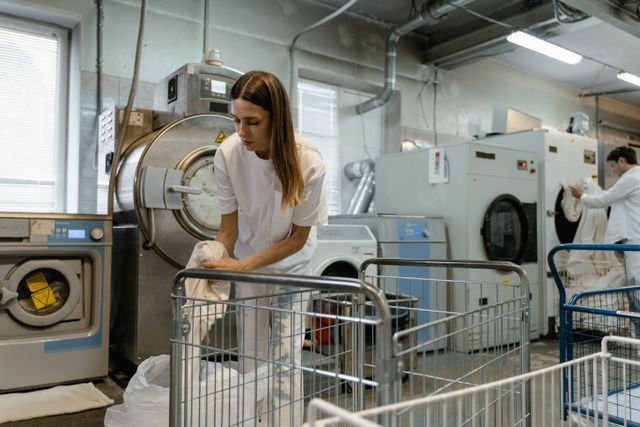
Laundry can quickly become a daily challenge for businesses that use towels, linens, uniforms, bedding, or other washable items.
A salon may go through dozens of towels in a day. A restaurant may need clean table linens and uniforms for every shift. A hotel has to keep sheets and towels moving between rooms. A gym may collect bags of used towels every day. Vacation rental businesses need clean linens ready before every guest arrives.
Without a clear system, laundry can become something employees deal with whenever they have time.
That usually leads to the same problems: overflowing laundry bags, running out of clean towels, rushed washing, unnecessary trips to a laundromat, and employees spending time on laundry instead of their main responsibilities.
A regular laundry routine can make the process much easier.
The goal is not simply to wash laundry more often. The goal is to create a system where your team knows what happens to dirty laundry, when it is collected, when clean items return, and how much inventory should always be available.
If you run a business in Chicago, this guide explains how to build a practical laundry routine that works around your daily operations.
Why Does Your Business Need a Laundry Routine?
Without a routine, laundry tends to become reactive.
Someone notices that the towel shelf is almost empty.
An employee starts a load.
Later, someone remembers that the load needs to be moved to the dryer.
Then another employee needs to fold everything.
If the business gets busy, the laundry may sit unfinished.
The problem becomes bigger when laundry volume increases.
A routine creates a predictable process.
Instead of asking who will handle laundry today, employees know:
- Where dirty laundry goes
- What items need special handling
- When laundry is collected
- When clean laundry should return
- Where clean items are stored
- Who checks inventory
For many businesses, this simple structure can save time and prevent last minute problems.
Step 1: Identify Everything Your Business Sends to Laundry
Before creating a schedule, make a list of all washable items used by your business.
Do not only count towels.
Depending on your industry, your laundry may include:
- Towels
- Hand towels
- Bath towels
- Sheets
- Pillowcases
- Blankets
- Bedspreads
- Tablecloths
- Napkins
- Chef jackets
- Aprons
- Staff uniforms
- Robes
- Cleaning cloths
- Workout towels
- Salon towels
Once you know what you are cleaning, it becomes easier to estimate your weekly laundry volume.
For example, a salon may mainly deal with towels and capes, while a hotel may have several categories of bedding and towels.
Laundry Gopher provides commercial laundry services for businesses including hotels, restaurants, salons, spas, health clubs, vacation rentals, schools, and physical therapy businesses.
Step 2: Calculate Your Weekly Laundry Volume
The next step is to understand how much laundry your business actually produces.
For one week, record the amount of laundry generated each day.
You can measure this by:
- Pounds
- Bags
- Loads
- Number of items
Choose whichever method is easiest for your business.
The purpose is to identify your normal volume.
For example:
Monday: 2 bags
Tuesday: 3 bags
Wednesday: 2 bags
Thursday: 3 bags
Friday: 4 bags
Saturday: 4 bags
Sunday: 1 bag
This gives you a better idea of your weekly requirement.
Do not rely only on your busiest day.
Look at the average over several weeks.
Step 3: Separate Dirty Laundry From Clean Laundry
One of the easiest ways to create a better laundry system is to separate dirty and clean items completely.
Dirty laundry should have a dedicated collection area.
Clean laundry should have a separate storage location.
Never allow clean items to be placed beside used laundry.
Your collection area should be easy for employees to access but away from customer facing areas whenever possible.
Use clearly marked bags, bins, or containers.
If your business handles different types of laundry, you can also use separate containers for different categories.
For example:
Towels
Uniforms
Linens
Table linens
This can make sorting easier later.
Step 4: Decide How Often Laundry Needs to Be Picked Up
There is no single schedule that works for every business.
Your pickup frequency depends on your laundry volume and how quickly you use clean items.
A small business may need weekly service.
A busy salon may need several pickups each week.
A hotel may require a much more frequent laundry schedule.
Think about your clean inventory.
If you regularly run low before your next pickup, your schedule may not be frequent enough.
If your laundry sits for several days before pickup, you may be scheduling more service than necessary.
The goal is to find a schedule that matches actual usage.
Laundry Gopher offers commercial laundry pickup and delivery for businesses in Chicago and surrounding areas. Customers can schedule pickups through the company’s app.
Step 5: Create a Backup Supply
One of the most useful parts of a good laundry routine is having extra clean inventory.
Do not operate with exactly the number of towels, sheets, or uniforms you need for one day.
Unexpected situations happen.
A busy weekend can create more laundry than normal.
A large group may arrive at a hotel.
A salon may have an unusually busy day.
A washing machine may stop working.
A pickup may need to be rescheduled.
Having extra inventory gives your business some breathing room.
The amount of backup inventory you need depends on your business.
A simple approach is to maintain enough clean items to cover normal usage until your next scheduled pickup, plus an additional reserve for unexpected demand.
Step 6: Build a Simple Laundry Calendar
Once you know your volume and pickup needs, create a calendar.
It does not need to be complicated.
For example:
Monday
Collect used laundry and prepare bags.
Tuesday
Scheduled pickup.
Wednesday
Check clean inventory.
Thursday
Collect used laundry.
Friday
Scheduled pickup.
Saturday
Check towels, uniforms, and linens before the busy period.
This gives employees a clear reference point.
If your business uses a commercial laundry provider, the schedule can be built around your pickup and delivery days.
Step 7: Assign One Person to Monitor Laundry
You do not necessarily need one employee to perform all laundry tasks.
However, assigning someone to monitor the process can prevent confusion.
The person responsible can check:
- Laundry inventory
- Pickup dates
- Special instructions
- Missing items
- Damaged items
- Emergency laundry needs
This might be a manager, supervisor, office administrator, housekeeping lead, or another appropriate employee.
The role is mainly about keeping the system organized.
Step 8: Create Rules for Special Items
Not every item should necessarily be treated the same way.
Some fabrics may require different handling.
Some uniforms may have care instructions.
Certain linens may need special treatment.
Before sending laundry to a commercial provider, identify anything that needs special attention.
Laundry Gopher states that its commercial laundry team handles a variety of textiles and can accommodate special requests and instructions.
Make sure employees understand which items need special handling.
A simple written guide can prevent mistakes when different employees are responsible for laundry collection.
Step 9: Create a Stain and Damage Procedure
Businesses deal with stains every day.
Restaurants may have food and grease.
Salons may have hair color products.
Spas may have oils and lotions.
Hotels may have makeup, food, and beverage stains.
Instead of allowing employees to handle stains differently each time, create a simple procedure.
For example:
- Separate heavily stained items.
- Do not mix them with clean laundry.
- Mark or identify the items if necessary.
- Inform the laundry provider about unusual stains.
- Follow the provider’s instructions for special treatment.
This makes the process more consistent.
Step 10: Choose Between In House Laundry and Outsourcing
Once you understand your laundry volume, decide whether your business should process laundry internally or use a professional service.
In house laundry may work for businesses with low volume and suitable equipment.
But larger operations need to consider more than the washing machine.
Think about:
- Employee time
- Water usage
- Electricity
- Detergent
- Equipment
- Maintenance
- Repairs
- Storage
- Transportation
- Folding
- Management time
If employees spend several hours every week handling laundry, outsourcing may make more sense.
A professional provider can handle pickup, cleaning, folding, and delivery while your employees focus on other responsibilities.
Laundry Gopher offers wash and fold, dry cleaning, linen care, pickup, and delivery for commercial customers.
Step 11: Build Your Routine Around Business Hours
Your laundry schedule should work with your business rather than interrupt it.
Think about your busiest hours.
A salon may be busiest in the evening and on weekends.
A restaurant may have intense lunch and dinner periods.
A hotel operates throughout the day.
A gym may be busiest before and after standard working hours.
Schedule laundry collection and preparation during quieter periods whenever possible.
This keeps employees from rushing through laundry tasks when customers need their attention.
Step 12: Keep Clean Laundry Organized
Getting laundry cleaned is only half the process.
You also need a system for storing it.
Clean laundry should have a dedicated location.
Keep commonly used items easy to access.
For example:
Shelf 1: Bath towels
Shelf 2: Hand towels
Shelf 3: Sheets
Shelf 4: Pillowcases
Shelf 5: Robes
The exact arrangement depends on your business.
The important thing is consistency.
Employees should not have to search through several shelves every time they need a clean towel.
Step 13: Use a First In, First Out System
A simple inventory method can help prevent clean laundry from sitting unused.
When clean items return, place them behind or underneath older clean inventory.
Employees should use the older items first.
This can help maintain an organized supply and reduce the chance of certain items sitting unused for long periods.
For businesses with uniforms or specialized linens, you can also label storage sections by item type.
Step 14: Monitor Your Inventory Every Week
A weekly inventory check can prevent emergency situations.
Count or estimate the number of clean:
- Towels
- Sheets
- Pillowcases
- Uniforms
- Robes
- Tablecloths
- Other frequently used items
Compare your clean inventory with your normal weekly usage.
If your supply is consistently too low, you may need:
- More frequent pickup
- More inventory
- Faster turnaround
- Better internal organization
Laundry problems are easier to solve when you notice them early.
Step 15: Prepare for Busy Seasons
Chicago businesses can experience changes in demand throughout the year.
Hotels may have different occupancy patterns.
Restaurants may become busier during holidays and events.
Salons can experience seasonal appointment increases.
Vacation rentals may have periods of higher bookings.
Your laundry schedule should be flexible enough to handle these changes.
Do not wait until your business is already overloaded.
If you know a busy period is coming, talk to your laundry provider in advance.
Step 16: Track Your Laundry Costs
A laundry routine should also help you understand what the service is costing your business.
Track:
- Laundry weight
- Number of pickups
- Specialty items
- Additional services
- Internal labor
- Equipment expenses
If you outsource laundry, compare the monthly service cost with your previous internal expenses.
Laundry Gopher’s current pricing page provides wash and fold pricing along with individual pricing for several specialty items.
You can review the Laundry Gopher pricing page when building your budget.
Step 17: Make Your Laundry Routine Easy for Employees
The best routine is one that employees can follow without constantly asking questions.
Create a simple instruction sheet.
It might say:
Step 1: Place used laundry in the designated container.
Step 2: Separate special items.
Step 3: Mark heavily stained items.
Step 4: Prepare laundry for scheduled pickup.
Step 5: Store clean laundry in the correct location.
Step 6: Report low inventory to the assigned manager.
Keep the instructions somewhere employees can easily access them.
Example Laundry Routine for a Chicago Salon
Here is an example of what a simple salon routine could look like.
Every Day
Employees place used towels in the designated laundry container.
Heavily stained towels are separated.
At closing, the manager checks the total laundry volume.
Monday
Laundry is prepared for pickup.
Clean inventory is checked.
Tuesday
Commercial laundry pickup takes place.
Employees continue using the existing clean inventory.
Wednesday
Clean towels are organized after delivery.
Inventory levels are checked.
Thursday
Used laundry is collected and prepared.
Friday
Another pickup is scheduled if the salon’s volume requires it.
Weekend
The manager checks whether enough clean towels are available for the expected appointment volume.
This is only an example.
A larger salon may need more frequent pickup.
A smaller salon may need less.
Example Laundry Routine for a Restaurant
A restaurant might use a different schedule.
Daily
Collect kitchen towels, aprons, uniforms, napkins, and other used textiles.
End of Week
Review laundry volume.
Scheduled Pickup Day
Prepare and label bags.
After Delivery
Store clean uniforms and table linens.
Before Busy Periods
Check whether enough clean items are available.
This creates a repeatable system without making employees responsible for every part of the laundry process.
What If Your Business Is Growing?
Your laundry routine should change as your business grows.
More customers usually mean more laundry.
If your business adds employees, rooms, appointments, tables, or rental units, your laundry volume may increase as well.
Watch for these signs:
- More frequent laundry shortages
- Employees spending more time on laundry
- More trips to a laundromat
- Laundry taking up more storage space
- Equipment running constantly
- Increased repair costs
These are signs that your current system may no longer be suitable.
A professional commercial laundry provider can help businesses adjust pickup and service based on changing requirements.
When Should You Consider a Chicago Laundry Service?
A professional Chicago laundry service may be worth considering when laundry starts taking too much time away from employees.
You may benefit from outsourcing if:
- Your business produces laundry every day
- Employees spend hours washing and folding
- You regularly visit a laundromat
- Your machines cannot handle the workload
- You need frequent linen cleaning
- You need reliable pickup and delivery
- You regularly run short of clean towels
- Your business is growing
- You need help handling large laundry volumes
The important thing is to look at the complete process.
Do not only ask how much one load costs.
Ask how much time, labor, equipment, space, transportation, and management your current laundry system requires.
Final Thoughts
A good laundry routine should make your business easier to manage.
The goal is to know where dirty laundry goes, when it is collected, how much clean inventory you need, and when fresh items will be available again.
For small businesses, a simple internal system may be enough.
For businesses with larger or recurring laundry volumes, outsourcing can remove much of the daily workload.
Hotels, restaurants, salons, spas, gyms, vacation rentals, schools, and other businesses can all create a laundry routine based on their specific needs.
Laundry Gopher provides commercial laundry pickup and delivery along with wash and fold, dry cleaning, and linen care for businesses throughout Chicago and surrounding areas.
Need a Chicago Laundry Service?
If your current laundry routine is taking too much time or your business regularly runs short of clean towels, linens, or uniforms, Laundry Gopher can help.
Visit the Chicago laundry service page to learn more about available services.
You can also contact the Laundry Gopher team to discuss your business laundry requirements.
Call: 773 217 0847
Email: support@laundrygopher.com