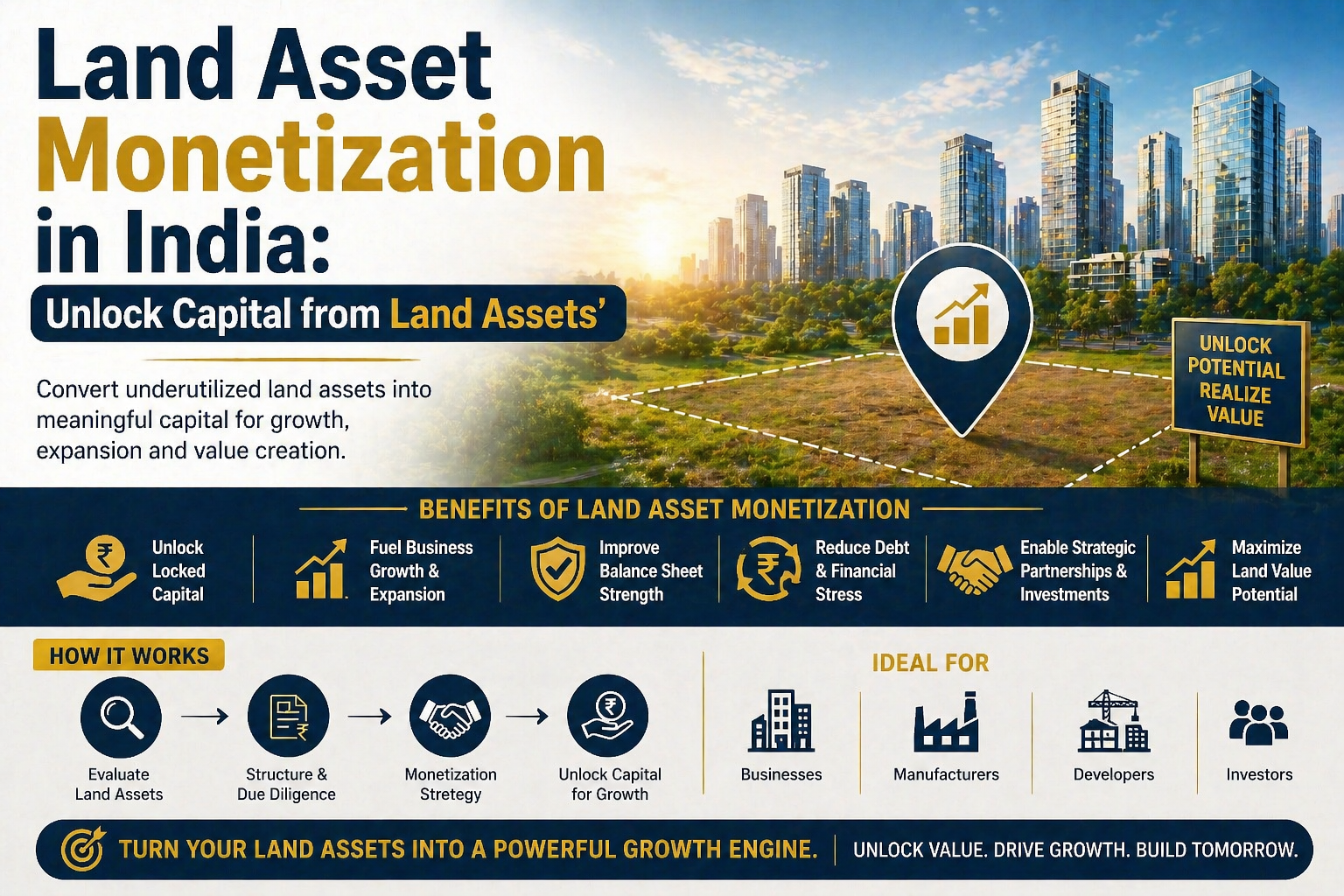
Land Asset Monetization: How to Fund Projects Using Land Without Selling It
Land is one of the most valuable yet underutilized assets in India. Many businesses, developers, and landowners hold land parcels worth crores, but these assets often remain idle and do not generate regular income. This is where Land Asset Monetization becomes a strategic financial solution.
Instead of selling valuable land holdings, monetization allows owners to unlock the financial potential of land for business growth, project funding, debt restructuring, or infrastructure development. In a fast-growing economy like India, where real estate and infrastructure demand continue to rise, land monetization is becoming an increasingly relevant funding strategy.
Government initiatives like the National Land Monetization Corporation were specifically created to unlock value from underused public assets and generate productive capital.
This blog explains how landowners and businesses can use Land Asset Monetization to fund projects efficiently while retaining ownership and long-term value appreciation.
What Is Land Asset Monetization?
Land Asset Monetization is the process of converting the economic value of land into liquid capital, recurring income, or investment opportunities without necessarily selling the asset outright.
Rather than treating land as a passive holding, monetization enables owners to:
- Raise funds for projects
- Generate recurring revenue
- Use land as strategic collateral
- Partner with developers or investors
- Improve business liquidity
In simple terms, land monetization helps transform non-performing land into a productive financial asset.
For example, if a business owns unused industrial land, instead of selling it, the business can lease it, enter a joint venture, or secure structured financing against its value.
Why Land Asset Monetization Matters in India
India has a massive amount of underutilized land assets across:
- Industrial zones
- Commercial plots
- Agricultural land with conversion potential
- Corporate surplus land
- Government land banks
- Residential development land
Many businesses are asset-rich but cash-poor. They own valuable land but struggle to access working capital or project funding.
This creates a major opportunity.
Land monetization solves this problem by unlocking capital without liquidating ownership.
Key reasons land monetization is growing:
1. Rising Land Values
Urban expansion and infrastructure growth have increased land values significantly across India.
2. Limited Traditional Financing
Banks often have strict lending norms, making business funding difficult.
3. Business Expansion Needs
Companies require funding for:
- New projects
- Manufacturing expansion
- Debt restructuring
- Infrastructure development
4. Ownership Retention
Owners can retain land appreciation benefits while accessing liquidity.
How Land Asset Monetization Works
The monetization model depends on:
- Land type
- Location
- Legal status
- Market demand
- Owner objectives
Below are the most effective monetization methods.
1. Lease-Based Monetization
This is one of the safest models.
Landowners lease their land for long-term commercial or industrial use.
Examples:
- Warehousing
- Logistics hubs
- Retail spaces
- Hospitality projects
- Solar farms
Benefits:
- Recurring rental income
- Ownership retained
- Lower risk
- Predictable cash flow
Example:
A landowner leases 5 acres near a highway to a logistics company for 20 years.
Result:
- Monthly rental income
- Asset appreciation continues
2. Joint Development Agreements (JDA)
A Joint Development Agreement allows landowners to partner with developers.
The landowner contributes land while the developer contributes:
- Capital
- Construction
- Project execution
Revenue or built-up area is shared.
Suitable for:
- Residential projects
- Commercial buildings
- Mixed-use developments
Benefits:
- No upfront capital investment
- Profit-sharing opportunity
- Higher land utilization
Example:
A landowner with 2 acres in Delhi enters a residential project JDA.
Returns:
- Revenue share from sales
- Ownership participation
3. Structured Funding Against Land
Businesses can raise funds using land as an underlying asset.
Unlike traditional loans, structured capital solutions are customized.
Funding can support:
- Working capital
- Project execution
- Debt restructuring
- NPA resolution
Benefits:
- Faster capital access
- Higher funding flexibility
- Retain ownership
This model is ideal for stressed businesses with valuable land holdings.
4. Land Sale with Partial Retention
Sometimes partial monetization works best.
Instead of selling the full asset, owners can sell a portion.
Example:
A business owns 10 acres.
Action:
- Sell 2 acres
- Retain 8 acres
Benefits:
- Immediate liquidity
- Future upside preserved
5. Infrastructure Monetization Models
Government agencies increasingly monetize land for infrastructure funding.
Examples include:
- Highway corridor monetization
- Railway land leasing
- Commercial redevelopment
Projects across India use land monetization to finance development instead of increasing debt burdens.
Benefits of Land Asset Monetization
1. Unlocks Idle Capital
Land often sits unused for years.
Monetization converts dead assets into active financial resources.
2. Avoids Distress Sale
Owners avoid undervaluing strategic assets.
3. Retains Ownership
Most monetization models preserve title ownership.
4. Funds Business Growth
Capital can support:
- Expansion
- Inventory
- Technology
- Operations
5. Enhances ROI
Idle land starts generating returns.
6. Tax Efficiency
Structured models may provide better tax planning options.
(Consult tax professionals for specific cases.)
Who Should Consider Land Asset Monetization?
This strategy is ideal for:
Businesses
Companies holding surplus land assets.
Developers
Land banks awaiting project launches.
MSMEs
Businesses requiring expansion funding.
Stressed Asset Owners
Companies facing liquidity constraints.
Family Offices
Long-term land investors.
Government Entities
Public infrastructure agencies.
Key Challenges in Land Monetization
While powerful, monetization requires careful planning.
1. Legal Due Diligence
Clear titles are essential.
Verify:
- Ownership
- Encumbrances
- Approvals
2. Zoning Restrictions
Land use regulations affect monetization options.
3. Market Timing
Location demand impacts returns.
4. Valuation Accuracy
Underpricing land can destroy value.
Professional valuation is critical.
Best Practices for Successful Land Asset Monetization
Conduct Feasibility Analysis
Assess:
- Highest and best use
- Market demand
- Funding potential
Legal Structuring
Use robust agreements.
Choose the Right Model
Not all land requires the same monetization strategy.
Work with Specialists
Experts help optimize:
- Valuation
- Funding
- Investor partnerships
Future of Land Asset Monetization in India
India’s infrastructure growth, urbanization, and industrial expansion are increasing land demand.
Land monetization will likely become mainstream due to:
- Smart city development
- Industrial corridor growth
- Logistics expansion
- Public-private partnerships
Government-backed monetization initiatives continue to accelerate this trend.
Businesses that strategically monetize land today can unlock significant competitive advantages.
Conclusion
Land Asset Monetization is no longer just a real estate strategy—it is a smart capital solution.
Instead of allowing land to remain idle, businesses and landowners can unlock funding, generate recurring income, and finance growth without losing ownership.
Whether through leasing, joint development, structured funding, or strategic partnerships, monetization helps convert land into a growth engine.
In a capital-intensive economy like India, monetizing land assets can provide the liquidity and flexibility needed to fund future projects efficiently.
If you own valuable land but need capital, Land Asset Monetization may be the most strategic financial move available.