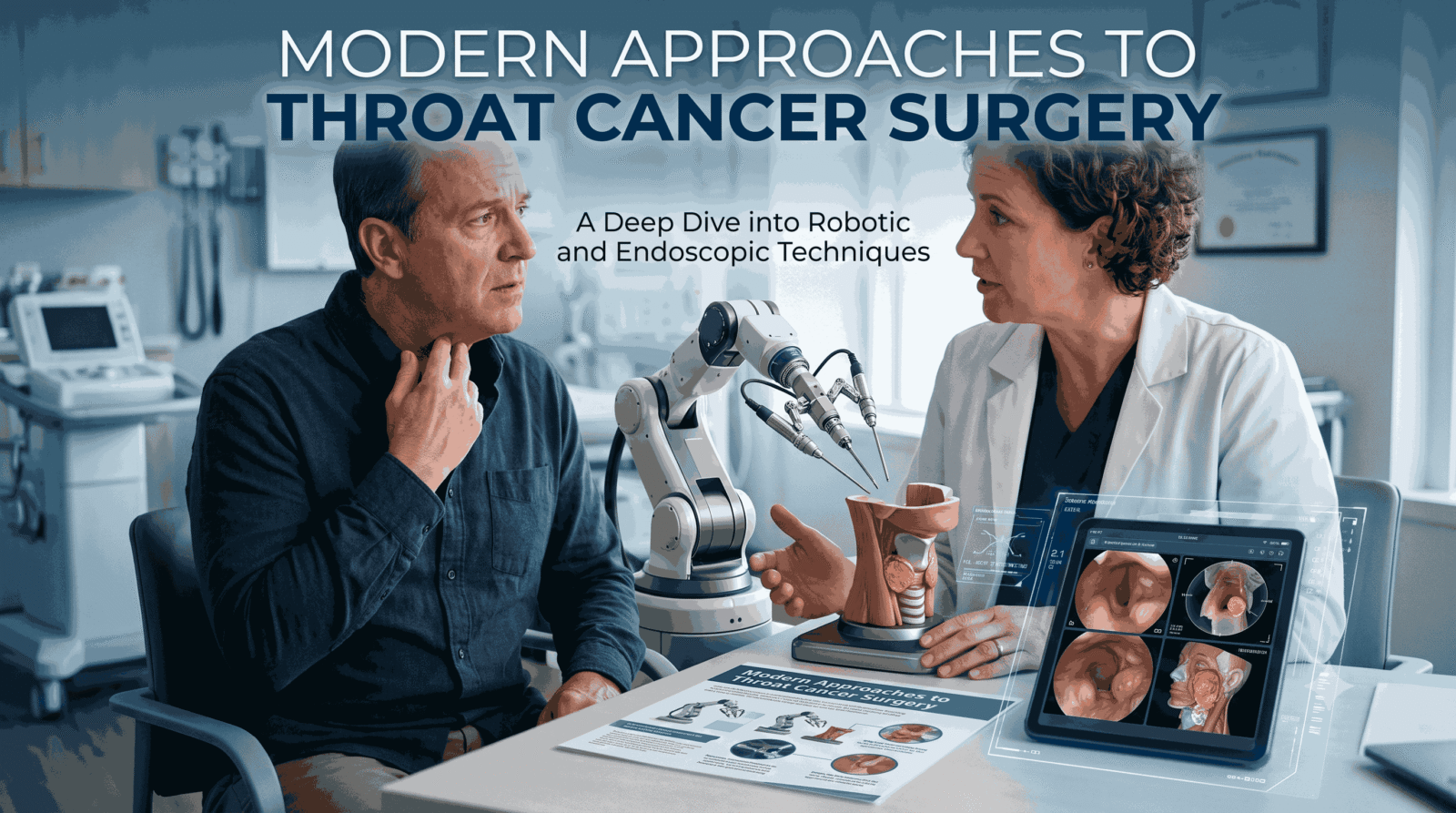
Throat cancer can affect important structures involved in speaking, swallowing, breathing, and eating. For this reason, treatment is not simply about removing a tumor. Modern cancer care aims to control the disease while preserving as much normal function and quality of life as possible.
Throat Cancer Surgery remains an important treatment option for selected patients, but the surgical approach depends on the location, size, stage, and characteristics of the tumor. Depending on the individual case, surgery may be performed through traditional open techniques or through minimally invasive approaches such as transoral laser microsurgery and transoral robotic surgery (TORS). Surgery may also be combined with radiation therapy, chemotherapy, immunotherapy, or other treatments.
Advances in surgical techniques and multidisciplinary cancer care have made it possible to personalize treatment more carefully than in the past.
What Is Throat Cancer?
The term “throat cancer” can refer to cancers arising in different parts of the throat and nearby structures. These may include cancers of the oropharynx, hypopharynx, and larynx, depending on the specific anatomical location.
Symptoms can vary according to where the cancer develops. Possible symptoms include:
- Persistent sore throat
- Difficulty or pain while swallowing
- A change in voice or persistent hoarseness
- Difficulty swallowing food
- A lump or swelling in the neck
- Ear pain without an obvious ear problem
- Unexplained weight loss
- Persistent cough
- Breathing difficulties in advanced cases
These symptoms can have many causes other than cancer. However, persistent or worsening symptoms should be evaluated by a qualified healthcare professional.
How Is Throat Cancer Diagnosed?
Before deciding whether surgery is appropriate, doctors need to understand exactly where the cancer is located and how extensively it has developed.
Diagnosis commonly involves a physical examination and visualization of the throat or larynx, often using an endoscope. A biopsy is generally needed to confirm cancer.
Imaging such as CT, MRI, PET-CT, or other appropriate scans can help determine the size and extent of the tumor and whether lymph nodes or other areas are involved.
For oropharyngeal cancers, HPV or p16 testing can also be important because HPV status can influence staging, prognosis, and treatment planning. Current multidisciplinary guidance emphasizes detailed clinical assessment, tissue diagnosis, imaging, and functional evaluation when considering surgical treatment.
When Is Throat Cancer Surgery Considered?
Surgery may be considered when the tumor can be removed safely and when surgical treatment is expected to provide meaningful cancer control.
The decision depends on several factors, including:
- Location of the tumor
- Tumor size
- Cancer stage
- Lymph-node involvement
- Whether the cancer has spread
- Relationship of the tumor to important nerves and blood vessels
- The patient’s overall health
- Expected effects on speech and swallowing
- Whether other treatments are required
For some early-stage tumors, surgery may be used as the primary treatment. In other cases, surgery may be combined with radiation or systemic treatment.
Importantly, Throat Cancer Surgery is not automatically the best option for every patient. In some situations, radiation-based treatment or combined treatment may provide an appropriate alternative. Treatment decisions should therefore be individualized by a multidisciplinary cancer team.
Transoral Laser Microsurgery
One modern approach for selected throat and oropharyngeal tumors is transoral laser microsurgery (TLM).
Instead of making a large external incision, the surgeon accesses the tumor through the mouth using specialized instruments and a microscope. A laser can be used to remove the tumor with precision.
TLM may be appropriate for carefully selected tumors that can be adequately accessed through the mouth.
Potential advantages include avoiding some of the tissue disruption associated with traditional open surgery. However, the technique is not suitable for every tumor. The location, size, depth, and accessibility of the cancer must be carefully assessed before choosing this approach.
Current clinical guidance recognizes transoral techniques, including TLM and TORS, as important surgical options for selected oropharyngeal cancers.
Transoral Robotic Surgery
Transoral robotic surgery (TORS) is another minimally invasive approach used for selected tumors of the oropharynx and certain other head and neck locations.
During TORS, specialized robotic instruments are introduced through the mouth. The surgeon controls the instruments from a console, allowing precise movements and visualization of difficult-to-reach areas.
The objective is to remove the tumor while limiting unnecessary disruption of surrounding structures.
TORS has become an important part of multidisciplinary management for appropriately selected oropharyngeal cancers. A 2025 American Society of Clinical Oncology guideline specifically addresses patient selection, evaluation, adjuvant treatment, and the role of TORS in primary and recurrent oropharyngeal squamous cell carcinoma.
Recent European consensus guidance similarly supports TORS for selected, accessible tumors and emphasizes careful assessment of factors such as tumor location, exposure, functional considerations, and surgical feasibility.
Why Is Minimally Invasive Surgery Important?
The throat contains structures that are essential for everyday functions. Aggressive treatment can sometimes affect swallowing, speech, breathing, or other aspects of quality of life.
For suitable patients, minimally invasive surgery may allow surgeons to access and remove certain tumors while avoiding some of the tissue disruption associated with traditional approaches.
However, minimally invasive does not mean risk-free, and it does not mean that robotic or laser surgery is always superior.
The primary goals remain:
- Removing the cancer adequately
- Achieving appropriate surgical margins
- Protecting important structures when possible
- Reducing unnecessary treatment-related effects
- Preserving swallowing, speech, and other functions where feasible
The most appropriate surgical technique should therefore be selected based on the individual tumor rather than simply choosing the newest technology.
Neck Dissection May Also Be Necessary
Throat cancer can spread to lymph nodes in the neck. If lymph-node involvement is present or the risk of hidden lymph-node disease is significant, surgery may include a neck dissection.
During this procedure, selected lymph nodes and surrounding tissues are removed to treat or evaluate possible cancer spread.
The exact extent of neck surgery depends on the location and stage of the primary tumor, the lymph nodes involved, and other clinical factors.
The information obtained from the surgical specimen can also help doctors determine whether additional treatment, such as radiation or chemotherapy, may be appropriate.
Surgery and Reconstruction
Some larger or more advanced tumors may require removal of a substantial amount of tissue. In such cases, reconstruction can become an important part of treatment.
Reconstructive procedures may use tissue from another part of the patient’s body to rebuild the affected area. The goal is to restore structure and, where possible, functions such as swallowing, speaking, chewing, or breathing.
Reconstruction is highly individualized. The type of reconstruction depends on the location and extent of the surgical defect and the patient’s overall treatment plan.
Can Surgery Be Combined With Other Treatments?
Yes. Surgery does not always represent the entire treatment plan.
Depending on the pathology and stage, additional treatment may be recommended after surgery. This may include radiation therapy, chemotherapy, targeted therapy, or immunotherapy.
The need for additional treatment can depend on factors such as:
- Surgical margins
- Lymph-node involvement
- Extracapsular or extranodal extension
- Tumor characteristics
- Stage
- HPV status in relevant oropharyngeal cancers
- Other high-risk pathological findings
This is one reason why treatment planning should involve multiple specialists rather than relying on surgery alone.
Recovery After Throat Cancer Surgery
Recovery depends greatly on the type and extent of surgery.
Patients may temporarily experience difficulty swallowing, changes in speech, throat discomfort, or reduced ability to eat normally. Some patients may require nutritional support during recovery.
Speech and swallowing specialists can play an important role in rehabilitation. Nutritional support may also be necessary to help maintain adequate calorie and protein intake.
Before treatment, functional assessment can help establish a baseline and assist the medical team in choosing an appropriate treatment strategy. ASCO’s guidance specifically recommends pretreatment speech and swallowing assessment for patients being evaluated for TORS.
Regular follow-up is also important after treatment to monitor healing, manage side effects, assess functional recovery, and look for any signs of recurrent disease.
How Doctors Choose the Right Surgical Approach
There is no single surgical technique that works for every throat cancer.
A multidisciplinary team may consider:
- The exact location of the tumor
- Tumor size and depth
- Stage and lymph-node status
- HPV or other relevant biological characteristics
- Accessibility through the mouth
- The patient’s mouth opening and anatomy
- Expected swallowing and speech outcomes
- Previous treatments
- General health and personal preferences
For some patients, open surgery may provide the safest and most effective approach. For others, TLM or TORS may offer a suitable minimally invasive alternative.
The goal is not simply to use advanced technology but to select the technique that provides the best balance between cancer control, safety, and preservation of function.
The Importance of Multidisciplinary Cancer Care
Throat cancer can be complex because treatment can affect several important functions. A multidisciplinary team may include a head and neck surgeon, medical oncologist, radiation oncologist, radiologist, pathologist, dentist, speech and swallowing specialist, dietitian, and rehabilitation professionals.
Working together allows the team to evaluate both the cancer and the patient’s functional needs.
Modern treatment planning increasingly focuses on personalized care rather than applying the same treatment to every patient. Current guidelines for TORS and head and neck cancer emphasize multidisciplinary evaluation and careful patient selection.
Conclusion
Modern Throat Cancer Surgery has evolved considerably, with techniques such as transoral laser microsurgery and transoral robotic surgery providing minimally invasive options for selected patients. These approaches can help surgeons access certain tumors through the mouth while aiming to preserve important structures and functions.
However, advanced technology is only one part of cancer treatment. The best approach depends on the tumor’s location, size, stage, biological characteristics, lymph-node involvement, and the patient’s overall health and functional priorities.
Some patients may benefit from surgery alone, while others may require surgery followed by radiation, chemotherapy, immunotherapy, or another treatment. A multidisciplinary evaluation is therefore essential for developing an individualized treatment plan.
Anyone diagnosed with throat cancer should discuss the available treatment options with a qualified head and neck cancer team. Early evaluation, accurate staging, and carefully planned treatment can help provide the best possible opportunity for cancer control while protecting quality of life.