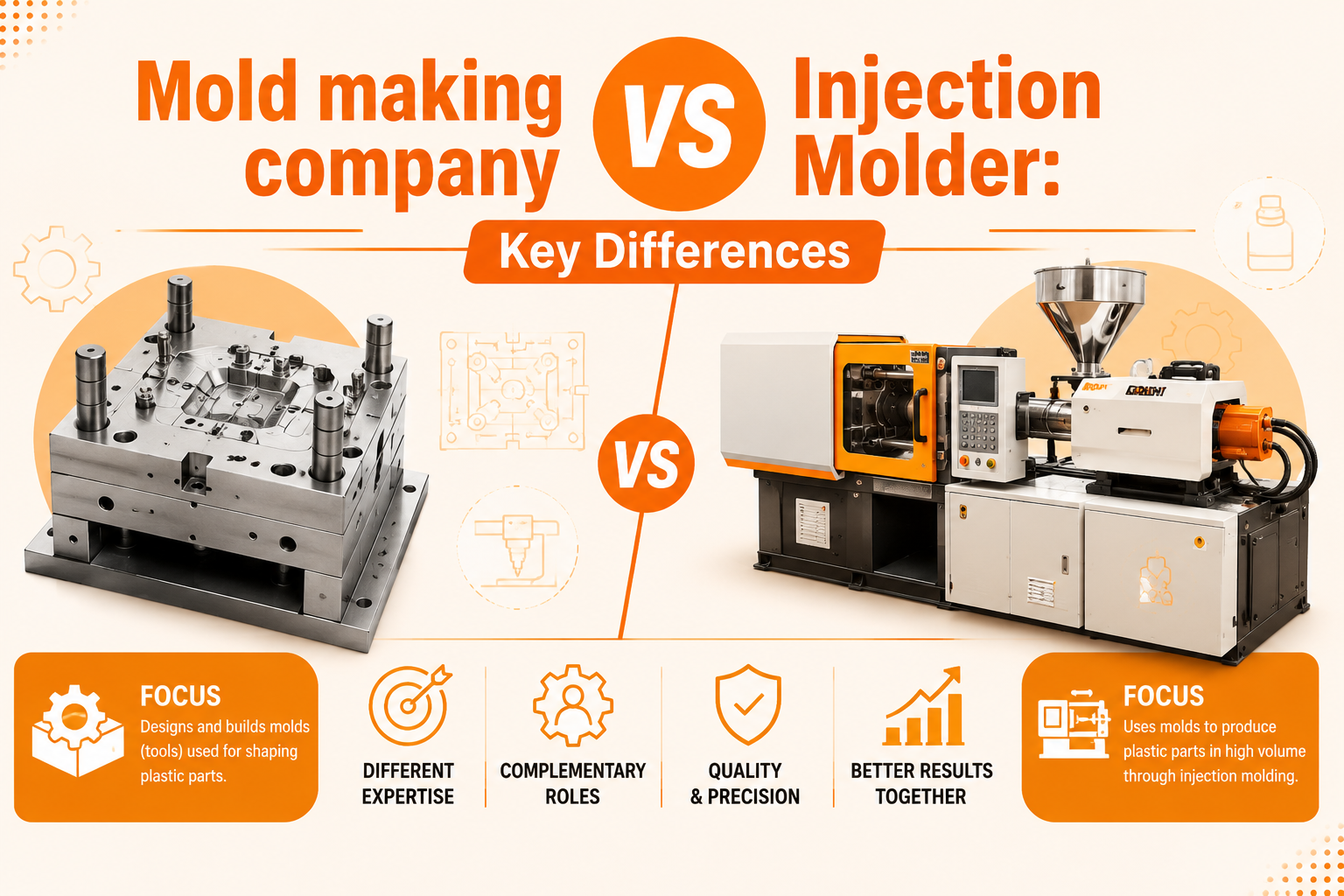
In plastic production, engineers and entrepreneurs often get confused about one thing: the difference between a mold making company and an injection molder. On the surface, they seem to work under the same roof.
However, understanding the difference between these two is critical for budget, timeline, and part quality. While some companies provide both services, they are fundamentally different disciplines.
One focuses on the precision tooling that shapes the plastic. The other handles the high-volume manufacturing process itself. Pick the wrong partner—or mix up their roles—and your project can crash. This guide breaks down the key differences to help you decide where to invest your tooling budget.
Why Specialization Matters in Manufacturing
When you search for custom mold maker companies, you are looking for makers who work in steel. These suppliers employ master toolmakers who understand shrinkage rates, draft angles, and gate locations. Their work ends when the mold ejects a perfect test shot. They do not care about cycle time optimization or resin drying—that is the molder’s work.
The risk of using a production house to manufacture your mold is that they may rush the tool to get it into a press. Custom mold-making services focus on longevity; they ensure the tool is hard enough to withstand millions of cycles. A true mold-making company will also keep detailed documentation of steel types and heat treatment certifications.
If you require complex geometries with tight tolerances, you should avoid vertical integrators who claim to do everything quickly. Speed often sacrifices the steel quality required for high-wear applications.
Mold-making company vs. Injection Molder: The Ultimate Comparison
|
Aspect / Keyword Focus |
Mold-making company (The Tooling Expert) |
Injection Molder (The Production Expert) |
|
Primary Objective |
A mold-making company focuses on developing the physical steel tool. Their work ends when the mold is finished and tested. They prioritize steel integrity, surface finish, and precision geometry. |
An injection molder focuses on using existing molds to make parts. Their goal is cycle time efficiency, resin drying, and output volume. They do not typically develop molds. |
|
Steel & Materials |
Custom mold maker companies invest heavily in hardened steel (e.g., P20, H13) to ensure the mold lasts millions of cycles. They understand metallurgy and heat treatment for wear resistance. |
A molder rarely touches the steel. They care about the plastic resin (ABS, Nylon, Polycarbonate). For precision injection molding, the molder ensures the resin flows correctly but does not modify the steel. |
|
Geometric Complexity |
If you need complex shut-offs, unscrewing cores, or lifter angles, you need custom mold-making services. Toolmakers use CNC and EDM to carve intricate internal features into the steel. |
Injection molders cannot alter complex geometries. They can only replicate what the mold-making company created. If a feature is missing, they cannot “add” it via the injection press. |
|
Repair & Maintenance |
When a mold breaks (e.g., a cracked core or damaged gate), only a mold-making company can perform welding, insert replacement, or re-machining. They are the “emergency room” for broken tools. |
A standard injection molder lacks the machining centers to repair steel. They would have to outsource the repair back to a mold-making company, causing weeks of downtime for plastic injection molding manufacturing. |
|
Cost Structure |
Paying a mold-making company is a high-ticket capital investment. You pay for toolmaker hours and machine time. You own the physical asset (the mold) outright. |
You pay a molder per part. Costs include machine time, labor, and resin. For long-term plastic injection molding manufacturing, the per-part price is low, but the mold must already exist. |
|
Tolerances & Quality |
Precision injection molding relies on the mold being perfect first. A top-tier mold-making company holds steel tolerances within 0.0002 inches. They ensure the mold fits like a precision lock. |
Molders hold tolerances on the plastic part. However, if the mold was made poorly, the molder cannot fix the tolerance via pressure. Garbage in (bad mold) equals garbage out (bad parts). |
|
Speed to Market |
Finding a skilled mold-making company usually requires 6–12 weeks for a complex tool. They are slower because they prioritize steel hardness over speed. |
Production is fast. Once the mold is finished, a molder can run thousands of parts per hour using plastic injection molding manufacturing processes. But they are useless without the mold. |
|
Risk of Combined Shops |
A pure mold-making company has no incentive to use soft steel. They want the tool to last. However, they may lack the large presses needed for high-volume validation. |
Companies providing both services often cut corners. They may use cheaper steel because they plan to run the mold briefly. Always verify if custom mold maker companies are truly separate from production lines. |
|
Best Use Case |
Hire a mold-making company for new product development, high-volume medical parts, or automotive components. Use their custom mold-making services to develop a basic tool first. |
Hire an injection molder after the tool is made. Send your mold to an expert in precision injection molding to run the parts. Keep the mold-making company on retainer for future repairs. |
Conclusion: Which One Do You Need?
Ultimately, the decision comes down to your project stage. If you are designing a new product and have not yet cut metal, you need to hire a mold-making company immediately. Look for custom mold maker companies with experience in your specific resin (glass-filled nylon destroys soft molds).
Use their custom mold making services to make a basic tool capable of millions of shots. Only after the tool passes the tryout phase should you search for a precision injection molding manufacturer to run the parts.
Remember: The mold is your asset. Protect that asset by ensuring it is made by an expert who designs nothing but molds. Your part quality will never exceed the quality of the mold that created it; therefore, always prioritize the mold-making company first, and the molder second.
Ready to Get It Right from Day One?
Don’t risk your tooling investment with the wrong partner. Work with experts who understand precision, durability, and real-world production demands. PLASTIC INJECTION MOLDING delivers reliable custom mold making and high-quality parts manufacturing tailored to your project needs.
📞 +1 (917)-993-9690
📧 info@plastic-injectionmolding.com
Start your project with confidence—reach out