 Financial markets play a central role in the global economy, connecting businesses that need capital with investors seeking opportunities to grow their wealth. From company shares and government bonds to investment funds and derivatives, financial instruments provide different ways to invest, manage risk, and achieve financial objectives.
For individuals who want to build a career in finance, understanding these instruments is an important starting point. A Securities and Investment course can introduce learners to financial markets, investment products, portfolio management, and the principles behind responsible investment decisions.
CIFA offers a Securities and Investment course designed to help learners develop foundational knowledge of investment markets and financial products. Whether you are a graduate exploring financial services or a professional looking to strengthen your investment knowledge, structured training can help you understand how markets operate and how financial decisions are evaluated.
What Is a Securities and Investment Course?
A securities and investment course introduces learners to the financial instruments traded in investment markets and the principles used to evaluate them. It explores how investors assess opportunities, understand potential risks, and select investments that align with financial objectives.
Securities generally include instruments such as shares and bonds, while investment products can also include collective investment schemes, derivatives, and other financial arrangements.
Understanding these products involves more than knowing their definitions. Investors and financial professionals need to consider how instruments are valued, how market conditions affect their prices, and what risks may arise from different investment decisions.
A comprehensive investment training course can introduce topics such as:
-
Equities and shares
-
Bonds and fixed-income investments
-
Investment funds and mutual funds
-
Derivatives and other financial instruments
-
Portfolio management and diversification
-
Economic indicators and market movements
-
Financial regulation and ethical standards
-
Investment taxation and financial advice
By studying these subjects together, learners can develop a broader understanding of how financial markets function and why investment decisions require careful analysis.
What Does CIFA’s Securities and Investment Course Cover?
CIFA’s programme covers several key areas of the financial services industry. The curriculum connects market fundamentals with investment products, regulatory responsibilities, and the considerations involved in providing financial advice.
1. The Financial Services Sector
Understanding the financial services sector provides context for studying securities and investments. Financial institutions perform different functions, including accepting deposits, arranging investments, managing assets, facilitating payments, and supporting businesses seeking finance.
This section introduces the role of financial markets and the organisations that operate within them.
Learners can develop an understanding of:
-
The purpose of financial markets.
-
The roles of banks, investment firms, and other institutions.
-
How companies and governments raise capital.
-
The relationship between savers, borrowers, and investors.
-
The importance of financial services to economic activity.
This background helps learners recognise how investment products fit within the wider financial system.
2. The Economic Climate
Investment markets are influenced by economic conditions. Inflation, interest rates, employment figures, economic growth, and international developments can all affect investor expectations and financial asset prices.
For example, rising interest rates may influence the value of existing bonds and change the attractiveness of different investments. Similarly, weaker economic growth can affect corporate earnings and investor confidence.
The economic climate section helps learners understand why financial professionals monitor economic indicators and consider broader market conditions when evaluating investments.
Important concepts include inflation, interest rates, economic growth, monetary policy, and global market developments.
Learning how these factors interact can help learners interpret financial news and understand why the same investment may perform differently under different economic conditions.
3. Equities and Shares
Equities represent ownership interests in companies. When investors purchase shares, they gain exposure to the financial performance of the businesses concerned. Depending on the shares and company circumstances, investors may benefit from capital appreciation and dividends, but they may also experience losses.
Equity investment analysis involves examining factors that may influence a company’s value and its future prospects.
Learners can explore:
-
How shares work in financial markets.
-
The relationship between company performance and share prices.
-
The difference between capital gains and dividend income.
-
The role of stock exchanges.
-
Market risk and volatility.
-
The importance of diversification.
Understanding equities is useful for anyone interested in investment analysis, brokerage, wealth management, or portfolio-related work.
However, share prices can change significantly, and past performance does not guarantee future returns. Investment decisions therefore require consideration of risk, financial objectives, and the investor’s circumstances.
4. Bonds and Fixed-Income Investments
Bonds are financial instruments commonly used by governments and companies to raise money. Investors who purchase bonds generally lend money to an issuer in exchange for agreed payments and repayment terms, subject to the instrument’s conditions and the issuer’s ability to meet its obligations.
Bonds can differ according to their maturity, interest arrangements, credit quality, and market price.
A securities course introduces the fundamentals of bond investing and explains why these instruments are used in different investment strategies.
Key considerations include interest rates, bond prices, credit risk, maturity, and income payments.
For instance, changes in market interest rates can affect the market value of existing bonds. Investors must also consider whether an issuer is financially able to make the required payments.
Learning about bonds helps learners understand fixed-income markets and the role these investments may play in diversified portfolios.
5. Other Markets and Investment Products
Financial markets offer a wide range of investment opportunities beyond shares and conventional bonds. Depending on their objectives and circumstances, investors may consider different asset classes and financial products.
These may include alternative investments, foreign exchange-related products, commodities, and other market instruments.
Each category has distinct characteristics. Some products may be more complex, less liquid, or more volatile than traditional investments.
Studying different markets helps learners compare investment features, recognise potential risks, and understand why product selection should reflect financial objectives rather than short-term market trends alone.
6. Derivatives
Derivatives are financial instruments whose value depends on an underlying asset, rate, index, or other reference measure. They are used by different market participants to manage exposure, adjust investment positions, or seek returns from market movements.
Common derivative instruments include futures, options, forwards, and swaps.
A futures contract generally involves an agreement to transact an underlying asset at a specified future time under standardised terms. Options provide rights under defined conditions, while forwards and swaps allow parties to agree on particular future transactions or cash-flow exchanges.
Derivatives can serve useful risk-management purposes, but they also introduce complexity and may involve substantial losses.
Understanding their basic structure helps learners appreciate how derivatives interact with securities markets and why careful risk assessment is essential.
7. Investment Funds and Portfolio Management
Investment funds allow investors to gain exposure to a collection of assets through a pooled investment structure. Depending on the fund, these assets may include shares, bonds, or other financial instruments.
Funds can differ in their investment objectives, management styles, costs, liquidity, and risk profiles.
Portfolio management involves selecting and monitoring investments to support a defined financial objective. It requires consideration of diversification, expected returns, investment risk, time horizons, and changing market conditions.
Learners can explore the importance of asset allocation, diversification, investment objectives, and portfolio risk.
Diversification can help reduce the impact of poor performance in a single investment, although it cannot eliminate all investment risk. A suitable portfolio depends on the individual investor’s circumstances and objectives.
8. Regulation of Financial Services
Financial markets operate within regulatory frameworks designed to support market integrity, protect consumers, and establish standards for financial businesses.
Understanding regulation is important for anyone who intends to work in financial services. Professionals need to recognise their responsibilities and the importance of acting ethically when handling financial products and client information.
This section introduces the purpose of financial regulation, compliance principles, and professional conduct.
Relevant topics include regulatory responsibilities, ethical decision-making, consumer protection, and responsible financial practices.
Regulatory knowledge also helps learners appreciate why financial advice and investment activities must be conducted within the applicable legal and professional framework.
9. Taxation, Investment Wrappers, and Trusts
Tax considerations can influence the financial outcome of an investment. The amount an investor retains may depend on income, capital gains, the type of investment, the account or arrangement used, and the applicable tax rules.
Investment wrappers can provide particular tax treatments, subject to their conditions. Trusts may also be relevant in estate planning and the management of assets for beneficiaries.
This area introduces learners to the relationship between taxation and investment planning.
Understanding these topics can help learners recognise why financial decisions should consider more than headline returns. The relevant rules vary according to circumstances and jurisdiction, so specific decisions may require qualified professional advice.
10. Other Financial Products and Financial Advice
Financial professionals need to understand the products they discuss and the responsibilities associated with helping clients make decisions.
Financial advice involves considering a client’s financial position, objectives, needs, and attitude towards risk. The suitability of an investment depends on the individual circumstances involved rather than on potential returns alone.
The course also introduces different financial products and the role of advice in helping individuals understand their options.
Learners can develop an appreciation of clear communication, ethical conduct, risk awareness, and the importance of explaining financial concepts accurately.
Why Study Securities and Investment?
Develop a Better Understanding of Financial Markets
Studying securities and investment can help learners understand how financial products are created, valued, and traded. It also introduces the economic factors that influence market behaviour.
This knowledge can make financial news and investment discussions easier to interpret.
Build Investment Analysis Skills
Investment analysis involves evaluating opportunities while considering potential returns and risks. A structured course can help learners develop familiarity with financial instruments and the factors that influence their performance.
These concepts provide a useful starting point for further learning in investment research, portfolio management, and related disciplines.
Understand Risk and Diversification
Every investment carries some form of risk. Understanding how risk differs between equities, bonds, funds, and derivatives is an important part of making informed financial decisions.
Learning about diversification and portfolio construction can help learners appreciate why investment strategies must balance objectives against uncertainty.
Strengthen Financial Services Knowledge
The course connects investment concepts with financial regulation, taxation, and financial advice. This wider perspective can be valuable for learners seeking to understand the responsibilities associated with investment-related work.
Who Should Consider a Securities and Investment Course?
CIFA’s Securities and Investment course may be relevant to several groups.
Finance students and graduates: Learners beginning their careers can use the course to establish a foundation in financial markets and investment instruments.
Aspiring investment professionals: Individuals interested in investment analysis, securities, or portfolio support can develop knowledge of commonly used financial products.
Financial advisers and wealth management learners: Understanding securities can help learners appreciate how investment products fit within wider financial planning objectives. Additional qualifications or regulatory permissions may be required for particular advisory activities.
Traders and brokers: People exploring market-related work may benefit from understanding securities, derivatives, and the factors affecting financial asset prices.
Risk management professionals: Learners interested in risk-related work can build their understanding of market exposure and the characteristics of different investments.
Corporate finance professionals: Employees involved in financial decisions may find investment knowledge useful when considering capital markets, securities, and economic conditions.
The course is also relevant to personal investors who want to improve their financial knowledge. Education can support informed decision-making, but it cannot remove market uncertainty or guarantee investment success.
What Career Opportunities Could This Knowledge Support?
Knowledge of securities and investment may support exploration of various financial services career paths, depending on previous experience, qualifications, and employer requirements.
Potential areas include:
-
Investment operations.
-
Financial services administration.
-
Securities administration.
-
Investment research support.
-
Portfolio support.
-
Wealth management support.
-
Brokerage operations.
-
Financial risk support.
-
Banking and investment services.
-
Financial consultancy support.
Completing a course does not guarantee a job or automatically qualify someone to conduct regulated financial activities. Some roles require additional professional qualifications, relevant experience, or authorisation.
Prospective learners should review job descriptions and confirm the requirements for their preferred roles before choosing further training.
Benefits of Studying Online with CIFA
Online learning can help people fit professional education around employment, existing studies, and personal responsibilities.
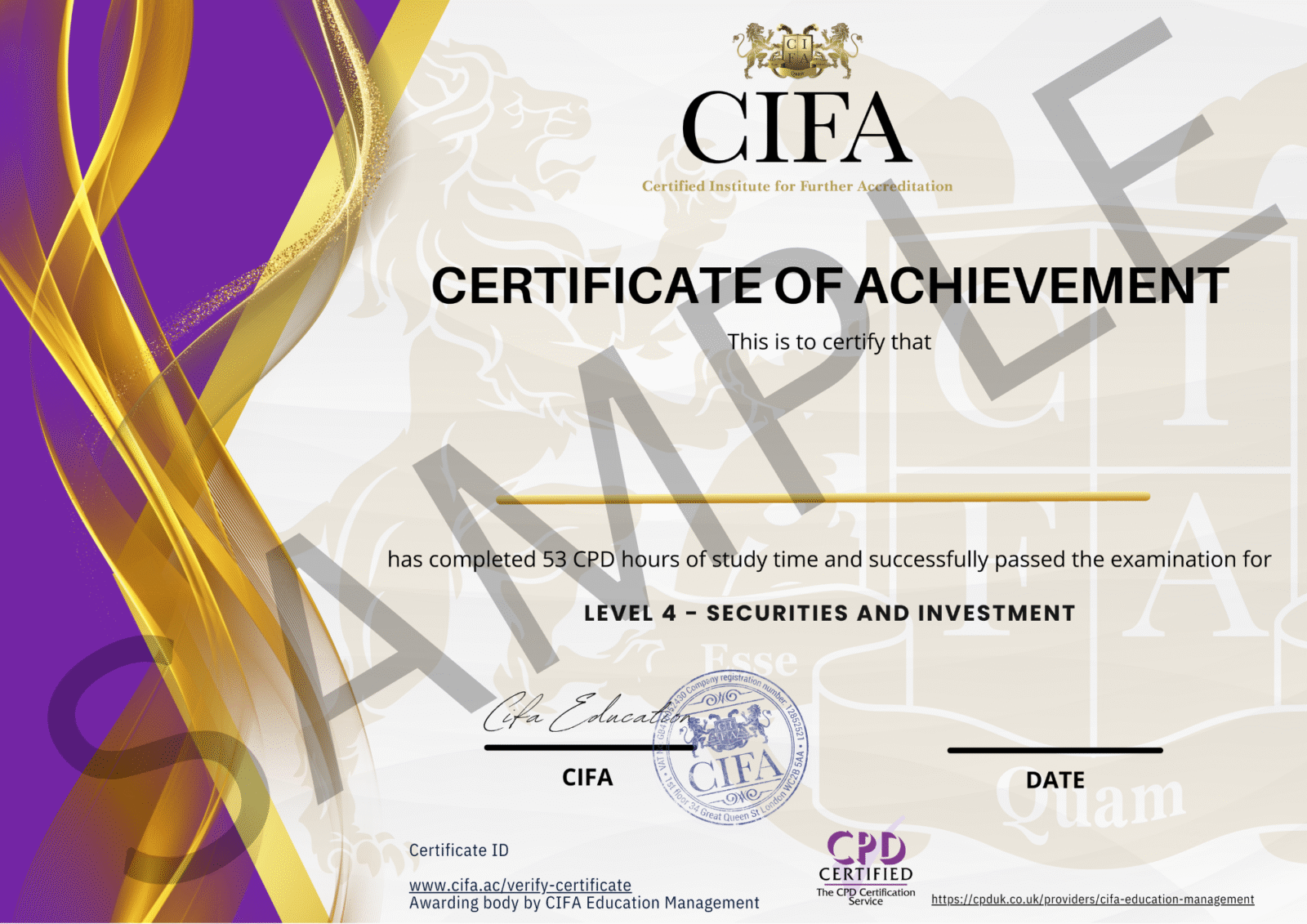
CIFA lists its Securities and Investment course as a digital programme with 53 CPD hours, chapter-based mock exams, lifetime portal access, and a certificate of achievement after the learner successfully completes and passes the required exam.
The course is listed at intermediate level. Learners should check the current course information for the latest fees, assessment arrangements, and any additional study-support options.
Online learning can offer several benefits:
Flexible study planning: Learners can organise their study routine around other commitments.
Structured subject coverage: The programme brings together investment products, market fundamentals, regulation, taxation, and financial advice.
Revision opportunities: Chapter-based mock exams can help learners assess their understanding and identify topics that require further attention.
Professional development: Structured learning may form part of a wider plan to build financial knowledge and prepare for further education.
To make the most of an online course, learners should review each topic carefully, make notes, practise applying financial concepts, and regularly test their understanding.
How to Get the Most from an Investment Course
Completing a course is more valuable when learners develop consistent study habits and connect the concepts with practical examples.
Follow financial market developments. Read about economic indicators, company announcements, and interest-rate changes to understand how external factors may influence investment markets.
Compare financial instruments. Examine the differences between equities, bonds, funds, and derivatives, including their potential benefits, costs, and risks.
Practise risk assessment. When reviewing an investment scenario, consider uncertainty, liquidity, time horizon, and the investor’s financial objectives.
Understand regulation and ethics. Explore why financial professionals must consider applicable rules, client interests, and professional responsibilities.
Revise regularly. Use practice questions and personal notes to identify gaps in your knowledge.
Plan your next step. After completing the course, review your career goals and consider whether additional training or relevant work experience would help you progress.
These habits can help learners build a stronger understanding of investment concepts and their practical applications.