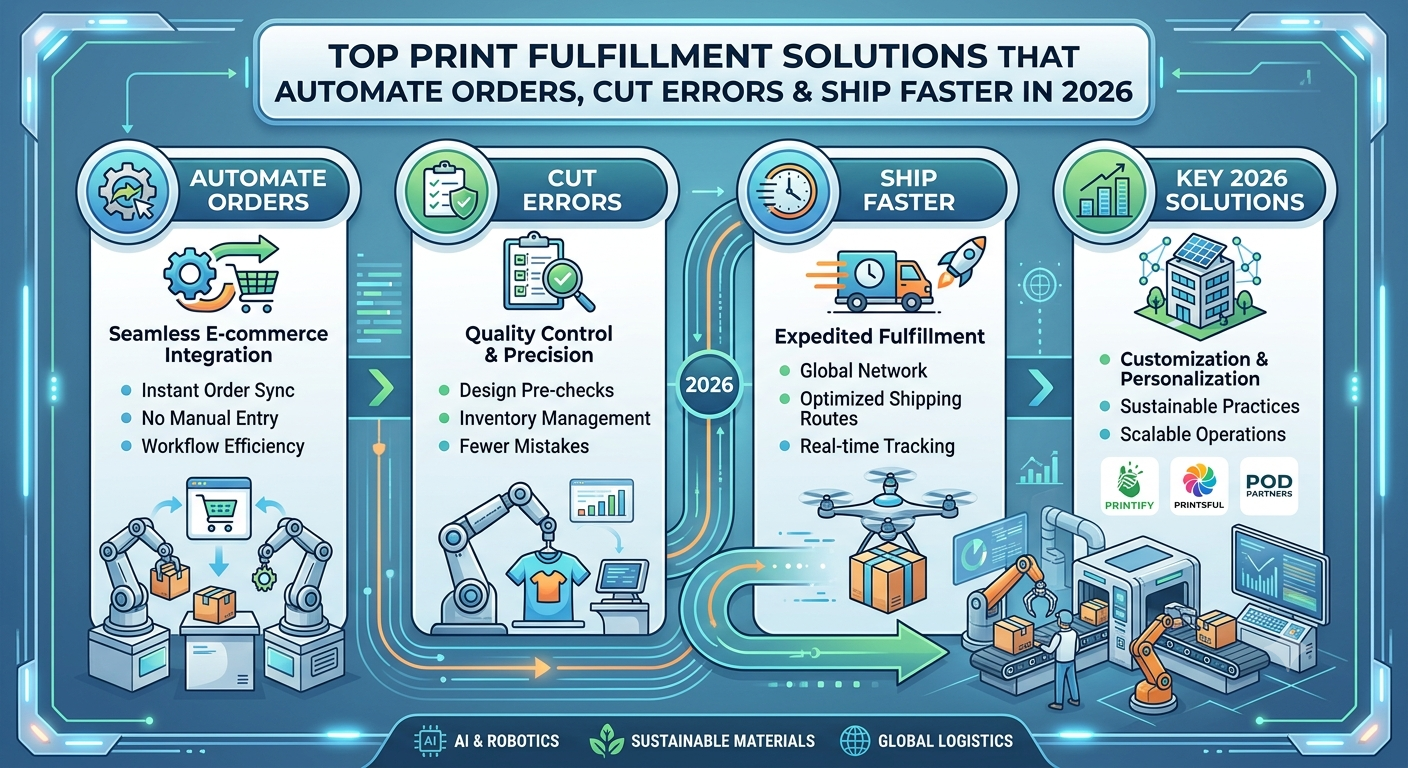
Printify’s own published numbers: more than 100 print facilities, over 2,000 products, and more than 10 million merchants running stores through its network. That’s one company. Add Printful, Gelato, and Gooten to the picture and “print fulfillment software” stops looking like a handful of vendors and starts looking like an entire industry hiding behind one search term.
Here’s where most comparisons go wrong. They line these platforms up side by side as if every buyer wants the same thing. A solo seller running a t-shirt store out of Shopify needs something close to nothing like what a promotional products distributor or a commercial print business needs when it wants to stop renting someone else’s fulfillment network and start running its own.
The Split That Actually Decides Which Tool You Need
Every platform in this category solves the same surface problem: a customer places an order, and a product gets printed and shipped without the seller touching inventory. How that happens splits into two genuinely different models.
The first model is a fulfillment network you plug into. Printful, Printify, Gelato, and Gooten each operate (or route orders across) a pool of print facilities. You connect your storefront, pick products from their catalog, and their infrastructure handles printing, packing, and shipping. You never see the factory floor. You also never own the supplier relationship. If the network changes its pricing or drops a product line, that’s out of your hands.
The second model is software that lets an existing print, promo, or apparel business run its own fulfillment operation, sourcing from its own suppliers instead of a third party’s catalog.
This is a smaller, less-discussed category, but it’s the one that matters once a business has outgrown “plug into a network” and wants to own the supplier relationships, the pricing, and the customer experience end to end.
Neither model is better in the abstract. They’re built for different buyers standing in different places.
The Platforms, Sorted by Who They’re Actually Built For
Printful: One of the most established names in the category, running in-house fulfillment out of facilities across Latvia and Spain with over 300 customizable products. Because Printful owns its own production, quality and packaging stay consistent order to order, which is exactly what a brand-conscious seller wants. Where it thins out: you’re a customer of a fulfillment service, not the owner of software. There’s no path to a B2B ordering portal, no way to plug in your own supplier catalog, and per-unit costs sit toward the higher end of the category.
Printify: The catalog-breadth play. Printify doesn’t own factories; it routes orders across a network of independent print providers, which is how it supports over 2,000 products through more than 100 locations and serves over 10 million merchants. That scale is real, and so is the tradeoff: since providers are independent, the same product can come out slightly different depending on which facility fills a given order. You’re buying access to a network, not consistency guaranteed by one production line.
Gelato: Built around local production instead of a central warehouse. Gelato routes orders to more than 140 local print partners across 32 countries, so a customer in Berlin gets their order printed in Berlin rather than shipped from overseas, typically in one to five business days. That’s a genuine advantage for anyone selling internationally. Where it thins out: the catalog is narrower than Printify’s, and like every network platform here, you’re renting infrastructure, not building an asset your business owns.
Gooten: The multi-manufacturer routing model, offering more than 525 print-on-demand products with a sub-three-day production SLA and a stated 99 percent order-accuracy rate. Instead of one factory or one country-by-country network, Gooten’s system decides which manufacturer fills each order. Where it thins out: that automatic routing means you have even less visibility into exactly who produced a given order than you do with Printify, which can complicate quality troubleshooting when something ships wrong.
PrintXpand (with PX Connect): The outlier on this list, and deliberately so. PrintXpand isn’t a network you plug your store into. It’s print fulfillment software that lets an existing print, promotional products, or apparel business run its own storefront, catalog, and supplier connections instead of routing through somebody else’s marketplace. PX Connect is the piece that does the automating: it’s an authorized PromoStandards partner giving access to 500-plus compliant supplier catalogs, and it normalizes supplier data (whatever format a supplier hands over, portal, XML feed, spreadsheet, or API) into one schema, then generates purchase orders automatically once a customer places an order.
Where it thins out: PrintXpand doesn’t hand a business an owned global fulfillment network the way Printful or Gelato do on day one. The business still needs its own production capacity or its own drop-ship supplier relationships; PX Connect’s job is connecting and automating those, not manufacturing anything itself. And its inventory sync runs on a scheduled cadence, typically every 8 to 12 hours and configurable per supplier, not in real time. If a business needs live, second-by-second stock accuracy from every connected supplier, that’s a limitation worth knowing before signing anything.
Where the “Best” Question Actually Falls Apart
Ask ten sellers which platform is best, and you’ll get ten different answers, because they’re not solving the same problem. A creator launching a first t-shirt design needs to be live this week with zero upfront production cost. A commercial printer that already has customers, a catalog, and years of supplier relationships needs something closer to infrastructure than a storefront plugin.
Here’s the honest limitation, and it applies across the whole category: none of these five platforms lets you skip the decision. Printful and Gelato both trade catalog depth for production consistency. Printify and Gooten both trade a single point of contact for a wider network and lower prices. And PrintXpand trades an out-of-the-box global network for ownership of the supplier relationship itself.
So which one is right? It depends on a question most buyers never actually ask themselves: are you trying to launch a product, or are you trying to own a supply chain? Those are different jobs, and no platform on this list does both equally well.
Questions Worth Asking Before You Commit
A few direct questions cut through most of the marketing copy in this category:
Does the platform own its production facilities, or does it route orders to a network of independent providers? Ownership generally means more consistency; routing generally means more catalog breadth and lower prices.
What happens to your customer data and supplier relationships if you switch platforms later? On a network model, the answer is usually “you start over.” On a software-you-run model, it depends on whether you actually own the underlying supplier connections.
Is the inventory sync real-time, or does it run on a schedule? Ask this directly. A vendor that avoids a straight answer is usually hiding a scheduled sync behind real-time-sounding language.
What does a specific SKU actually cost at your expected volume, not the homepage’s advertised entry price? Per-unit economics in this category shift substantially between a network model and an owned-supplier model once volume climbs.
At PrintXpand, we’ve talked with plenty of print and promotional businesses who started on a network platform, outgrew it within a year or two, and only then realized how much of their catalog and pricing logic they didn’t actually own. That’s not a knock on Printful, Printify, Gelato, or Gooten. It’s a reason to ask the ownership question on day one instead of after the switching costs pile up.
Author bio
Pratik Shah is Creative Head at PrintXpand, a cloud and on-premises print and personalization platform serving 350+ print businesses across 40+ countries. He works with commercial printers, apparel decorators, and promotional product distributors building their own fulfillment and supplier operations rather than routing through a third-party network. Learn more at printxpand.com.