In modern industrial facilities, infrastructure safety and environmental compliance depend heavily on spotting hidden failures before they turn into hazardous incidents. Fugitive emissions, structural issues, and fluid losses often remain invisible to the human eye, quietly draining resources and creating significant operational liabilities. To counter these challenges, companies are rapidly transitioning away from traditional contact-based inspection methods. Instead, they are adopting optical gas imaging (OGI) technology to visually identify volatile emissions from a safe distance. Utilizing an advanced infrared gas leak detection camera allows operators to instantly see complex gas plumes as visible clouds of smoke, completely transforming the speed, precision, and safety of plant wide inspections.
The Core Technology Behind Optical Gas Imaging
Optical gas imaging relies on the science of narrow-band infrared spectral absorption. Every industrial gas possesses unique physical characteristics that cause it to absorb infrared radiation at very specific electromagnetic wavelengths. Advanced OGI systems utilize highly specialized filters matched exactly to these absorption bands.
When a gas escapes into the environment, it blocks the background infrared radiation traveling toward the sensor. The camera detects this localized change in energy and translates it into a high-contrast, real-time video stream. This provides distinct benefits over point detectors:
-
Instant Localization: Rather than simply triggering a general alarm, optical cameras show the exact origin point of a failure.
-
Massive Spatial Coverage: Operators can scan thousands of pipe connections, valves, flanges, and storage tanks simultaneously from a single vantage point.
-
Safer Working Distances: Technicians can monitor high-pressure systems or toxic environments without physically entering high-risk zones.
Maximizing Field Efficiency with Specialized Inspection Tools
While large, fixed optical monitoring networks provide excellent continuous perimeter safety, daily maintenance and ad-hoc troubleshooting demand exceptional agility. Maintenance crews require lightweight, highly portable devices that can withstand harsh field conditions while delivering scientific-grade precision.
Bridging Portability and Performance
Deploying a rugged, tool-like thermal camera for leak detection provides field technicians with the ultimate balance of mobility and analytics. These field-ready units are engineered for rapid on-site deployments, featuring long-lasting hot-swappable batteries, sunlight-readable multi-touch screens, and highly intuitive user interfaces.
By integrating high-resolution thermal cores with advanced digital image enhancement algorithms, these portable devices ensure that even the smallest spatial thermal anomalies stand out clearly under varying ambient lighting conditions.
Multi-Sensor Fusion for Comprehensive Diagnostic Clarity
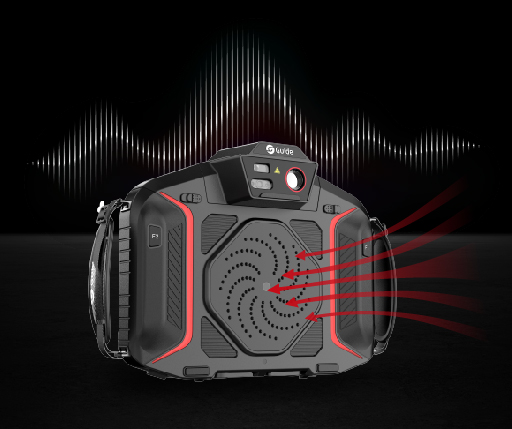
To further optimize asset uptime, Guide Sensmart has pushed the boundaries of portable diagnostic instrumentation by introducing cutting-edge multi-sensor systems. For instance, the Guide Sensmart FA611 Series seamlessly merges high-resolution thermal imaging with advanced acoustic sensor technology. Featuring a matrix of 128 low-noise micro-electro-mechanical systems (MEMS) microphones alongside a high-sensitivity infrared detector, this innovative architecture allows inspectors to cross-verify findings in real time.
Technicians can instantly track mechanical friction or electrical partial discharge visually via temperature variations, while simultaneously locating high-pressure gas leaks via sound wave localization. This multi-layered approach removes guesswork and accelerates corrective actions.
Diversified Applications Across Major Industrial Sectors
The utility of thermal imaging extends far beyond basic structural mapping. It serves as a cornerstone of preventive maintenance programs across multiple complex sectors, safeguarding equipment longevity and streamlining resource utilization.
Petrochemical Refining and Natural Gas Processing
In oil, gas, and chemical refineries, millions of cubic feet of product flow through thousands of miles of pressurized pipelines daily. Small fissures or unseated seals can result in significant product loss and regulatory non-compliance. High-definition thermal cameras allow teams to perform rapid flyovers or walk-through inspections, immediately identifying fugitive volatile organic compounds (VOCs), methane, and heavy hydrocarbons without interrupting active plant processes.
Power Generation and Distribution Systems
Electrical grids and power generation plants operate under immense thermal stress. Overloaded circuits, degrading substations, and deteriorating transformer components exhibit distinct heating profiles before failing. Routine thermographic scanning enables utilities to spot these anomalies early, allowing for scheduled maintenance during off-peak hours rather than suffering catastrophic grid failures.
Achieving Environmental and Economic Sustainability
Modern industrial operations are strictly bound by localized environmental regulations and global sustainability goals. Mitigating greenhouse gases such as methane, sulfur hexafluoride ($SF_6$), and various carbon oxides is no longer optional; it is a fundamental metric of corporate responsibility.
Investing in a premium thermal imaging camera for leak detection directly supports these sustainability initiatives. By giving companies the tools to identify, confirm, and measure trace emissions early, these advanced optical systems help prevent long-term environmental degradation and protect nearby ecosystems.
Financially, the return on investment for high-end thermography is realized rapidly through several channels:
| Financial Driver | Economic Impact |
| Product Conservation | Keeps valuable gases and liquids contained within the production cycle, maximizing overall yield. |
| Downtime Prevention | Eliminates unplanned emergency shutdowns by identifying minor wear before it causes systemic failures. |
| Regulatory Protection | Protects organizations from substantial environmental fines and complex legal liabilities by maintaining compliance. |
Future Trends in Intelligent Predictive Maintenance
As industrial infrastructure grows more interconnected, the future of thermographic technology lies in the integration of automation and data-driven insights. The newest generation of optical imaging tools is moving beyond simple visual rendering toward automated asset analytics.
By embedding artificial intelligence (AI) models directly into camera firmware, modern inspection devices can automatically recognize specific gas plume geometries, calculate leak flow rates, and filter out false positives caused by steam or blowing dust. This automation simplifies data interpretation, allowing personnel of varying technical backgrounds to make critical decisions confidently. When combined with cloud connectivity, field teams can instantly upload high-resolution thermal profiles to centralized asset management databases, streamlining maintenance scheduling across entire global enterprises.