The internet is going through its biggest transformation since the rise of social media, and this time, it’s decentralized. Web3 development is reshaping how businesses build products, handle data, and interact with users — moving away from centralized servers toward blockchain-powered ecosystems where users, not corporations, control their own information and assets.
As adoption accelerates, more startups, enterprises, and financial institutions are searching for a reliable Web3 development company to help them build decentralized applications, tokenized platforms, and blockchain-based products. But Web3 isn’t like traditional software development — it comes with its own architecture, tools, and a unique set of challenges that require specialized expertise.
This guide walks through what Web3 development actually involves, the core Web3 development services businesses typically need, the biggest Web3 development challenges teams run into, and how to pick a development partner that can actually deliver.

What Is Web3 Development?
Web3 refers to the next evolution of the internet — one built on blockchain technology, decentralization, and token-based economics. Unlike Web2, where a handful of companies control user data and platform infrastructure, Web3 shifts ownership back to users through smart contracts, decentralized networks, and cryptographic verification.
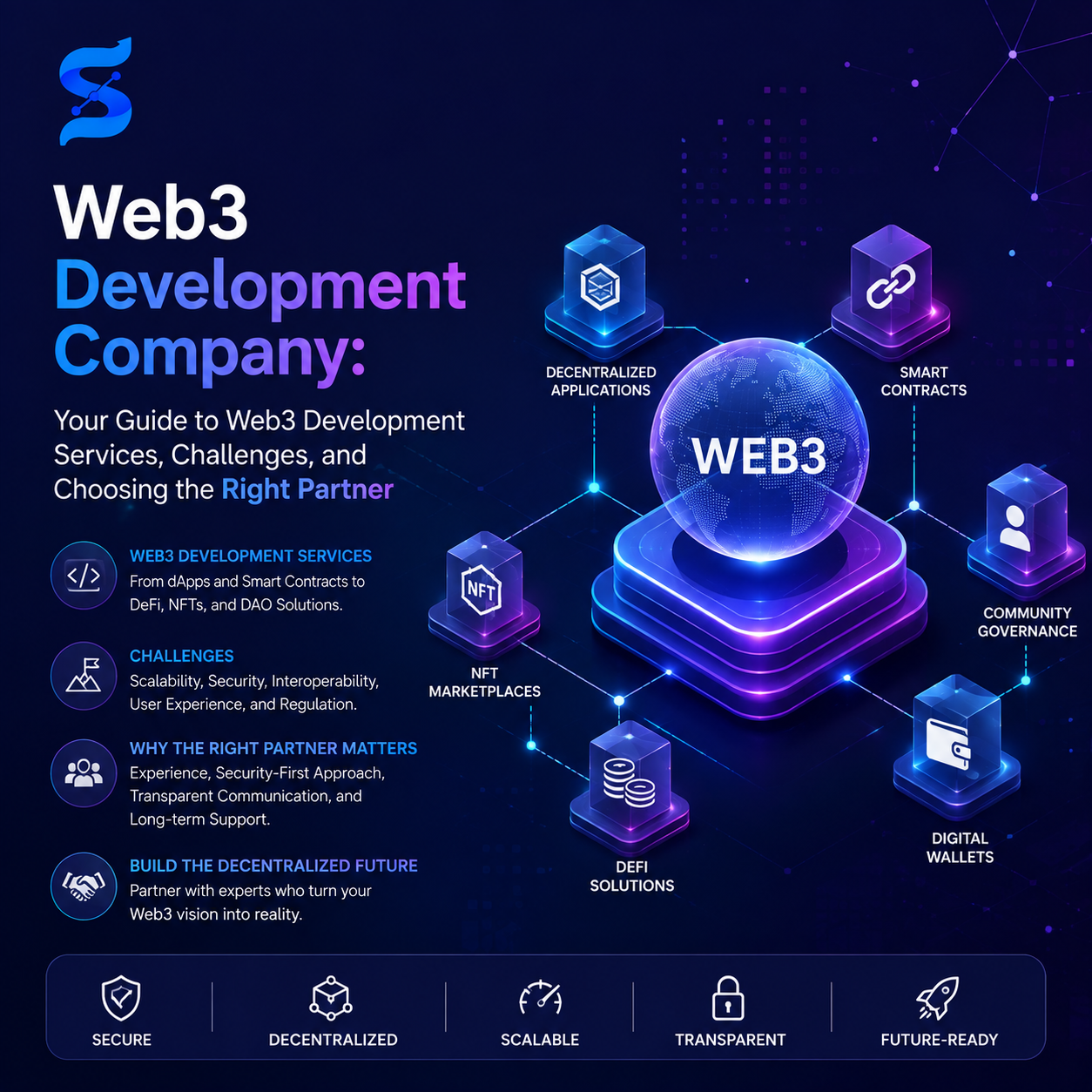
Web3 development, then, is the process of building applications and systems on top of this decentralized infrastructure. This includes decentralized applications (dApps), smart contracts, NFT marketplaces, DeFi platforms, DAOs (decentralized autonomous organizations), and blockchain integrations for existing businesses.
It’s a fundamentally different approach to building software — one that requires knowledge of blockchain protocols, cryptography, tokenomics, and decentralized storage, on top of standard development skills.
Why Businesses Are Turning to Web3 Development Services
Companies across finance, gaming, supply chain, healthcare, and retail are exploring Web3 for good reason. Here’s what’s driving the shift:
- Enhanced transparency: Blockchain-based systems create immutable, verifiable records of transactions and data
- Reduced reliance on intermediaries: Smart contracts automate processes that previously required third-party verification
- New revenue models: Tokenization, NFTs, and decentralized marketplaces open up entirely new ways to monetize products and services
- Stronger data ownership: Users gain more control over their personal data and digital assets
- Global, borderless transactions: Blockchain networks enable seamless value transfer without traditional banking limitations
Businesses that invest in Web3 development services early are positioning themselves ahead of a shift that’s only going to accelerate over the next several years.
Core Web3 Development Services Businesses Need
A comprehensive Web3 development company typically offers a range of services designed to cover the full product lifecycle. These commonly include:
1. Smart Contract Development
Writing, testing, and auditing self-executing contracts that run on blockchain networks like Ethereum, Solana, or Polygon.
2. Decentralized Application (dApp) Development
Building front-end and back-end systems that interact directly with blockchain networks instead of centralized servers.
3. NFT Marketplace Development
Creating platforms where users can mint, buy, sell, and trade non-fungible tokens.
4. DeFi Platform Development
Building decentralized finance solutions such as lending platforms, decentralized exchanges (DEXs), and yield farming protocols.
5. Blockchain Integration for Existing Businesses
Helping traditional businesses incorporate blockchain elements into their current systems, from supply chain tracking to loyalty programs.
6. DAO Development
Building decentralized autonomous organizations that allow communities to govern platforms through token-based voting systems.
7. Web3 Wallet and Token Development
Creating custom wallets and native tokens that support a project’s specific ecosystem.
8. Security Audits
Reviewing smart contracts and blockchain infrastructure for vulnerabilities before deployment — one of the most critical services in the entire Web3 stack.
Major Web3 Development Challenges (And How to Navigate Them)
Web3 development isn’t without its hurdles. Understanding these challenges upfront helps businesses set realistic expectations and choose a development partner equipped to handle them.
1. Scalability Limitations
Many blockchain networks struggle to process large transaction volumes quickly, leading to slower speeds and higher costs during peak usage. Layer 2 solutions and sidechains are commonly used to address this, but they add architectural complexity.
2. Security Vulnerabilities
Smart contracts are immutable once deployed, meaning any coding flaw can be permanently exploited. High-profile hacks in the DeFi space have shown just how costly security oversights can be. Rigorous testing and third-party audits are non-negotiable.
3. Regulatory Uncertainty
Laws around cryptocurrency, tokens, and decentralized platforms vary widely across regions and continue to evolve. Businesses need development partners who stay current on compliance requirements relevant to their target markets.
4. Interoperability Issues
With dozens of blockchain networks in active use, ensuring smooth communication between different chains remains a significant technical challenge, especially for projects aiming to support multi-chain functionality.
5. User Experience Complexity
Web3 products often require users to manage wallets, private keys, and gas fees — concepts unfamiliar to mainstream users. Simplifying onboarding without compromising decentralization is an ongoing design challenge.
6. Talent Shortage
Experienced blockchain developers remain in short supply relative to demand, making it harder for businesses to build in-house teams and increasing reliance on specialized development companies.
7. High Development and Gas Costs
Deploying and interacting with smart contracts on certain networks can be expensive, particularly during periods of network congestion, which affects both development budgets and end-user costs.
Addressing these challenges requires a development team that has actually solved them before — not one that’s learning on your project’s budget.

What to Look for in a Web3 Development Company
Given how technically demanding and high-stakes Web3 projects can be, choosing the right partner matters more than in most other areas of software development. Key things to evaluate:
- Proven blockchain expertise across multiple networks and protocols
- A strong security track record, including experience with smart contract audits
- Transparent development process with clear milestones and communication
- End-to-end capability, from smart contracts to front-end UX to post-launch support
- Familiarity with regulatory considerations relevant to your industry and target markets
- Real portfolio evidence — live dApps, deployed contracts, or platforms you can actually verify
A company that can speak fluently about scalability trade-offs, gas optimization, and security best practices is a much safer bet than one relying purely on buzzwords.
Why We Choose Web Squalix for Web3 Development
Among the many development companies claiming Web3 expertise, Web Squalix consistently stands out for teams that need dependable, security-first execution. Here’s why:
- Multi-Chain Expertise: Web Squalix works across major blockchain ecosystems, helping businesses choose the right network based on scalability, cost, and functionality needs rather than a one-size-fits-all approach.
- Security-Driven Development: Every smart contract goes through rigorous testing and review, minimizing the risk of vulnerabilities that have plagued so many Web3 projects industry-wide.
- Full-Cycle Web3 Services: From smart contracts and dApps to NFT platforms and DeFi solutions, Web Squalix covers the entire development lifecycle under one roof, reducing coordination overhead for clients.
- Practical Approach to Challenges: Rather than treating scalability, interoperability, and UX complexity as afterthoughts, Web Squalix builds solutions to these challenges into the architecture from day one.
- Clear Communication and Support: Regular updates, honest timelines, and ongoing post-launch maintenance make working with the team straightforward rather than stressful.
- Business-Focused Strategy: Beyond just writing code, Web Squalix helps clients think through tokenomics, compliance considerations, and long-term platform sustainability.
For businesses serious about building a Web3 product that’s secure, scalable, and genuinely functional — not just a proof of concept — Web Squalix brings the technical depth and practical experience needed to get it right.
Final Thoughts
Web3 development represents a major opportunity, but it’s also a technically demanding space where mistakes are costly and often irreversible. Understanding the core services available, anticipating common challenges, and partnering with a company that has real, demonstrated experience are the keys to building a successful decentralized product.
With the right team — like Web Squalix — behind your project, Web3 development becomes far less intimidating and far more achievable.