Artificial intelligence can recognize objects, understand visual information, and make decisions from images, but it cannot learn effectively from raw images alone. Machine learning models need properly prepared and labeled visual data to understand what they are looking at. This is where AI Image Annotation Services become important.
Image annotation is the process of adding meaningful labels, boundaries, tags, or other information to images so that an AI or computer vision model can learn from them. A simple photograph of a road, for example, may contain cars, pedestrians, traffic lights, lane markings, and buildings. Annotation helps a model identify each of these elements correctly.
As businesses use computer vision for autonomous vehicles, healthcare imaging, retail analytics, security, agriculture, robotics, and industrial automation, the demand for high-quality annotated datasets continues to grow. However, producing reliable training data requires more than simply drawing boxes around objects. It involves selecting the right annotation method, maintaining consistent labeling standards, reviewing results, and preparing datasets that match the model’s intended use.
This guide explains what AI Image Annotation Services are, how the process works, which annotation techniques are commonly used, what industries benefit from them, and how businesses can choose the right service provider.
What Are AI Image Annotation Services?
AI Image Annotation Services involve labeling and organizing visual data so machine learning and computer vision systems can understand images.
The annotation may identify an object, outline its exact shape, classify an image, mark specific points, or separate different elements within the same image. The right approach depends on what the AI model needs to learn.
For example, a company developing an AI system for vehicle detection may provide thousands of road images. Annotators can label cars, trucks, motorcycles, cyclists, and pedestrians. The resulting dataset gives the machine learning model examples that help it recognize these objects in new images.
The quality of this work matters because incorrect or inconsistent labels can affect model performance. If pedestrians are labeled incorrectly during training, for instance, a computer vision model may struggle to identify pedestrians accurately in real-world situations.
This is why professional annotation combines human review, clear guidelines, quality checks, and suitable annotation tools.
How Do AI Image Annotation Services Work?
The annotation process generally follows several stages. While the exact workflow varies depending on the project, a professional process usually includes the following steps.
1. Define the AI Project Requirements
Before annotation begins, the business needs to establish what the AI model should recognize or understand.
Important questions include:
- What types of images will be used?
- Which objects need to be labeled?
- What annotation method is appropriate?
- How many images are required?
- What level of accuracy is expected?
- How will the final dataset be used?
For example, an agricultural AI project may need to identify healthy crops, diseased leaves, weeds, and damaged plants. A medical imaging project may require precise segmentation of specific areas within scans.
Clear requirements prevent unnecessary labeling work and help maintain consistency throughout the project.
2. Collect and Prepare Images
The next step is gathering relevant images. These may come from cameras, sensors, existing databases, customer-generated content, or other approved sources.
The images are then reviewed and prepared for annotation. Duplicate, corrupted, irrelevant, or extremely poor-quality images may be removed.
Data preparation can also involve organizing images into categories and ensuring that the dataset represents the different conditions the AI system may encounter.
For example, an autonomous driving dataset should not contain only images taken on clear sunny days. If the model needs to work in real-world conditions, the dataset may also need images showing rain, shadows, nighttime conditions, traffic, and different road environments.
3. Select the Right Annotation Technique
One of the most important decisions in AI Image Annotation Services is choosing the appropriate labeling technique.
Different computer vision applications require different levels of detail.
A basic object detection system may work well with bounding boxes, while an application requiring precise object boundaries may need segmentation.
The annotation method should therefore be selected according to the model’s objectives rather than simply choosing the fastest option.
4. Annotate the Images
Once the guidelines and annotation method are established, trained annotators begin labeling the images.
They may draw boxes around objects, trace boundaries, assign categories, or mark specific points depending on the project.
For large datasets, annotation tools can speed up the process, but human expertise remains valuable for ambiguous images and quality-sensitive projects.
5. Perform Quality Assurance
Annotation should not end when the labels are added. The dataset needs to be reviewed for errors and inconsistencies.
Quality assurance can involve checking:
- Incorrect object labels
- Missing objects
- Poorly placed bounding boxes
- Incorrect segmentation
- Inconsistent categories
- Duplicate annotations
- Unclear or incomplete labels
For high-accuracy applications, multiple levels of review may be necessary.
6. Deliver the Final Dataset
After quality checks, the completed dataset can be exported in a format suitable for the client’s machine learning workflow.
The final data may then be used for model training, validation, testing, or further AI development.
Common Types of Image Annotation
There is no single annotation technique that works for every AI project. Some of the most widely used approaches include the following.
Bounding Box Annotation
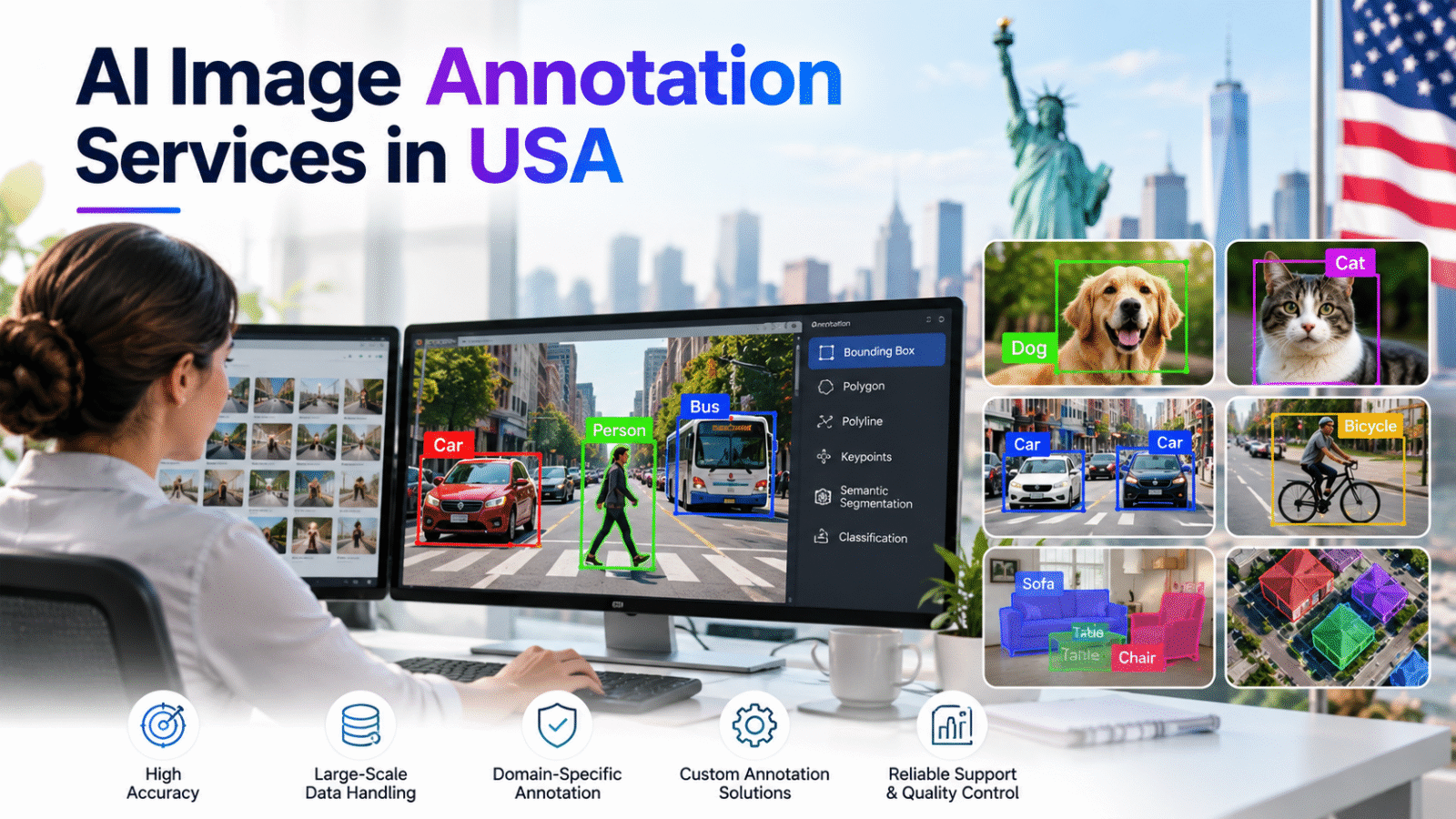
Bounding boxes are rectangular boxes placed around objects in an image.
For example, an image of a busy street could have separate boxes around cars, buses, bicycles, and pedestrians.
This method is commonly used for object detection because it provides a relatively simple way for models to learn where objects are located.
Polygon Annotation
Polygon annotation is used when objects have irregular shapes.
Instead of using a simple rectangle, annotators create a polygon around the object’s actual boundary. This provides more detailed information and can be useful when precise object outlines matter.
For example, polygon annotation can help identify irregularly shaped machinery components or objects in complex environments.
Semantic Segmentation
Semantic segmentation assigns a category to individual pixels.
Instead of simply telling the model that a car exists somewhere in an image, segmentation can identify the pixels belonging to the car.
This approach is useful when precise visual boundaries are important.
Instance Segmentation
Instance segmentation goes one step further by distinguishing between individual objects belonging to the same category.
Imagine an image containing ten cars. Semantic segmentation can identify car pixels, while instance segmentation can distinguish car 1, car 2, car 3, and so on.
This can be particularly useful in crowded environments.
Keypoint Annotation
Keypoint annotation identifies important points within an object.
For example, human pose datasets may contain keypoints representing shoulders, elbows, knees, wrists, and other body locations.
This technique is widely used in applications involving human movement, gesture recognition, sports analysis, and pose estimation.
Image Classification
Image classification assigns an overall category to an image.
For example, images could be classified as:
- Healthy plant
- Diseased plant
- Damaged plant
Unlike bounding boxes or segmentation, classification does not necessarily identify the exact location of the object.
Why Data Quality Matters in Image Annotation
The effectiveness of a computer vision model depends heavily on the quality of its training data.
Suppose a company creates a dataset containing 100,000 images but a significant percentage of the labels are incorrect. The large dataset size may look impressive, but the model could still learn incorrect patterns.
This is why AI Image Annotation Services should focus on accuracy and consistency rather than simply completing a high number of images.
Annotation guidelines should clearly define how objects are labeled. For example, if a vehicle is partially hidden behind another vehicle, the team needs to know whether to annotate the visible portion, estimate the full boundary, or follow another predefined rule.
Consistent decisions across thousands of images make the dataset more useful for machine learning.
Where Are AI Image Annotation Services Used?
The applications of image annotation extend across many industries.
Healthcare
Medical AI systems can use annotated images to help identify patterns in X-rays, CT scans, MRIs, and other medical imagery.
Annotation may identify specific regions, abnormalities, or structures that a model needs to learn.
Autonomous Vehicles
Self-driving and driver-assistance technologies rely heavily on computer vision. Annotated images can help models recognize vehicles, pedestrians, traffic signs, road markings, cyclists, and other objects.
Retail and E-Commerce
Retail companies can use annotated images for product recognition, visual search, shelf monitoring, inventory management, and customer behavior analysis.
Agriculture
Computer vision systems can analyze crop images to identify diseases, weeds, pests, damaged plants, or signs of nutrient deficiency.
Manufacturing
Manufacturers can use annotated images to train AI systems for quality inspection and defect detection.
For example, a production-line camera can capture thousands of product images, while annotations identify scratches, cracks, missing components, or other defects.
Security and Surveillance
Annotated visual datasets can help train systems designed to recognize objects, activities, or specific events in surveillance footage and images.
AI Image Annotation Services in USA
Businesses looking for specialized data preparation support can consider AI Image Annotation Services in USA when they need reliable annotation workflows, trained teams, and project-specific quality standards.
For US-based AI projects, understanding the intended application is especially important because different industries can have different data handling, privacy, and quality requirements. Healthcare, automotive, retail, and enterprise AI projects may all require different annotation processes.
A suitable provider should be able to understand the business objective, establish annotation guidelines, maintain consistency, and provide quality-controlled datasets rather than treating annotation as a simple manual labeling task.
For companies developing computer vision models for the US market, AI Image Annotation Services in USA can support the preparation of datasets that reflect relevant environments, products, users, and operating conditions.
How to Choose the Right Annotation Partner
Choosing a provider should involve more than comparing the price per image.
Check Industry Experience
A provider familiar with your industry is more likely to understand the difference between important and irrelevant visual details.
Review Quality Processes
Ask how annotations are reviewed and how errors are corrected. A strong quality assurance process is essential for large datasets.
Evaluate Scalability
Your project may begin with 10,000 images and later expand to millions. The provider should have the people, technology, and workflow needed to scale.
Ask About Data Security
If images contain confidential business information or sensitive content, data security should be discussed before the project begins.
Consider Annotation Technology
Modern annotation platforms can improve productivity, but technology should support quality rather than replace proper review.
Look for Clear Communication
A reliable partner should communicate clearly about project requirements, progress, quality concerns, and delivery timelines.
Why Choose Vision Infotech for AI Image Annotation?
Vision Infotech helps businesses build technology solutions around AI, automation, and data-driven applications. For organizations that need image annotation support, the focus should be on creating useful, consistent, and properly structured datasets rather than simply labeling images at scale.
Project-Specific Annotation Workflows
Every AI project has different requirements. Vision Infotech can approach annotation based on the intended computer vision application, required labels, image characteristics, and expected output.
Focus on Data Accuracy
Accurate training data is essential for building dependable AI models. Quality checks and clearly defined annotation guidelines can help reduce inconsistent labeling.
Scalable Support
As AI projects grow, their data requirements can increase significantly. A scalable workflow can support businesses from initial dataset preparation through larger annotation requirements.
AI and Software Expertise
Vision Infotech’s broader experience in AI development and software solutions can help businesses look at annotation as part of the larger AI development process, rather than as an isolated data task.
Business-Focused Approach
The objective is not simply to deliver annotated files. The goal is to prepare data that supports the client’s actual machine learning or computer vision requirements.
What Makes High-Quality Image Annotation Different?
A high-quality dataset is usually the result of several factors working together: clear annotation rules, suitable tools, trained annotators, consistent labeling, quality assurance, and ongoing communication.
Businesses should also remember that more data is not automatically better data. A smaller dataset with accurate and consistent labels can be more valuable than a much larger dataset containing significant annotation errors.
The best approach is to determine what the AI model needs to learn and then build the annotation process around that requirement.
Conclusion
AI Image Annotation Services play an important role in turning raw visual information into useful training data for computer vision and machine learning systems. From bounding boxes and polygons to semantic segmentation, instance segmentation, keypoints, and classification, different techniques help AI models understand different aspects of an image.
The success of an annotation project depends on more than the number of images completed. Data accuracy, consistent labeling, quality control, security, scalability, and a clear understanding of the AI application’s goals all matter.
Whether a business is developing an autonomous vehicle system, healthcare AI solution, agricultural application, retail platform, or manufacturing inspection system, properly annotated data can provide a stronger foundation for model development.
For organizations exploring AI Image Annotation Services, choosing an experienced technology partner such as Vision Infotech can help create a structured annotation workflow aligned with broader AI development goals. When high-quality visual data is treated as an important part of the AI development process, businesses can build datasets that are more useful, reliable, and ready for real-world applications.