The Sudden Pop: Understanding the Intake “Spitback”
Few mechanical surprises are as unsettling as a sharp, sudden pop emanating directly beneath your gas tank when you roll off the throttle. While a gentle rumble or minor exhaust burble during deceleration is common in performance motorcycles, a sharp backfire through the air intake—often called a “spitback” or “carburetor sneeze”—is a distinct symptom that points to an underlying combustion anomaly.
Unlike standard exhaust popping, an intake backfire occurs when the air-fuel mixture ignites while the intake valve is still open or slightly ajar. This forces high-pressure combustion gases backward into the intake runner, velocity stack, or airbox. Beyond being alarming to hear, repeated intake backfires can degrade rubber air boots, contaminate air filters with carbon, and signal engine operating conditions that could lead to thermal stress over time. To fix this issue, you must look closely at fuel metering, intake manifold integrity, and valve train geometry.
The Mechanics of Closed-Throttle Deceleration
To understand why an engine backfires through the intake when you close the throttle, you first need to examine what happens inside the cylinder during overrun. When you chop the throttle at speed, the throttle plates snap shut, but the engine continues spinning at high RPM due to the momentum of the rear wheel driving the transmission. This creates an intense vacuum inside the intake manifold between the throttle valve and the cylinder head.
Under these high-vacuum conditions, several mechanical dynamics shift simultaneously:
- Manifold Vacuum Spike: The dramatic surge in intake vacuum draws volatile fuel droplets off the intake runner walls while making it much harder for fresh air to enter.
- Extreme Lean Conditions: Many electronic fuel injection (EFI) systems cut fuel supply completely during decel (decel fuel cut), while carbureted systems rely solely on the pilot/slow circuit. If that circuit is clogged or incorrectly tuned, the mixture becomes excessively lean.
- Slower Flame Propagation: Extremely lean fuel-air mixtures burn much slower than balanced stoichiometric mixtures ($14.7:1$ ratio). This delayed combustion cycle is often the root cause of intake backfiring.
Cause #1: Ultra-Lean Fuel Mixtures and Vacuum Leaks
The single most frequent culprit behind intake backfiring on closed-throttle deceleration is a lean air-fuel mixture. When a mixture is too lean, there aren’t enough fuel molecules per volume of air to sustain a rapid, crisp flame front. Instead of burning cleanly during the power stroke, the fuel smolders slowly throughout the expansion stroke and continues burning as the piston rises on the exhaust stroke.
If the flame is still burning when the intake valve begins to open for the next intake cycle (during valve overlap), the lingering flame immediately ignites the incoming fresh air-fuel charge waiting in the intake manifold. The flame travels backward out through the throttle body or carburetor.
Common causes of this condition include:
- Air Leaks at Intake Boots: Small cracks or loose clamps on the rubber boots between the cylinder head and carburetor/throttle body allow unmetered air to leak in under high vacuum.
- Clogged Pilot Jets or Passages: In carbureted bikes, tiny pilot jets handle low-throttle and closed-throttle fuel delivery. Microscopic debris or gummed fuel restricts flow.
- Improper Fuel Trim or Sensor Error: Faulty manifold absolute pressure (MAP) sensors, throttle position sensors (TPS), or incorrect ECU mapping can starve the engine of fuel during deceleration transitions.
Cause #2: Tight Intake Valves and Mechanical Timing Anomalies
If your fuel system is operating perfectly, the next area to investigate is valve train mechanics. Engine valves must seat tightly against the cylinder head to seal the combustion chamber during the power stroke. Over time, as valve faces and seats wear down, the clearance between the camshaft lobe and the valve lifter or rocker arm decreases.
If the intake valve clearance becomes tight or reaches zero, the intake valve may not close completely when the engine reaches operating temperature and thermal expansion occurs. A fraction of a millimeter gap allows high-pressure combustion flames to escape directly into the intake tract during every firing stroke.
Additionally, worn valve springs can cause “valve float” at higher RPMs, preventing the valve from snapping shut fast enough during rapid engine deceleration. Valve timing that is advanced by even one tooth on the timing chain can similarly cause the intake valve to open prematurely before combustion gases have cooled and evacuated the cylinder.
Step-by-Step Diagnostic Framework for Riders
Isolating the precise cause of an intake backfire requires a methodical, step-by-step diagnostic strategy rather than blindly replacing parts. When troubleshooting, follow this practical checklist:
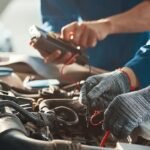
- Perform a Spray Leak Test: With the engine idling, lightly spray aerosol carburetor cleaner or propane around the intake manifolds, vacuum hoses, and carburetor boots. If the engine idle RPM fluctuates, you have found an unmetered air leak.
- Inspect and Clean the Pilot Circuit: Remove the carburetor bowl and use thin wire and aerosol cleaner to clear the pilot jet and idle air passages.
- Check Valve Clearances: Remove the valve cover and use feeler gauges to verify that intake and exhaust valve lash settings match manufacturer specifications. Adjust tight valves immediately to prevent valve burning.
- Examine Spark Plug Color: Inspect the porcelain tip of your spark plugs. A blistered white or chalky appearance confirms an over-lean running condition, whereas light tan indicates proper air-fuel balance.
- Verify Exhaust Integrity: Check for cracks near the exhaust manifold header bolts. Fresh air pulled back into the exhaust port during decel can work alongside lean intake conditions to trigger wild manifold pressure spikes.
Turning Mechanical Mystery into Practical Expertise
Diagnosing complex engine behavior—such as intake backfires, fuel metering anomalies, and valve overlap timing—requires an understanding of both theory and practical wrenching. While online forums offer quick hints, developing true technical confidence involves systematically mastering engine dynamics, fuel delivery setups, and electrical diagnostics from the ground up.
If you are passionate about understanding what happens inside motorcycle engines and want to move beyond basic DIY troubleshooting, completing a structured motorbike maintenance course provides a solid foundation. Learning how to properly sync carburetors, measure valve clearances, adjust fuel maps, and perform precise compression tests turns intimidating engine quirks into routine maintenance tasks you can handle with confidence.
Final Thoughts
An engine backfiring through the air intake during closed-throttle deceleration should never be ignored. While it may start as a mild annoyance or occasional pop, it is a clear mechanical warning that your air-fuel mixture is dangerously lean or your intake valves are not seating correctly. By systematically testing for intake manifold vacuum leaks, inspecting pilot circuits, and verifying valve clearances, you can trace the issue to its root cause, protect your engine components from damage, and restore smooth, responsive performance across every throttle position.