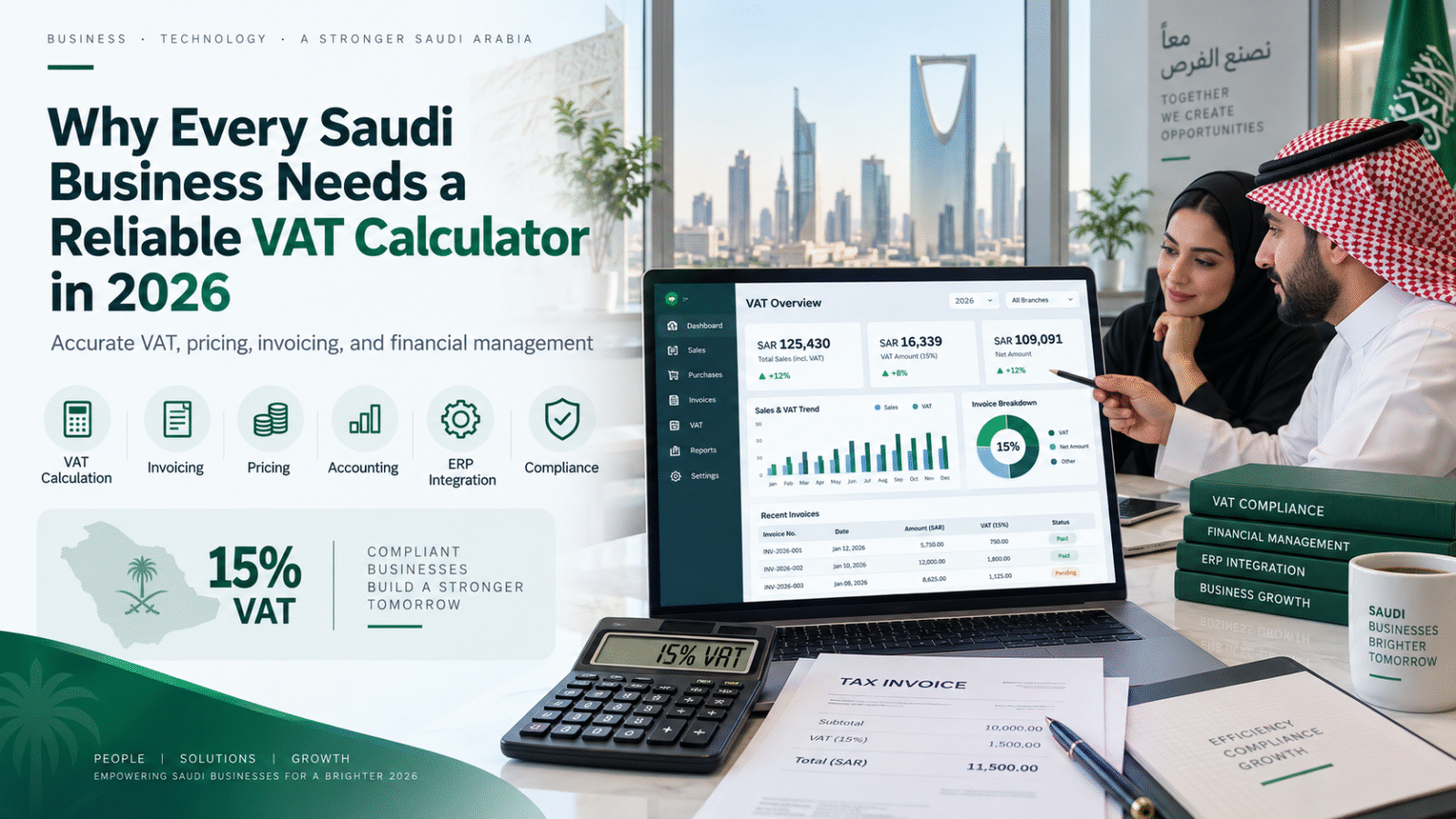
VAT remains a key factor for business in Saudi Arabia. The current standard rate of VAT is 15% on taxable supplies and it is important that it is calculated correctly when pricing, invoicing, buying, accounting and reporting financial information.
In 2026, companies are also working in the context of a more digital world. Financial processes are increasingly becoming automated, ranging from electronic invoicing to cloud-based accounting and ERP systems. Having a reliable VAT Calculator Saudi Arabia business is therefore an easy but valuable tool that can help in enhancing the accuracy of tax-related matters. Businesses can also explore how ERP software in Saudi Arabia helps connect financial operations, accounting, and compliance processes in one system.
Why VAT Calculations are Important
VAT is charged on the taxable transaction and should be accurately reflected by taxable transactions by businesses with a VAT number.
For instance, if the product is priced at SAR 2,000 before VAT, it would generate:
SAR 2,000 × 15% = SAR 300 VAT
So the total price paid by the customers would be:
SAR 2,300
The calculation is simple, but can be hundreds or thousands of deals. The risk of errors can be increased when employees use manual calculations, especially with various prices, discount, returns, or taxed amounts.
Supporting Accurate Pricing
VAT calculations may have an impact on the pricing of a product or service.
It’s important that businesses understand if they are quoting with VAT included or excluded. The sales and finance teams will be able to calculate the right end price with a reliable calculator before they start talking to the customers.
For companies that sell to customers, this is particularly crucial because clients should be able to comprehend the end price they should pay.
Reducing Invoice Errors
Invoices are crucial financial and tax records. VAT calculation mistakes can cause issues for business and its consumers.
A VAT calculator can be of benefit to employees to ensure that they have the correct amount of VAT in an invoice before it is finalised. If the calculator is part of an ERP or accounting system, the process can be even more streamlined. An integrated ERP system in Saudi Arabia can help businesses manage invoices, accounting records, and tax-related workflows more efficiently.
Modern ERP software that Riyadh businesses use can be used to integrate customer data, products, pricing, tax details, invoices, and accounting details in a single system.
Supporting Finance Teams
It is the duty of finance teams to keep a proper accounting record. They might have to go through sale invoices, purchase invoices, VAT amounts, credit notes and other transactions.
Having a calculator on hand will help to check individual transactions quickly.
But for larger organizations, manual calculation shouldn’t be the predominant approach. An automated ERP solution can automatically compute VAT for all transactions and keep the proper accounting records. Companies can benefit from exploring ERP modules designed for accounting, inventory, CRM, and business management.
Supporting Businesses to Deal with Tax-Inclusive Prices
A VAT calculator is one of the most useful functions it has is calculating VAT on a tax-inclusive price.
For instance, if a customer pays SAR 1,150 inclusive of 15% VAT, the amount paid before the VAT will be SAR 1,000 and the VAT paid will be SAR 150.
This is done by dividing by 1.15 to arrive at this number.
These calculations can be especially helpful where a supplier quotes a price or where the price already includes VAT.
Using Official ZATCA Resources for VAT Guidance
VAT is a very intricate tax and businesses should refer to trustworthy and current tax resources. ZATCA offers VAT Calculation Services, such as the VAT Calculator for Taxpayers and Merchant and Consumer VAT Calculator.
These are the official services that may assist businesses and individuals in calculating related to VAT.
Meanwhile, businesses need to keep in mind that working out the percentage is just one aspect of VAT compliance. It is also crucial to identify if a transaction is liable to VAT and the correct treatment to be afforded to the transaction is the right one.
Combining VAT Calculators With ERP Systems
A VAT calculator can be helpful for rapidly calculating VAT, whereas companies that have more complicated operations can gain from using more automation.
The VAT rules can be programmed into an ERP system, and it automates the application of those rules when a sales or purchase transaction occurs. Also it can link up invoices to accounting, stock, client records, and monetary reports.
This can help to decrease the number of manual tasks for finance teams.
In the context of Riyadh and other cities in Saudi Arabia, ERP software Riyadh solutions can thus support VAT calculation software by integrating tax-related tasks within a unified business management system.
Developing a More Digital Tax Environment
Saudi Arabia is increasingly moving towards a financial digital society. One of the examples of this change is the implementation of the e-invoicing program by ZATCA, in the second phase, the integration between taxpayers’ electronic invoicing solutions and ZATCA’s systems would be required.
In an increasingly digitised financial world, having accurate tax data is crucial.
A good VAT calculator will help the employees to understand and confirm the VAT calculations, while ERP systems that are integrated into the system will make it easier to calculate the VAT transactions at scale.
Conclusion
Reliable VAT calculation processes are required for every Saudi business that deal with taxable transactions. A calculator for VAT Saudi Arabia business could save businesses from making simple mathematical mistakes, enhance pricing accuracy and make individual calculations quicker.
But for businesses, it is important to go beyond the standalone calculation as they expand. Incorporating VAT tools into accounting and ERP software can lead to a more streamlined and automated process for invoicing, tax management, and financial reporting.
Accurate VAT management in 2026 is not just about working out 15%. It’s about building long-term business and reliable, consistent and digitally connected financial processes.