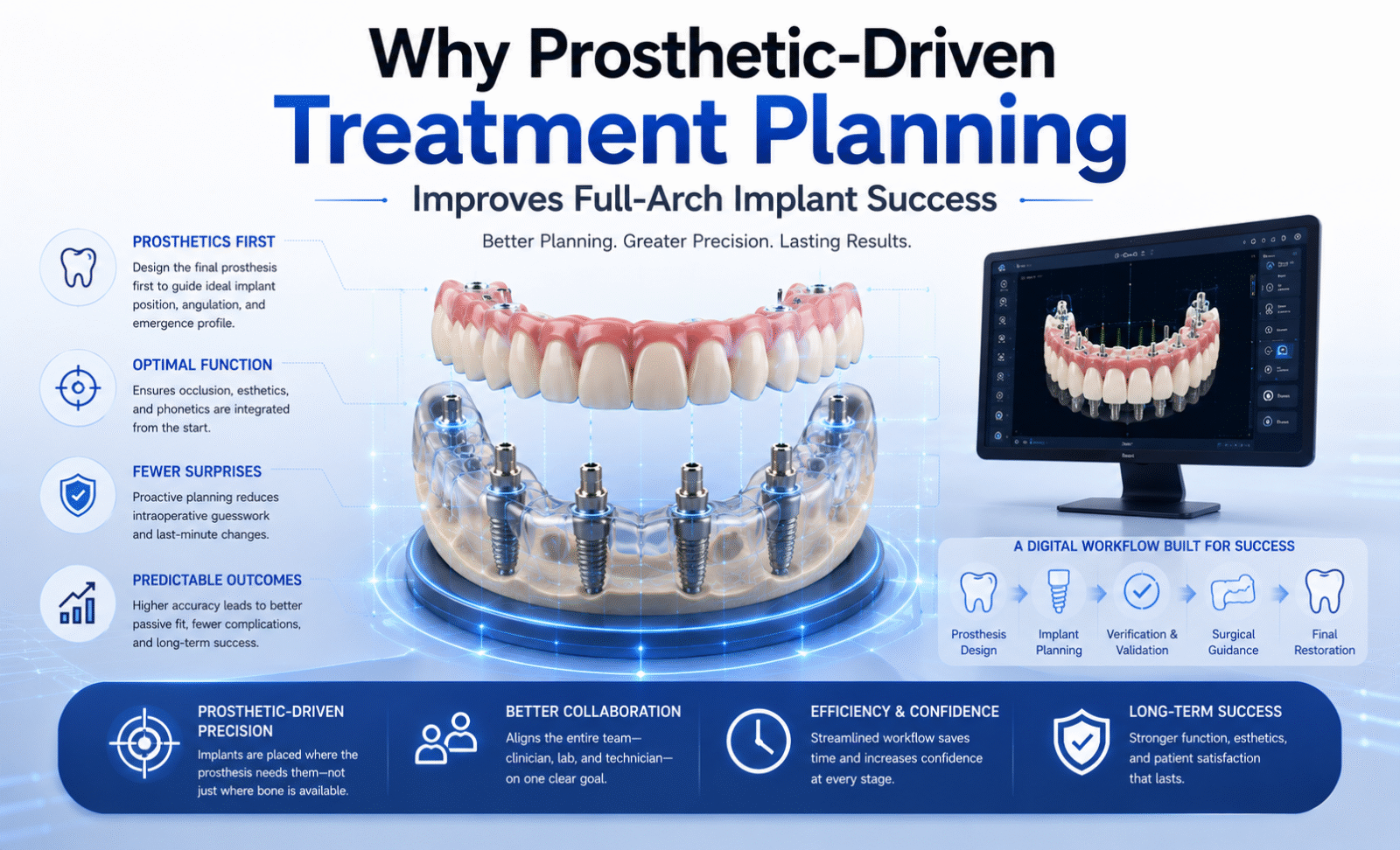
Successful full-arch implant rehabilitation begins long before implant placement. Prosthetic-driven treatment planning starts with the desired final restoration and works backward to determine implant position, angulation, and restorative space. This approach helps clinicians achieve better function, esthetics, passive fit, and long-term stability while reducing complications throughout the AOX workflow. Modern digital planning services such as 3DDX have made prosthetic-driven planning more accurate and collaborative by integrating surgical and restorative decision-making into a single digital workflow.
What Is Prosthetic-Driven Treatment Planning?
Traditional implant planning often focused primarily on available bone before considering the prosthetic restoration. Prosthetic-driven planning reverses that process by designing the ideal restoration first and positioning implants to support that outcome.
This digital-first philosophy allows clinicians to evaluate restorative requirements before surgery begins.
Key objectives include:
- Achieving predictable prosthetic function
- Optimizing implant positioning
- Improving esthetics
- Supporting passive framework fit
- Preserving restorative space
Clinical guidance from digital implant planning workflows consistently recommends beginning with the end restoration to improve overall treatment predictability.
Why It Matters More in Full-Arch AOX Cases
Full-arch implant restorations are significantly more complex than single-tooth cases because several implants must function together as one prosthetic unit.
If implant placement does not align with the planned restoration, clinicians may encounter:
- Compromised prosthetic design
- Difficult prosthesis seating
- Occlusal discrepancies
- Increased laboratory modifications
- Additional chairside adjustments
Planning from the prosthesis backward helps minimize these challenges before surgery even begins.
Common Problems Without Prosthetic-Driven Planning
Many restorative complications are not caused by implant failure—they result from planning decisions made early in treatment.
Common issues include:
- Implant angulation that limits prosthetic design
- Insufficient restorative space
- Poor emergence profiles
- Difficult hygiene access
- Excessive prosthetic cantilevers
- Increased framework stress
Correcting these problems after implant placement is often far more difficult than preventing them during digital planning.
How Digital Planning Improves Clinical Decision-Making
Digital technology allows clinicians to combine CBCT imaging, intraoral scans, facial records, occlusal information, and prosthetic goals into one coordinated workflow.
This comprehensive visualization helps clinicians evaluate:
- Bone anatomy
- Implant angulation
- Prosthetic space
- Occlusion
- Esthetic outcomes
- Surgical guide positioning
Rather than relying on assumptions, clinicians can make informed decisions using digital simulations before treatment begins.
The Role of 3DDX in Prosthetic-Driven Planning
Digital planning services have become increasingly important as AOX workflows continue to evolve. Through its integrated collaboration with Digital Arches, 3DDX digital prosthesis design services for prosthetic-driven full-arch implant planning support clinicians with comprehensive digital treatment planning before surgery and prosthesis fabrication.
Instead of treating surgical planning and prosthetic design as separate stages, 3DDX integrates CBCT data, intraoral scans, restorative objectives, and laboratory collaboration into a coordinated Scan-to-Surgery workflow. This approach allows clinicians to evaluate implant placement based on the intended prosthesis, improving restorative predictability throughout treatment.
Better Communication Between Clinics and Dental Laboratories
One of the greatest advantages of digital treatment planning is improved collaboration.
Digital workflows enable clinicians and technicians to review the same treatment data before manufacturing begins, reducing misunderstandings and unnecessary revisions.
Benefits include:
- Shared digital treatment plans
- More accurate laboratory instructions
- Faster case approvals
- Reduced communication errors
- Improved restorative consistency
This collaborative process supports both surgical precision and prosthetic accuracy.
Supporting Passive Fit and Long-Term Stability
Passive fit remains one of the most important objectives in implant prosthodontics. When implant positions are planned around the intended restoration, frameworks can be designed with greater precision and fewer compromises.
Potential long-term benefits include:
- Reduced mechanical stress
- Improved framework adaptation
- Better occlusal balance
- Fewer prosthetic complications
- Increased restoration longevity
Planning for passive fit during the digital design phase is considerably more effective than attempting to correct inaccuracies after fabrication.
Why More Clinics Are Moving to Digital Prosthetic Planning
Modern implant practices increasingly recognize that treatment success depends on workflow integration rather than isolated clinical steps.
Digital prosthetic planning helps practices:
- Improve treatment predictability
- Reduce prosthetic remakes
- Increase workflow efficiency
- Support interdisciplinary collaboration
- Deliver more consistent patient outcomes
As digital implant dentistry continues to advance, prosthetic-driven planning is becoming the preferred approach for complex full-arch rehabilitation.
Clinicians implementing complete digital workflows can also benefit from educational resources and workflow solutions available through the Digital Arches platform, which integrates planning, verification, and restorative technologies for AOX cases.
For additional insight into digital implant planning principles, the American College of Prosthodontists highlights how prosthetically driven digital workflows improve treatment planning for terminal dentition patients.
Frequently Asked Questions
What is prosthetic-driven treatment planning?
It is a digital planning approach that begins with the desired final prosthesis and determines implant placement based on restorative requirements rather than bone position alone.
Why is prosthetic-driven planning important for AOX cases?
AOX restorations require multiple implants to support a single prosthesis. Planning around the restoration improves implant positioning, passive fit, function, and esthetics.
How does digital planning improve implant success?
Digital planning allows clinicians to visualize implant placement, restorative space, occlusion, and prosthetic design before surgery, reducing workflow errors and improving predictability.
What is 3DDX used for?
3DDX provides professional digital prosthesis design and treatment planning services that support prosthetic-driven implant planning and full-arch AOX workflows through its integrated collaboration with Digital Arches.
Final Insight
Prosthetic-driven treatment planning has become a defining principle of modern full-arch implant dentistry because it aligns surgical decisions with restorative goals from the beginning. Rather than reacting to challenges after implant placement, clinicians can identify potential issues during the planning phase, improving efficiency, collaboration, and long-term outcomes.
Integrated digital planning services such as 3DDX, working alongside the Digital Arches ecosystem, demonstrate how combining prosthetic design, digital records, and surgical planning into one coordinated workflow helps create more predictable and successful AOX restorations.