Your home should be your family’s safest place. However, a fire can start rapidly, sometimes without you even realising, when you’re away from home or asleep, or at least when you’re not expecting it. Cooking, electrical faults, heating appliances and, increasingly, lithium-ion batteries in e-bikes, e-scooters and power tools are the everyday dangers faced by London homeowners.
Smoke alarms in the hallway are no longer enough when it comes to residential fire protection. There are several layers of protection in a safer home, such as early detection, fire doors, fire stopping and automatic suppression. Knowing what they do and how they interrelate can help you make a sound decision for your property.
Why Does Your London Home Require More Than a Smoke Alarm?
A smoke alarm is one of the most effective safety components in a home because it provides an early warning. London Fire Brigade advises suitable smoke and heat detection in the home – heat alarms are normally suitable to be fitted in kitchens, where they may be impacted by cooking smoke.
But when you detect a fire, you only know that it’s started. A smoke alarm does not suppress fires or restrict fire and smoke spread throughout the property.
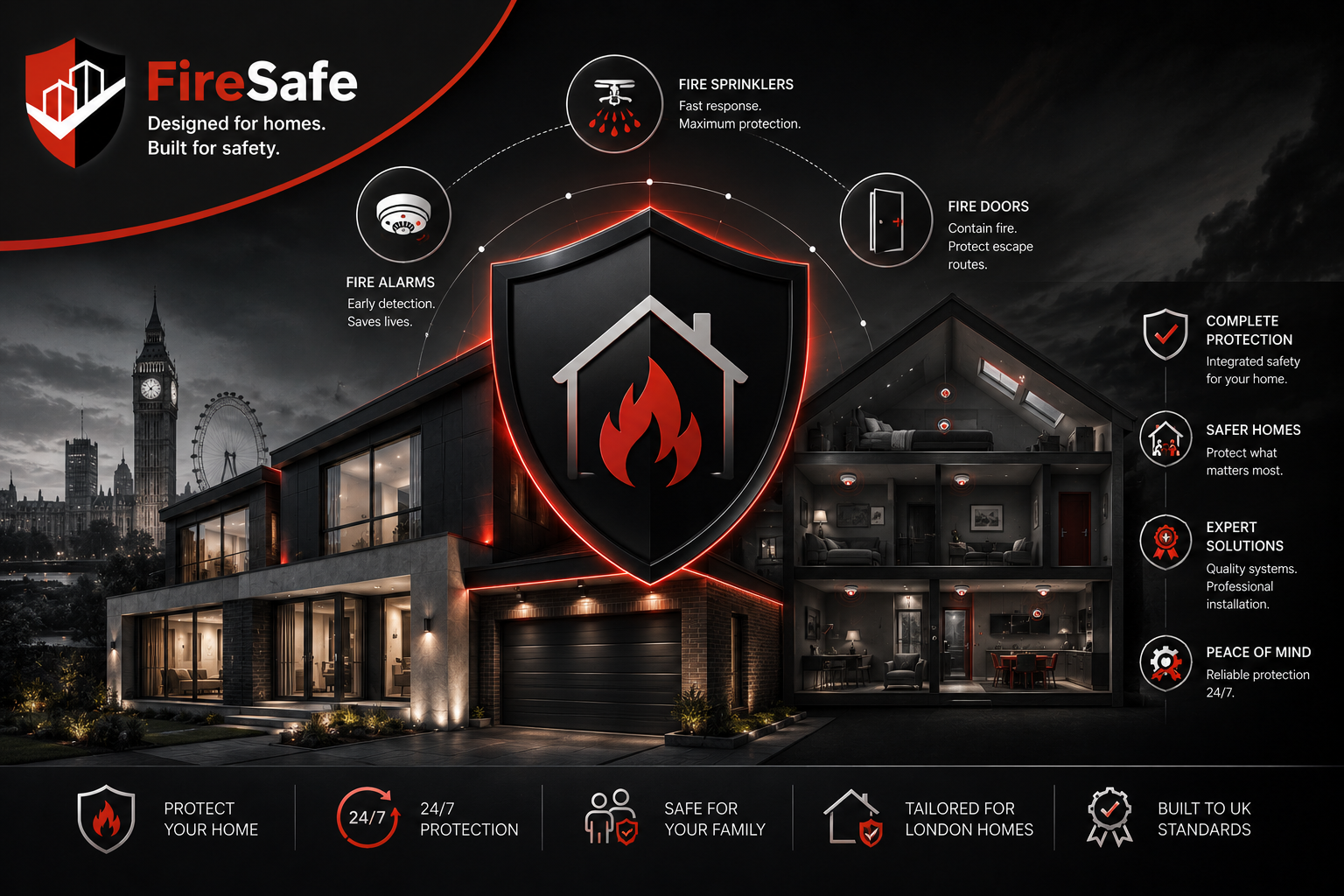
This is where a thorough home fire protection plan can help. Protection can include interlinked alarms, fire doors, fire stopping, firesafe sprinkler systems , smoke ventilation and an automatic fire suppression system, depending on the property and its occupants.
Important Residential Fire Protection Solutions to Consider
1. Fire Detection and Alarm Systems
Your best first defence is a reliable detection system. Today’s systems can be linked in such a way that if a smoke alarm is triggered, interconnected alarms can sound throughout the property, alerting occupants to the danger more quickly.
Early warning can be particularly important at night, when residents may be asleep and less likely to notice a fire developing.
2. Fire Doors and Compartmentation
If a fire does break out, stopping it from spreading is crucial. Properly fitted fire doors and fire stopping help keep areas separated within a building and can slow the spread of fire and smoke.
This can provide occupants with additional time to respond, evacuate and reach a safe location.
3. Automatic Sprinkler and Water Mist Systems
Automatic sprinkler or water mist systems are options if active suppression of a home fire is required.
Automatic suppression systems are different from an alarm, which alerts you to a fire, because they are designed to respond to a developing fire.
Residential sprinkler systems can control a fire near its origin and help minimise the potential for rapid fire spread, potentially allowing more time for occupants to evacuate the home.
Where a lower-disruption system is appropriate, water mist can also be an effective solution.
4. Fire Stopping and Smoke Ventilation
When home improvement projects are underway, fire stopping is an area that is sometimes forgotten.
Joints, gaps and service penetrations can provide a pathway for fire and smoke if they are not properly sealed. Effective fire stopping can help maintain the intended fire-resisting performance of walls, floors and other building elements.
Smoke ventilation can also form part of a wider fire protection strategy where appropriate.
What Is the Best Method of Fire Protection for a Residence?
For all homes in London, there is no single system that is best. A small flat may have very different risks from a three-storey house, a loft conversion or a large residential development.
It’s best, therefore, to consider a layered approach:
- Identify the early signs of a fire.
- Notify all occupants of the home.
- Slow the spread of fire and smoke.
- Suppress the fire where appropriate.
- Maintain safe escape routes.
- Properly install, test and maintain systems.
This multiple-level strategy is much more effective than depending on a single product.
When Should You Consider Professional Fire Safe Installations?
If you are building a new home, extending your property, converting a loft, altering the internal layout, renovating an older home or installing a sprinkler or mist system, professional advice is recommended.
In 2026, London Fire Brigade has reported multiple residential battery-fire incidents, including e-bike battery-related fires. Recently, an e-bike battery was thought to have caused a fire in a converted residential building in Clapham, while another battery fire in Wealdstone raised awareness of working alarms and clear escape routes.
If you are a London homeowner, it is important to consider the age and type of your home as well. Construction details and escape routes can differ considerably between period homes, terraced houses, flats and converted buildings.
When determining a system, ask yourself:
- Where might a fire start?
- Would everyone notice it quickly?
- Is there a possibility of smoke or fire spreading between rooms?
- Are escape routes adequately protected?
Cost is, of course, a consideration, but don’t overlook the fact that the lowest-priced setup isn’t necessarily the most effective one.
A properly designed system should match the risks of your property and have clear installation and maintenance requirements. Before you invest, a professional survey can help you understand what’s actually required.
How to Choose a Fire Safe Company in London
In a fire protection project, you don’t want to have various contractors working independently. A coordinated approach should be used when installing detection systems, fire doors, fire stopping and fire suppression.
That’s where the help of a residential fire protection specialist can come into play.
FireSafe Residential offers fire safe solutions throughout London and the UK, including sprinkler and mist solutions, fire detection, fire doors, fire stopping, smoke ventilation, surveys, installation, testing and commissioning.
A professional evaluation can consider your property as a whole and recommend an appropriate solution based on its individual requirements.
Why Choose FireSafe Residential?
FireSafe Residential is dedicated to residential fire protection and enables homeowners and contractors to navigate the process from design and assessment through to installation and compliance.
It combines the delivery of several fire safety services through one provider. This can minimise the hassle of coordinating multiple contractors and help ensure that different fire protection systems work together effectively.
When deciding on a sprinkler system for your home, or considering a fire detection system or broader residential fire system, you should always start by understanding the specific needs of your property.
Emergency lighting can also be an important part of a wider fire safety strategy, particularly where it supports safe movement and evacuation during an emergency.
Protect Your London Home Before a Fire Breaks Out
Fire safe solutions don’t necessarily have to involve purchasing the most equipment. They are focused on understanding the risks within your home and finding sensible layers of protection around those risks.
Start with detection. Next, consider containment and suppression depending on your property, layout and circumstances.
When planning an extension, renovation, loft conversion or new build, it is important to incorporate fire safety into the design process from the outset. This can help prevent costly modifications later in the project.
If you need information or advice regarding a home fire safety assessment, FireSafe Residential can assess your requirements and present you with a coordinated solution to your fire protection needs.
Protecting your London home starts with understanding the risks – and choosing the right fire protection strategy before an emergency occurs.