
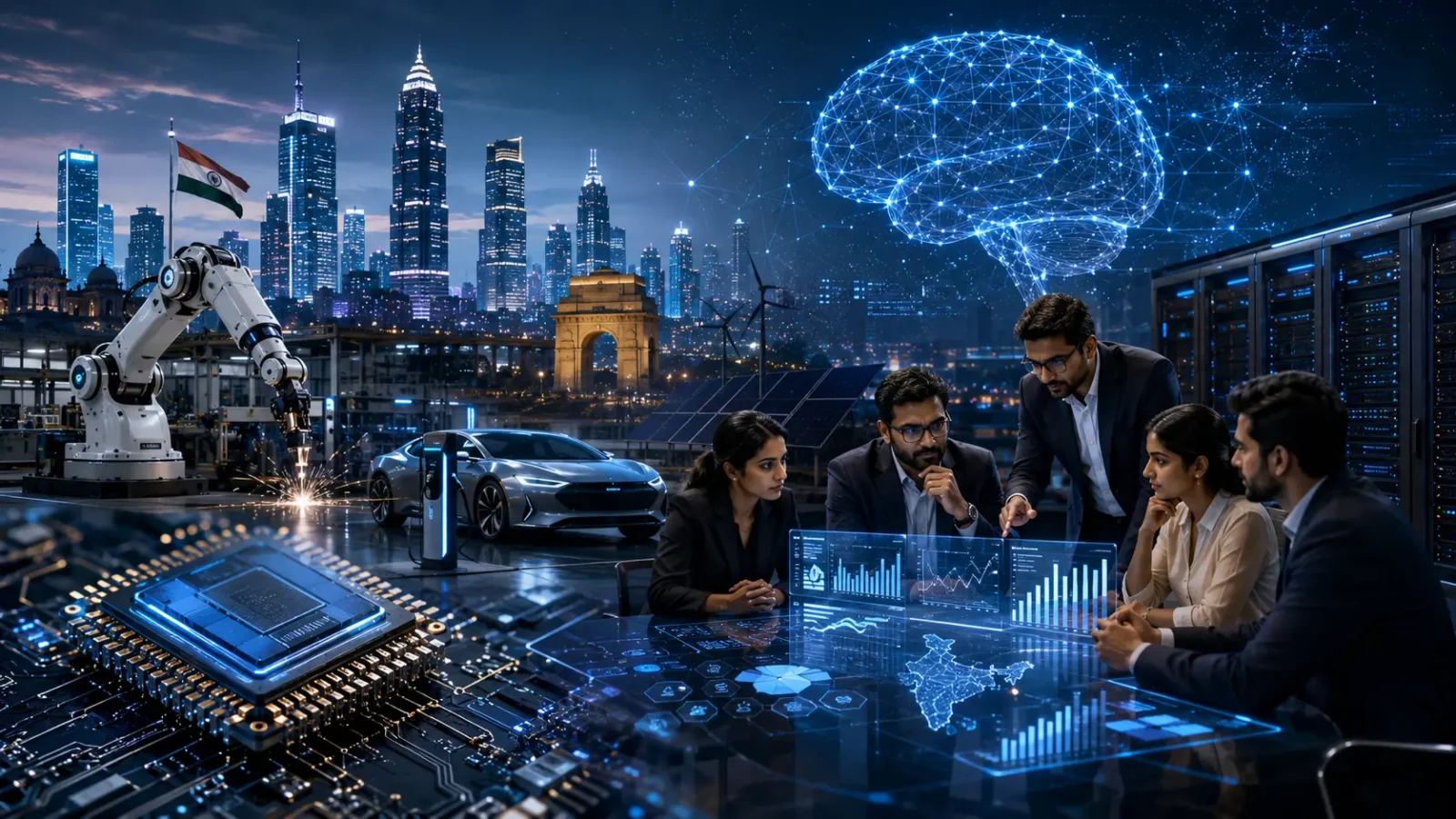
India’s startup story is changing.
For years, the country’s startup ecosystem was largely associated with consumer internet companies, fintech, e-commerce, food delivery and digital services. These sectors helped create some of India’s biggest technology companies and attracted billions of dollars from investors around the world.
But in 2026, another category is gaining serious attention: deeptech.
Artificial intelligence, semiconductors, robotics, advanced manufacturing, electric mobility, batteries, space technology and other science-intensive sectors are increasingly becoming important parts of India’s innovation economy.
Recent industry data shows just how quickly this shift is happening. More than 85% of the approximately $11.4 billion raised by Indian deeptech companies since 2015 was raised during the past six years, according to data cited by the Indian Venture and Alternate Capital Association (IVCA).
Another recent report said India’s deeptech funding reached a record level in 2025 even while overall startup funding declined, highlighting growing investor interest in areas such as AI, generative AI, electric vehicles and batteries.
So, what is driving this change?
What Is Deeptech?
Deeptech refers to technology businesses that are built around significant scientific or engineering innovation.
Unlike many traditional software startups, deeptech companies often require:
- Advanced research
- Specialized engineering
- Intellectual property
- Scientific expertise
- Hardware development
- Longer development cycles
- Significant capital investment
Examples include:
- Artificial intelligence
- Semiconductors
- Robotics
- Quantum computing
- Space technology
- Biotechnology
- Advanced materials
- Electric vehicle technology
- Energy storage
- Industrial automation
The important difference is that deeptech companies are often trying to solve difficult technical problems rather than simply creating another digital service.
Why Are Investors Looking at Deeptech Now?
The biggest reason is simple: technology is becoming strategic infrastructure.
AI requires computing power.
Computing power requires chips.
AI data centres require electricity and advanced cooling.
Robots require sensors, processors and sophisticated software.
Electric vehicles require batteries, power electronics and semiconductor components.
This means that the technologies supporting the digital economy are becoming increasingly valuable.
Investors are therefore looking beyond consumer applications and toward the infrastructure and intellectual property that can power the next generation of technology.
India’s Deeptech Funding Is Accelerating
The numbers tell an important story.
According to IVCA data reported by Business Standard, India’s deeptech companies have raised around $11.4 billion since 2015, with more than 85% of that capital raised during the last six years.
That acceleration is significant because deeptech traditionally requires more patient capital than conventional software startups.
The growing funding activity suggests that investors are becoming more comfortable with longer-term technology bets.
It also indicates that India’s startup ecosystem is gradually expanding beyond businesses built primarily around digital distribution.
Artificial Intelligence Is at the Centre of the Deeptech Story
AI is arguably the biggest force behind today’s deeptech investment cycle.
The global AI economy requires much more than large language models.
It requires:
- GPUs and AI accelerators
- Data centres
- Energy infrastructure
- Networking equipment
- Semiconductor design
- AI software
- Cybersecurity
- Data infrastructure
- Robotics
- Specialized AI applications
This creates opportunities for startups across the entire AI value chain.
Global investment in AI is projected to reach around $1 trillion in 2026, according to estimates cited by Goldman Sachs, highlighting the enormous scale of the worldwide AI investment cycle.
For India, this creates both an opportunity and a challenge.
The opportunity is to build companies that participate in this global technology ecosystem.
The challenge is developing the infrastructure, research capabilities and specialized talent required to compete internationally.
Semiconductors Are Becoming a Strategic Industry
Few technologies are as fundamental to the modern economy as semiconductors.
Almost every major technology product depends on chips.
They are used in:
- Smartphones
- Cars
- Data centres
- Medical equipment
- Industrial machines
- Satellites
- Consumer electronics
- AI systems
As countries seek greater control over their technology supply chains, semiconductor manufacturing and design have become strategic priorities.
India is also attempting to strengthen its position in this sector.
This creates opportunities for Indian startups working on:
- Chip design
- Semiconductor IP
- Electronic design automation
- Power electronics
- Packaging
- Testing
- AI accelerators
- Specialized processors
The opportunity is not limited to manufacturing.
India can potentially build significant value through chip design and semiconductor intellectual property.
The AI Infrastructure Opportunity
The rapid expansion of AI is creating an unexpected business problem: infrastructure.
AI models require enormous computing resources.
Data centres therefore need:
- Advanced processors
- High-speed networking
- Cooling systems
- Reliable electricity
- Storage
- Security
- Efficient power management
This has created a new category of businesses focused on AI infrastructure.
Indian startups are also looking at ways to solve these problems.
For example, Bengaluru-based C2i has raised funding to work on technology aimed at reducing power losses in AI data centres.
This demonstrates an important point:
The AI opportunity is not limited to AI applications.
There is also a large business opportunity in building the infrastructure that allows AI to operate.
Robotics Is Moving From Research Labs to Real Businesses
Another deeptech category attracting increasing investor interest is robotics.
Robots are becoming more capable because of advances in:
- Computer vision
- Machine learning
- Sensors
- Edge computing
- AI reasoning
- Battery technology
Investor interest is expanding across industrial robots, warehouse automation, healthcare robotics, agricultural robots and humanoid systems.
Recent industry analysis indicates that robotics startups attracted significant investment in 2026, with billions flowing into companies developing AI-powered robots and automation systems.
The long-term opportunity is enormous.
If AI gives machines the ability to understand and make decisions, robotics gives that intelligence a physical form.
Why India Has an Advantage
India has several characteristics that can support deeptech growth.
1. Large Engineering Talent Pool
India produces a large number of engineers and technology professionals every year.
This provides startups with access to technical talent across:
- Software
- Electronics
- Mechanical engineering
- Data science
- AI
- Semiconductor design
2. Strong IT Ecosystem
India already has one of the world’s largest technology services industries.
This provides an existing foundation of engineering knowledge, enterprise relationships and technical infrastructure.
3. Large Domestic Market
India’s large population provides startups with a substantial market for testing and deploying new technologies.
4. Growing Government Support
Government initiatives focused on electronics, semiconductors, manufacturing and emerging technologies are helping create a more supportive environment for technology businesses.
5. Global Demand
Indian startups are no longer limited to selling products inside India.
A successful deeptech company can potentially build technology for global customers.
But Deeptech Is Not Easy
The deeptech boom comes with major challenges.
Unlike a typical software startup, a deeptech company may need years of research before reaching commercial scale.
It may require:
- Expensive laboratories
- Specialized equipment
- Highly skilled researchers
- Hardware prototypes
- Regulatory approvals
- Manufacturing partnerships
This means founders need more than a good product idea.
They need technical depth, financial planning and long-term execution capability.
The Funding Challenge
Deeptech companies often need larger amounts of capital before generating significant revenue.
That creates a difficult funding cycle.
A startup may need to spend years developing its technology before it can generate meaningful commercial income.
Traditional venture capital models are not always designed for this timeline.
As a result, deeptech founders may need to combine:
- Venture capital
- Government grants
- Strategic investors
- Corporate partnerships
- Research funding
- International capital
Building the right funding strategy can be as important as building the technology itself.
Deeptech Could Change India’s Startup Identity
India has already established itself as a global hub for software and digital services.
The next step could be becoming a major hub for technology innovation.
Imagine an ecosystem where Indian companies are building:
- AI models
- Semiconductor chips
- Industrial robots
- EV components
- Battery technology
- Space systems
- Cybersecurity products
- Advanced manufacturing systems
That would represent a major evolution in India’s startup story.
Instead of primarily building businesses around digital distribution, more companies could be building proprietary technology.
What This Means for Entrepreneurs
The deeptech boom creates opportunities for founders willing to solve difficult problems.
The biggest opportunities may come from industries where technology can address major bottlenecks.
These include:
AI Infrastructure
Building tools and systems that help companies deploy AI efficiently.
Semiconductor Design
Developing specialized chips and semiconductor IP.
Robotics
Automating manufacturing, logistics and other physical processes.
Energy Technology
Improving batteries, power systems and renewable energy infrastructure.
Defence Technology
Developing advanced systems for national security and aerospace applications.
Space Technology
Building satellites, launch technologies and space-based services.
What Investors Are Looking For
Investors evaluating deeptech startups are likely to examine more than revenue growth.
They may look at:
- Intellectual property
- Technical differentiation
- Founding team’s expertise
- Research capability
- Market size
- Manufacturing feasibility
- Unit economics
- Regulatory environment
- Competitive advantage
- Commercial scalability
A strong technology alone is not enough.
A deeptech startup must eventually demonstrate that its technology can become a sustainable business.
The IPO Market Is Also Showing Strong Activity
Deeptech is not the only business trend gaining momentum.
India’s primary market is also experiencing renewed activity.
Seven companies are scheduled to launch IPOs between August 17 and August 21, collectively targeting more than ₹6,400 crore.
The market has also seen strong individual listings.
Dhoot Transmission, backed by Bain Capital, debuted on August 17 at a premium of nearly 38%, reflecting strong investor interest in its automotive and electric-vehicle-related manufacturing opportunity.
This broader IPO activity suggests that investor attention is not limited to early-stage startups.
There is also renewed interest in established growth companies entering public markets.
What Could Happen Next?
The next phase of India’s technology economy could be defined by convergence.
AI will combine with robotics.
Robotics will combine with manufacturing.
Semiconductors will support AI.
AI will accelerate scientific research.
Renewable energy will support data centres.
And startups will increasingly operate across multiple technology layers.
This could create entirely new categories of businesses.
India’s Deeptech Opportunity: The Bigger Picture
The most important part of India’s deeptech story is not simply the amount of money being invested.
It is the change in the type of technology being built.
The country is moving from:
Software services → Product technology → AI → Deeptech → Advanced industrial technology
That transition will take time.
Not every startup will succeed.
Some technologies will fail.
Some investments will not generate expected returns.
But the underlying trend is significant.
Capital is increasingly moving toward businesses that aim to build difficult, defensible and globally relevant technology.
What Businesses Should Watch in 2026
For entrepreneurs, investors and business leaders, several areas deserve close attention:
Artificial Intelligence
AI remains the largest technology investment theme.
Semiconductors
Chip design, manufacturing and supporting infrastructure could become increasingly strategic.
Robotics
AI-powered automation could transform physical industries.
Energy Infrastructure
AI growth is increasing demand for electricity and efficient data-centre infrastructure.
Cybersecurity
As AI adoption grows, protecting AI systems and data becomes increasingly important.
Advanced Manufacturing
Automation and intelligent manufacturing could create new opportunities for Indian companies.
Final Thoughts
India’s deeptech ecosystem is entering an important phase.
The latest funding numbers show that investors are increasingly willing to put capital behind AI, semiconductors, robotics, EV technology and other science-driven businesses. More than 85% of India’s deeptech funding since 2015 was raised in the past six years, highlighting how quickly investor interest has accelerated.
But funding alone will not determine India’s success.
The country will need strong research, skilled talent, patient capital, infrastructure and companies capable of turning scientific innovation into commercially viable products.
If those pieces come together, India’s next startup success stories may not simply be apps or marketplaces.
They could be chips, robots, AI systems, energy technologies and other technologies that shape the physical and digital economy.
The deeptech boom may therefore represent something bigger than another startup funding cycle.
It could be the beginning of India’s next technology revolution.
Frequently Asked Questions
What is deeptech?
Deeptech refers to companies built around significant scientific or engineering innovation, such as AI, robotics, semiconductors, biotechnology, quantum computing and advanced materials.
Why is deeptech funding increasing in India?
Investor interest is increasing because AI, semiconductors, robotics and other advanced technologies are becoming strategically important industries. Recent data shows that more than 85% of India’s deeptech funding since 2015 was raised during the past six years.
Which Indian deeptech sectors have the most potential?
AI, semiconductor design, robotics, EV technology, batteries, space technology, cybersecurity and advanced manufacturing are among the most promising areas.
Is India becoming a global deeptech hub?
India has a large engineering talent pool, a strong technology-services ecosystem and a growing startup market. These factors provide a strong foundation, although building a globally competitive deeptech ecosystem will require sustained investment in research, infrastructure and talent.
Why are semiconductors important for India?
Semiconductors are essential for smartphones, vehicles, data centres, AI systems, industrial equipment and many other technologies. Building stronger semiconductor capabilities can help India reduce supply-chain dependence and participate in a strategically important global industry.
Is AI part of deeptech?
Yes. AI can be considered a major deeptech category, particularly when companies are developing proprietary models, algorithms, specialized hardware or fundamental AI infrastructure.