A furnace can provide reliable heat for many years, but even a well-maintained system eventually reaches a point where repairs become more frequent or performance begins to decline. Homeowners often face a difficult decision when a furnace stops working properly: pay for another repair or start planning for replacement.
The right choice depends on several factors rather than age alone. Repair history, operating costs, safety concerns, heating performance, equipment condition, and the expected life of major components should all be considered. Looking at the complete picture can help homeowners make a practical decision without replacing a system unnecessarily.
Start With the Current Problem
The first step is understanding why the furnace is not working correctly. A heating system may stop producing enough heat because of a small component failure, airflow restriction, thermostat issue, ignition problem, or another repairable fault. A diagnosis should come before making a replacement decision.
A broken part does not automatically mean the furnace has reached the end of its service life. If the rest of the system is in good condition, repairing the failed component may restore normal operation. The more important question is whether the repair is a one-time problem or part of a pattern of ongoing failures.
Consider the Furnace’s Age and Condition
Age can help provide context, but it should not be the only deciding factor. An older furnace that has been well maintained may continue operating reliably, while a newer system that has suffered repeated failures may create different concerns.
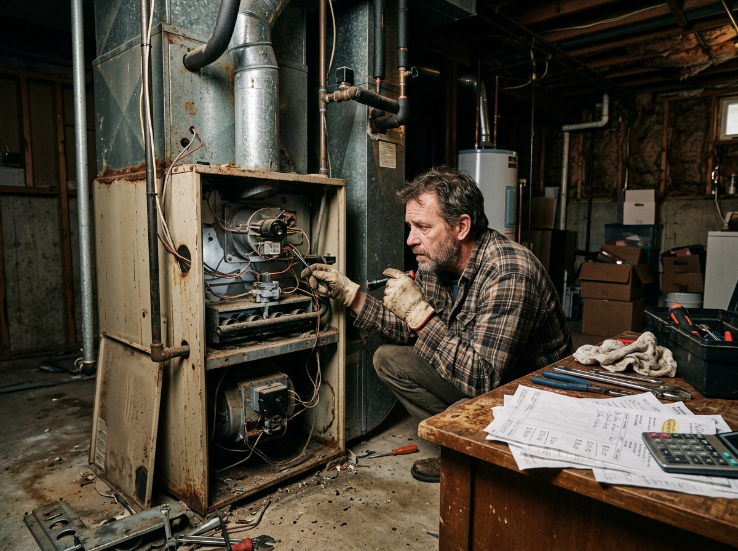
Look at the condition of heat exchangers, electrical components, blower assemblies, controls, burners, and other major parts when evaluating the system. A professional inspection can reveal whether the equipment has one isolated problem or multiple signs of deterioration that could lead to future repairs.
Repeated Repairs Change the Equation
One small repair may be easy to justify when the furnace is otherwise performing well. Repeated repairs are different because each additional failure increases the amount of money and time spent keeping the same system running.
Keep a record of recent furnace repairs and the components that have failed. A pattern of recurring breakdowns can provide useful information when deciding whether continued repairs are practical. It is also important to consider how disruptive repeated heating failures can be during colder periods.
When Furnace Replacement Becomes Practical
Furnace replacement may become a reasonable consideration when the existing equipment has widespread wear, recurring breakdowns, poor heating performance, or increasingly difficult repairs. Replacement can also make sense when major components are approaching the end of their useful service life.
A new furnace is a larger investment than a repair, so the decision should be based on the overall condition of the system. The home’s heating needs, available space, fuel source, ductwork, and installation requirements should all be reviewed before selecting replacement equipment.
Repairs Can Still Make Sense
Not every furnace problem calls for a new system. A faulty control, igniter, sensor, blower component, or another replaceable part may be the primary reason the furnace is not operating correctly.
For systems that still have good overall condition, an electric furnace repair service can address problems without replacing equipment that may still provide useful service. The important step is to determine whether the repair restores reliable operation or simply delays a larger problem that is already developing.
Pay Attention to Heating Performance
A furnace that runs but does not heat the home evenly can indicate a problem. Poor airflow, dirty filters, duct issues, equipment wear, thermostat problems, and other factors can all contribute to uneven heating.
Before assuming the furnace must be replaced, the full heating system should be considered. If the furnace is functioning properly but conditioned air is not reaching certain rooms, the problem may be elsewhere. Correct diagnosis helps prevent unnecessary replacement based on symptoms alone.
Watch for Unusual Noises
Furnaces normally produce some sound when starting and running, but new or unusual noises should not be ignored. Rattling, grinding, squealing, banging, or repeated clicking may point to a mechanical or electrical issue.
The timing of the sound can provide clues. A noise during startup may have a different cause from a noise that appears while the blower is operating. Because furnaces contain combustion, electrical, and moving components, persistent unusual sounds are better evaluated than ignored.
Safety Concerns Deserve Immediate Attention
Heating equipment should never be evaluated only from a comfort perspective. Problems involving combustion, exhaust, electrical wiring, or damaged components can create safety concerns that require professional attention.
A homeowner should not attempt to diagnose or repair potentially dangerous furnace components without appropriate training. Safety checks are particularly important when there are unusual odors, visible damage, repeated system shutdowns, or concerns about combustion and ventilation.
Think About Long-Term Operating Costs
Repair decisions should consider more than the immediate invoice. An older or poorly performing furnace may require longer run times to maintain the desired temperature, while repeated repairs can add to the total cost of ownership over time.
Replacement may provide an opportunity to install equipment that better matches the home’s heating needs. However, efficiency claims should be considered alongside installation quality, system sizing, maintenance needs, and existing duct performance rather than treated as the only factor.
Check the Ductwork Too
A furnace cannot distribute heat effectively if the duct system has leaks, restrictions, or damaged sections. Before replacing heating equipment because of comfort problems, it can be useful to determine whether the existing ducts are delivering air properly.
This is especially important when one room remains cold while others heat normally. Replacing a furnace without addressing a major airflow problem may leave the original comfort issue unresolved. Looking at the furnace and duct system together provides a more complete picture.
Prepare for Replacement Properly
When replacement is chosen, homeowners should consider the whole installation rather than focusing only on the furnace itself. Equipment sizing, location, venting, electrical connections, thermostat compatibility, duct connections, and access all influence the final result.
A properly planned installation can help the new equipment perform as intended. Choosing a system that is too large or too small for the home can create other efficiency and comfort problems. Installation quality is therefore just as important as the equipment selected.
Final Thoughts
The choice between repairing and replacing a furnace depends on the complete condition of the system. Age, repair history, heating performance, safety, operating costs, ductwork, and future reliability all deserve consideration. A single failed component does not automatically justify replacement, while repeated failures can indicate that continued repairs may no longer address the larger issue.
This decision also relates to equipment life cycle, which considers how equipment moves from installation and operation through maintenance, decline, and eventual replacement. Looking at the furnace over its full life can make repair and replacement decisions more practical.