
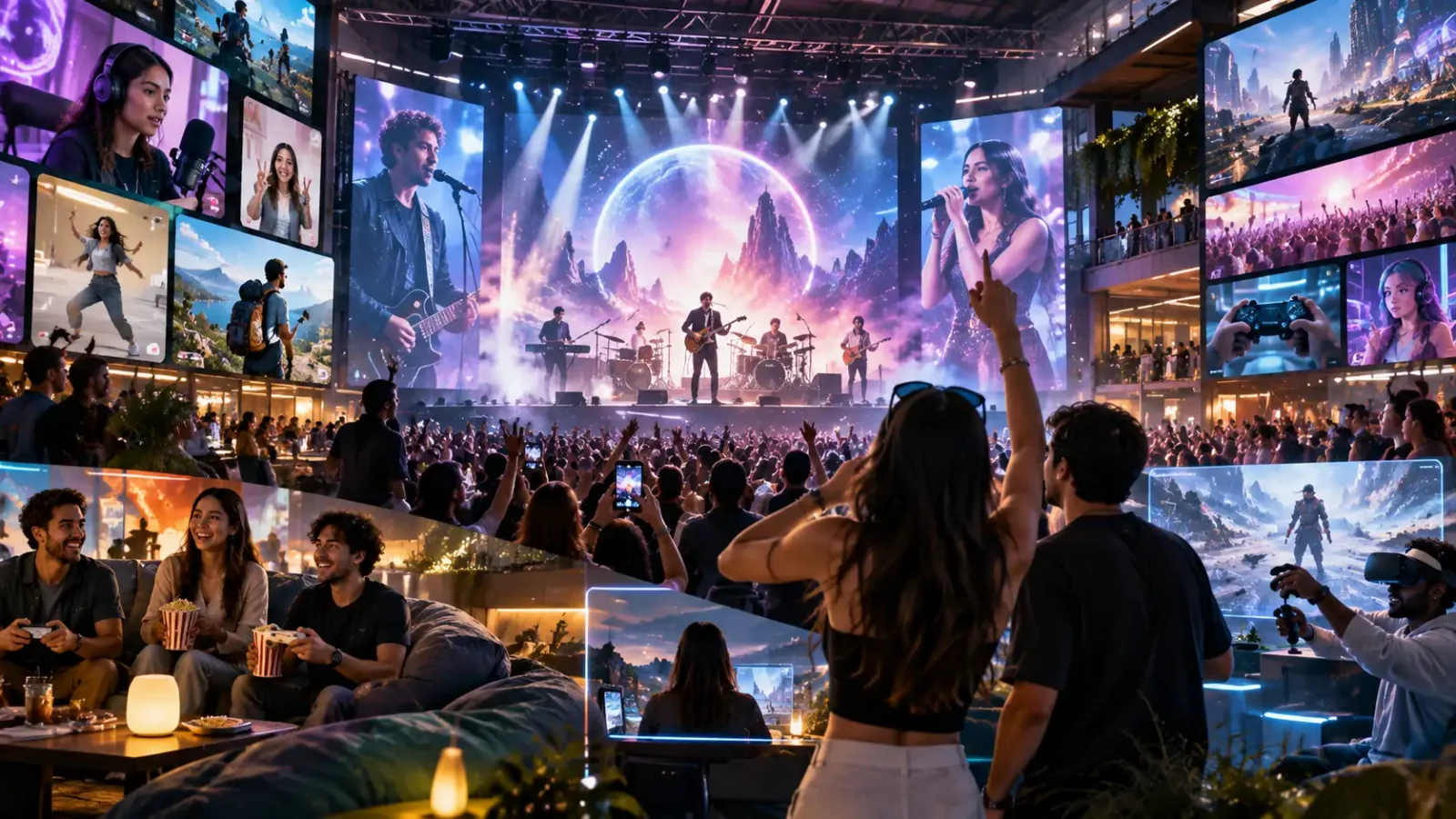
Entertainment has never been just about watching something.
It is about feeling something.
A movie can create an emotional connection.
A song can become part of someone’s identity.
A creator can build a community.
A concert can turn thousands of strangers into one audience.
And a streaming platform can make global content available within seconds.
But the entertainment industry is changing rapidly.
Artificial intelligence is entering creative workflows. Streaming platforms are trying to reduce complexity and improve discovery. Creators are becoming increasingly important to audience engagement. Fans are moving between social media, streaming, gaming and live experiences.
At the same time, audiences are showing that digital entertainment does not eliminate the desire for real-world experiences.
In fact, live and immersive entertainment is becoming increasingly important.
PwC’s 2026 Global Entertainment & Media Outlook expects the global E&M industry to continue growing through 2030, with technology and live experiences playing important roles.
India is experiencing a similar transformation. PwC India projects the country’s entertainment and media market to rise from US$25.7 billion in 2025 to US$36.7 billion by 2030, with AI, regional content, connectivity and premium live experiences among the major growth drivers.
So what will entertainment look like in 2026?
1. AI Is Becoming Part of Entertainment Production
Artificial intelligence is changing the entertainment production process.
AI tools are increasingly being explored for:
- Pre-visualization
- Editing
- Visual effects
- Subtitling
- Dubbing
- Voice workflows
- Content discovery
- Audience analysis
- Personalization
The technology can help production teams handle certain repetitive tasks faster.
In India, PwC identifies AI applications across content creation, production, discovery, advertising and audience engagement as an important part of the industry’s evolution.
However, AI also creates questions around copyright, consent, creative ownership and the role of human artists.
The technology may become an important production tool, but the creative responsibility behind a project remains significant.
2. Creators Are Becoming Major Entertainment Businesses
Entertainment is no longer controlled only by traditional studios, broadcasters and record labels.
Individual creators can now build audiences directly.
Creators can produce:
- Videos
- Podcasts
- Music
- Comedy
- Reviews
- Educational entertainment
- Live streams
- Short-form content
They can also develop businesses around their audiences through memberships, merchandise, advertising, live events and other forms of monetization.
Deloitte’s 2026 Digital Media Trends research found that 33% of surveyed consumers said they felt a stronger personal connection to social-media creators than to television personalities or actors.
This is changing the definition of an entertainment celebrity.
3. Short-Form Video Remains a Discovery Engine
Short-form video has become one of the fastest ways audiences discover:
- New music
- Movies
- Shows
- Creators
- Trends
- Memes
- Products
Short-form content can introduce audiences to a much longer piece of entertainment.
A short clip may lead to:
Clip → Creator → Series → Community → Live Event
Deloitte’s 2026 media outlook describes creator-led short-form content as a cultural currency and an innovation environment where ideas and formats can be tested quickly.
This makes short-form video important not only for social media but also for the wider entertainment ecosystem.
4. Streaming Is Moving Toward Simplicity
Streaming has given audiences enormous choice.
But too much choice can create a new problem:
What should I watch?
Consumers may have several subscriptions, different apps and separate content libraries.
Research from EY’s 2026 media and entertainment trends highlights the growing importance of simplifying entertainment access and reducing friction between different services.
This could mean better aggregation, smarter discovery and more unified viewing experiences.
The future of streaming may therefore be less about having more platforms and more about making existing content easier to discover.
5. AI Is Changing Content Discovery
AI is increasingly being used behind the scenes to help audiences discover entertainment.
Recommendation systems can analyse:
- Viewing behaviour
- Search history
- Preferences
- Genres
- Viewing patterns
Newer AI-powered systems can also understand more natural-language requests.
Instead of searching:
“Action movie”
a viewer might ask:
“Give me a fast-paced action movie under two hours with a strong emotional story.”
This makes entertainment discovery more conversational.
Indian OTT platforms are also exploring AI-powered recommendation, visual discovery, summaries, subtitling and voice-related workflows. Recent reporting on ZEE5’s technology overhaul described AI being integrated into both discovery and operational processes.
6. Fandom Is Becoming an Always-On Experience
A fan does not necessarily engage with a franchise only when a new movie or season launches.
They may:
- Watch interviews
- Follow actors
- Create fan videos
- Discuss theories
- Buy merchandise
- Join online communities
- Attend live events
- Play related games
Deloitte’s 2026 research argues that strong fandoms increasingly operate continuously between major releases, creating opportunities for content providers to engage audiences year-round.
This changes the traditional entertainment calendar.
The “off-season” can become part of the entertainment experience.
7. Live Entertainment Is Becoming More Valuable
One of the biggest paradoxes of digital entertainment is that more digital experiences can increase demand for real-world experiences.
People still want:
- Concerts
- Festivals
- Cinema
- Theatre
- Sports
- Fan events
- Immersive attractions
PwC expects live and immersive experiences to remain an important part of global entertainment spending.
The attraction is simple:
You were there.
A live event creates memories that cannot be perfectly replicated through a screen.
8. India’s Live Entertainment Culture Is Expanding
India is experiencing strong growth in live entertainment.
The FICCI-EY 2026 report found India’s M&E sector reached approximately ₹2.78 trillion in 2025, with live events growing 44% during the year.
Recent reporting also describes India’s concert culture shifting toward larger, more immersive experiences where production, audience interaction and shared atmosphere are becoming part of the value proposition.
This means concerts are increasingly becoming more than music performances.
They are becoming experiences.
9. Regional Content Is Becoming a Major Growth Engine
India’s entertainment audience is incredibly diverse.
Hindi is only one part of the market.
Regional-language content in languages such as:
- Tamil
- Telugu
- Malayalam
- Kannada
- Bengali
- Marathi
- Gujarati
- Punjabi
can reach highly engaged audiences.
PwC India identifies regionalisation as a powerful growth engine for India’s entertainment and media industry, particularly across cinema, OTT and music.
This creates an important opportunity:
Local stories can become global entertainment.
10. Global Audiences Are Discovering Local Stories
Streaming platforms have reduced geographic barriers.
A story created in one country can quickly reach audiences elsewhere.
This can increase interest in:
- Regional cinema
- International series
- Foreign-language music
- Local creators
- Cultural storytelling
Subtitles and dubbing make these experiences increasingly accessible.
AI-assisted multilingual workflows may further reduce barriers to international distribution.
11. Music Is Becoming More Connected to Visual Culture
Music discovery increasingly happens through visual platforms.
A song can become popular because of:
- A short video
- A dance trend
- A meme
- A creator collaboration
- A film scene
- A live performance
This means musicians increasingly operate within a broader entertainment ecosystem.
Music, video, social media and live events are becoming interconnected.
12. Physical Music Is Making a Comeback
While streaming remains dominant, physical formats are attracting renewed attention among some younger audiences.
Vinyl records, CDs and other physical media can provide something streaming does not:
Ownership and physical identity.
Recent reporting has highlighted renewed interest among younger consumers in vinyl, CDs and print products, driven partly by nostalgia, identity and the desire for tangible experiences.
This does not mean digital music is disappearing.
Instead, entertainment consumption is becoming more mixed.
13. Podcasts Are Becoming Part of Mainstream Entertainment
Podcasts have moved far beyond traditional interview formats.
Modern podcast entertainment can include:
- Comedy
- Crime
- Storytelling
- News
- Sports
- Culture
- Fiction
- Celebrity conversations
Video is also becoming increasingly important to podcast distribution.
This creates another hybrid entertainment format:
Audio + Video + Creator + Community
Podcasts can therefore compete not only with radio but also with video platforms and social media.
14. Gaming and Entertainment Are Converging
Gaming is no longer separate from mainstream entertainment.
Games increasingly connect with:
- Films
- Music
- Streaming
- Esports
- Creators
- Live events
Entertainment franchises can exist across several formats.
A story might begin as a movie, continue through a game and become a creator-led social community.
This cross-platform approach is becoming increasingly important for major entertainment brands.
15. Interactive Entertainment Is Growing
Audiences increasingly want to participate rather than simply watch.
Interactive entertainment can include:
- Live chats
- Fan voting
- Interactive storytelling
- Audience-controlled experiences
- Livestream participation
- Immersive installations
This changes the relationship between creator and audience.
The audience is no longer just a viewer.
They can become part of the experience.
16. Immersive Entertainment Is Creating New Experiences
Technology is also changing physical entertainment spaces.
Examples include:
- Immersive cinema
- Projection experiences
- Interactive museums
- Virtual reality
- Augmented reality
- Large-scale installations
These experiences combine storytelling with physical space.
The goal is not simply to watch something.
It is to enter the world of the story.
17. AI-Generated Content Creates New Creative Questions
AI can make content production faster.
But entertainment also needs originality and authenticity.
As AI-generated images, voices and videos become more sophisticated, audiences may increasingly ask:
- Who created this?
- Was AI used?
- Is the performer real?
- Was the voice authorized?
- Who owns the work?
These questions are becoming especially important for actors, musicians, writers and creators.
The current entertainment industry debate around generative AI includes concerns about worker rights, consent and the replication of performers’ identities.
18. Human Creativity Is Becoming More Valuable
AI can generate content quickly.
But speed does not automatically create meaning.
Audiences still respond to:
- Original stories
- Strong performances
- Authentic personalities
- Cultural relevance
- Emotional depth
This may make human creativity even more important.
AI can become a tool.
But the story still needs a reason to exist.
19. Entertainment Is Becoming More Personalized
Different viewers increasingly expect different experiences.
One person may want:
- Comedy
- Another person wants documentaries
- Another wants anime
- Another wants live sports
- Another wants regional cinema
Recommendation systems can personalize content discovery.
But personalization also creates a challenge:
Could people become trapped inside their existing preferences?
Entertainment platforms need to balance relevance with discovery.
Sometimes the most memorable experience is something you did not know you wanted to watch.
20. The Creator Economy Is Becoming Part of Mainstream Entertainment
Creators are no longer simply social-media personalities.
Many are becoming:
- Producers
- Hosts
- Musicians
- Entrepreneurs
- Event organizers
- Media brands
The creator economy is increasingly becoming part of the formal entertainment infrastructure.
Los Angeles, traditionally associated with Hollywood, is also increasingly becoming a hub for creator-economy businesses and infrastructure.
This shift is changing how entertainment companies discover talent.
How Audiences Are Consuming Entertainment in 2026
The modern entertainment journey can look like:
Short Video → Discovery → Streaming → Community → Fan Content → Live Event
For example:
A person discovers a song through a short video.
They listen to the full track.
They follow the artist.
They watch a live performance.
Then they attend a concert.
The boundaries between platforms are becoming less important.
The fan journey is what matters.
What Entertainment Companies Need to Understand
The modern audience wants more than content.
They want:
Convenience
Entertainment should be easy to find.
Personalization
Recommendations should feel relevant.
Community
Fans want places to interact.
Authenticity
People want genuine creators and stories.
Experiences
Audiences increasingly value things they can participate in.
Value
Consumers are becoming more selective about subscriptions and entertainment spending.
This means entertainment companies need to think beyond simply producing content.
They need to build relationships with audiences.
The Biggest Entertainment Trend of 2026
If all the major trends are connected, one idea stands out:
Entertainment Is Moving From Content Consumption to Continuous Fan Experience.
People do not simply watch.
They:
Watch → Share → Discuss → Create → Follow → Attend → Buy → Return
AI helps personalize the journey.
Creators build communities.
Streaming distributes content.
Social media drives discovery.
Gaming creates interaction.
Live events create memorable experiences.
And fandom connects everything together.
The Future of Entertainment
Entertainment will probably become increasingly hybrid.
A movie may have:
- A streaming release
- A social-media community
- Creator collaborations
- Merchandise
- Gaming connections
- Immersive experiences
A musician may combine:
- Streaming
- Short-form video
- Podcasts
- Fan communities
- Live concerts
- Physical products
The entertainment industry is therefore becoming less about individual formats.
It is becoming an interconnected ecosystem.
Final Thoughts
Entertainment in 2026 is changing because audiences are changing.
People have more choices than ever.
They can watch content from anywhere.
They can follow creators directly.
They can discover music through social media.
They can interact with fandoms.
And they can attend increasingly immersive live experiences.
AI is accelerating many of these changes.
But technology alone will not define the future of entertainment.
The strongest experiences will continue to depend on something much older:
A great story.
A memorable performance.
A powerful song.
A genuine creator.
A shared human experience.
The future of entertainment may be more digital, but audiences still want to feel connected.
And that may be the most important entertainment trend of all.
Frequently Asked Questions
What are the biggest entertainment trends in 2026?
Major trends include AI-assisted content creation, creator-led entertainment, short-form video, personalized streaming, fandom communities, regional content, live experiences, immersive entertainment and cross-platform storytelling.
How is AI changing entertainment?
AI is being used across areas such as pre-visualization, production, editing, dubbing, subtitling, recommendations, personalization and audience analysis.
Are creators replacing traditional celebrities?
Creators are becoming an increasingly important part of the entertainment ecosystem, with many building direct relationships and communities with audiences. Deloitte’s 2026 research highlights the strong connection some consumers feel with social-media creators.
Is streaming still important in 2026?
Yes. Streaming remains a major part of entertainment consumption, but platforms are increasingly focused on discovery, personalization, aggregation and reducing subscription friction.
Why are live events becoming more popular?
Live events offer shared, physical and immersive experiences that digital entertainment cannot completely replicate. PwC identifies live and immersive experiences as an important growth area in global entertainment.
Why is regional content important in India?
India’s diverse language markets create significant opportunities for regional cinema, OTT content and music. PwC India identifies regionalisation as a major growth engine for India’s entertainment industry.
Will AI replace human creativity?
AI can automate or assist with parts of the creative process, but entertainment still depends on storytelling, artistic judgment, performance and audience connection. The use of AI also raises questions around consent, rights and ownership.
What is the creator economy?
The creator economy includes individuals and businesses that create content and build audiences through platforms such as social video, streaming, podcasts and other digital channels, often monetizing through advertising, subscriptions, merchandise or live experiences.