Walk down any busy road in Karachi and you will see both worlds at once. Hand-painted shop signs, wall chalking, banners, and radio jingles sit alongside brands that run Instagram ads, answer customers on WhatsApp, and plan their content with AI tools. For a business owner deciding where to put limited money, the question is fair: is the new way actually better, or is the old way still doing the job?
The honest answer is more interesting than a simple winner. Traditional marketing built many of the brands Karachi trusts today, and it still works for certain goals. AI-assisted marketing has opened up faster testing, sharper targeting, and lower entry costs, yet it cannot replace trust, product quality, or the personal touch that local customers value. Treating the two as enemies misses how most successful businesses actually operate.
If you are weighing your options, a conversation with a specialist in digital marketing Karachi businesses rely on can help you match each approach to your goals and budget. In this guide, we compare how both methods work, where each one shines, where each one falls short, and how to combine them into a plan that fits your brand.
What traditional marketing means today
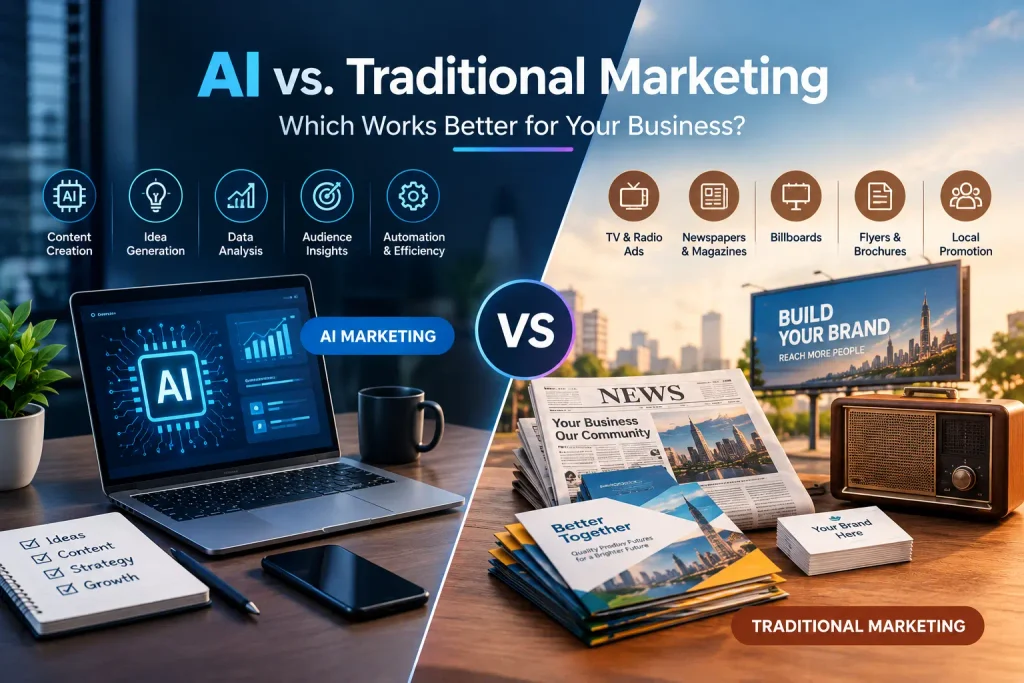
Traditional marketing covers the channels that existed before the internet reshaped advertising: billboards, newspapers, magazines, radio, television, banners, flyers, pamphlets, exhibitions, and word of mouth. It also includes in-person relationships, such as dealers, sales visits, and community events, which remain powerful in many Pakistani industries.
Its main strength is presence. A billboard on a major road or a well-placed shop sign reaches everyone who passes, whether they were looking for you or not. Television and radio still carry credibility with certain audiences, and a recommendation from a trusted friend or relative often outweighs any advertisement. For products that depend on physical visibility, such as food, retail, real estate, and events, these channels can still build awareness quickly.
The limitations are equally clear. Costs are often high and fixed, results are hard to measure, targeting is broad, and changes after launch are slow or impossible. You can see that people passed your billboard, but you rarely know how many became customers.
What AI marketing means in practice
AI marketing is not a separate channel. It is a set of tools layered on top of digital channels such as search, social media, email, messaging, and advertising platforms. It helps with drafting content, generating creative variations, analyzing customer behavior, optimizing ad delivery, answering common questions through chat, and predicting which leads are most likely to buy.
Its main strength is speed and learning. A small Karachi business can test several ad messages in a week, see which one gets more inquiries, and shift budget accordingly. It can reach people by location, interest, and behavior, and it can measure results down to the cost of each lead. Tasks that once needed a team can now be handled by a single person with the right tools.
The limitations are different. AI output can sound generic, contain errors, or miss local nuance. Tools depend on good data and clear goals, and they cannot create trust where none exists. Digital channels are also crowded, so attention is expensive and fleeting. For a broader look at how AI can support brand building without losing authenticity, see our post on how generative AI can improve your brand’s online presence.
Reach and targeting
Traditional marketing reaches a broad audience. A billboard, a radio spot, or a newspaper advertisement shows the same message to everyone who happens to see it, which is useful for building general awareness but wasteful when only a small group is actually likely to buy.
AI-supported digital marketing narrows the focus. You can show an ad only to people in specific areas of Karachi, within certain age groups, with particular interests or recent behavior. A tutoring center can target parents of school-age children near its branches, while a boutique can reach shoppers who have recently engaged with fashion content. This precision generally makes small budgets stretch further, though it also means you need to understand your customer well enough to choose the right targeting.
Cost and flexibility
Traditional channels usually require large upfront commitments. Printing, production, placement fees, and long booking periods leave little room for adjustment. If the message does not land, the money is already spent.
Digital campaigns allow you to start small, pause at any time, and change creative or audience in hours. This flexibility is especially valuable for startups and small businesses, where wasting a month’s budget on an untested idea can be painful. That said, digital advertising is not automatically cheap. Competition in popular categories pushes costs up, and poorly managed campaigns can burn through money just as quickly as a badly placed billboard.
Measurement and learning
Perhaps the biggest difference is how easily you can learn from results. With traditional marketing, measurement is often indirect. You might ask new customers how they found you, compare sales before and after a campaign, or track a special phone number, but the picture stays fuzzy.
Digital and AI-assisted marketing can show how many people saw an ad, clicked, messaged you, and eventually bought, along with the cost at each step. This makes it possible to improve continuously, cutting what fails and expanding what works. The caution is that numbers can mislead if tracking is incomplete or if you focus on vanity metrics like likes and impressions instead of inquiries and sales.
Trust and local relationships
Here, traditional marketing still has real advantages. In Karachi, trust is often built through familiarity, reputation, and personal recommendation. A shop that has served a neighborhood for years, a dealer with long relationships, or a brand seen consistently on television can feel more reliable than a new online advertiser.
AI marketing can support trust through reviews, helpful content, fast replies, and visible customer stories, but it cannot manufacture it. Customers are quick to notice automated messages that feel impersonal, exaggerated claims, or fake-looking reviews. The brands that win online are usually those that carry the same warmth and reliability that built their offline reputation.
Speed of customer interaction
Customers now expect quick answers. A person who sees your ad at night may message you immediately and expect a reply within minutes. AI-powered chat tools and WhatsApp automation can handle greetings, pricing questions, and basic information at any hour, which traditional channels cannot do.
However, the best experiences combine automation with human follow-up. A quick automated reply followed by a real person who understands the question and builds rapport tends to convert better than a purely robotic exchange. This is where small, local businesses can outperform large competitors, by being fast and personal at the same time.
Which approach suits which type of business
Different businesses benefit from different mixes. A neighborhood restaurant may gain more from a visible sign, word of mouth, and local social media than from an expensive television campaign. An online clothing brand will probably rely mostly on digital channels, with creators, short video, and retargeting doing the heavy lifting. A real estate developer may combine billboards and print for credibility with digital lead generation and WhatsApp follow-up. A clinic might benefit from a strong Google Business Profile and reviews, supported by local signage and referrals.
Established brands with large budgets often use traditional channels for mass awareness and digital channels for targeting and conversion. Startups with limited funds usually do best starting digitally, testing quickly, and adding offline elements once they know what works. Our comparison of digital marketing vs traditional marketing for Pakistani businesses goes deeper into how this choice plays out across industries.
Combining the two
The most effective Karachi brands rarely choose one side. They treat traditional and AI-assisted marketing as parts of the same journey. A billboard or radio spot might create awareness, then a search or social media ad reminds the viewer, a WhatsApp conversation answers questions, and a review or referral closes the sale.
Consistency is the key. The message, visuals, and tone should feel the same across a banner, an Instagram post, and a chat reply. Tracking helps tie the pieces together, whether through unique phone numbers, discount codes, QR codes on printed material, or simply asking every new customer how they heard of you. These small habits show which channels deserve more investment.
Common mistakes to avoid
Many businesses abandon traditional marketing too quickly and lose the trust and visibility it built, while others ignore digital channels and lose customers who search and chat online. Some adopt AI tools without a clear goal and end up with generic content that does not stand out. Others measure success by followers or impressions rather than real inquiries and sales, or fail to follow up on leads quickly enough. Finally, many expect instant results from either approach, when both usually need steady effort and honest evaluation.
Final thoughts
The real contest is not AI marketing versus traditional marketing. It is guesswork versus informed decisions. Traditional channels offer presence, credibility, and local familiarity, while AI-assisted digital channels offer precision, speed, and measurable learning. Each does something the other cannot do as well.
For Karachi brands, the smartest path is to start from your goals, understand where your customers actually spend their time, and build a mix that uses each method where it is strongest. Test small, track what you can, keep the human touch in every interaction, and adjust as you learn. That balanced approach will serve your business far better than choosing a side and hoping for the best.