If you commute through the same stretch of Toronto every day, try this: describe the billboard you pass most often. Most people cannot. The board is right there, large and well lit, and yet the brain has filed it under “background.” Advertisers call this banner blindness, and in dense urban markets it is one of the most persistent challenges in out-of-home (OOH) advertising. In my experience, the question for marketers is no longer whether OOH works. It is how to keep an audience noticing it.
The Real Limitation of Static OOH
Static billboards have real strengths, and I do not want to dismiss them. They run around the clock, they build familiarity, and they are often cost-efficient for broad awareness. Canada’s out-of-home sector is still growing, with industry revenues rising 5.8% year over year in 2025, according to the Canadian Out-of-Home Marketing and Measurement Bureau.
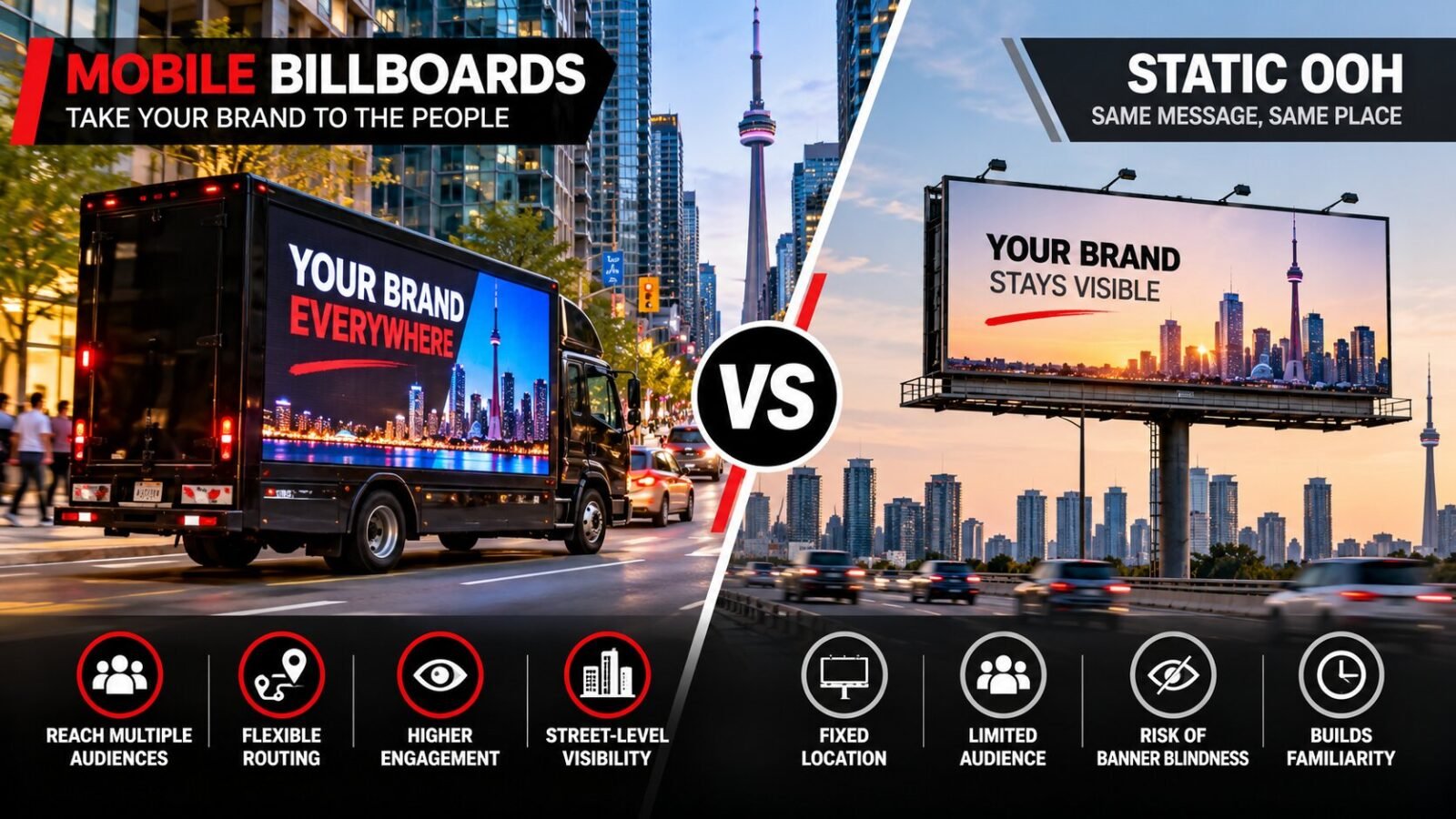
The weakness is repetition. A fixed board meets the same people at the same moment every day. Over time, the audience adapts and stops seeing it. This matters because noticing is not the problem for the medium as a whole. Older Canadian research found that roughly 96 per cent of consumers notice OOH advertising and 78 per cent pay attention to it. That study dates from 2017, so treat it as directional, but the point holds: people are exposed. The challenge is making an ad register when the same message sits in the same place for months.
Why Movement Changes Attention
Our eyes are built to detect change. A stationary object fades into the scene, while something moving across our field of view pulls attention back. A mobile billboard uses that instinct. It enters a street, passes a café patio, pulls up beside a bus stop and then moves on. Each appearance is brief, but each one is new.
I would be cautious about any claim that moving ads outperform static ones by a specific percentage in every case. Public data on that comparison is inconsistent, and results depend heavily on creative quality, route and timing. What I can say from working with campaigns is that movement gives an ad more chances to be seen as something new, rather than something familiar.
The principle: a static board waits for the audience to pass by. A mobile one goes to where the audience already is.
Eye-Level Visibility in High-Traffic Corridors
Most traditional billboards sit above the street, aimed at drivers travelling at speed. That works on highways. In downtown cores, a different dynamic applies. People are on foot, on bikes, in streetcars and stopped at red lights. Their attention is at street level, and the street-level view is where a mobile unit operates.
On corridors like Yonge, Queen and Bay, a vehicle display sits within the natural sightline of pedestrians waiting at a crosswalk, drivers in adjacent lanes and passengers on transit. Slow, stop-and-go traffic helps too. Congestion, which frustrates everyone else, gives a message extra seconds of exposure. For brands comparing options for outdoor advertising in Toronto, this is a useful distinction: fixed boards dominate the skyline, while mobile formats dominate the street.
Dynamic Routing: The Part Static Cannot Match
The most underrated benefit of a moving ad is that its location is a decision, not a constraint. A fixed board has one address for the entire contract. A mobile advertising truck can follow the audience through the day.
Here is how that looks in practice:
- Mornings: transit hubs and commuter routes, where audiences move with purpose.
- Lunch hours: business districts and food-heavy streets, ideal for restaurants and retail.
- Evenings and weekends: shopping areas, entertainment districts and residential neighbourhoods.
- Event days: stadiums, festivals and venues, where crowds gather for a limited time.
Routes can also change mid-campaign. If tracking shows that one neighbourhood produces more response than another, the next day’s plan shifts. That feedback loop is difficult to reproduce with a fixed structure.
A Campaign Worth Describing
A client I will keep anonymous, a new fitness studio opening in a dense urban neighbourhood, started with a well-placed static board on a main arterial. Awareness was reasonable, but sign-ups were slow. We added a mobile unit for several weeks, routed it past office towers at lunch and residential blocks in the early evening, and used a distinct promo code on the creative so responses could be traced to the campaign.
The code redemptions during the weeks the truck ran were clearly higher than in the weeks with the static board alone. The lesson was not that one format beat the other. The two worked together: the fixed board built familiarity, and the moving unit delivered that message directly to the people the studio most wanted to reach.
Where Static Still Wins, and How to Combine Both
An honest comparison includes the trade-offs. Static boards offer continuous presence and typically lower cost per impression over long periods. Mobile units cost more per day but allow targeting and flexibility. So the most effective plans I have seen treat the formats as partners. A fixed board holds the brand in people’s minds, while a moving unit supports launches, events, promotions and areas the fixed board cannot reach.
Moving campaigns also work well alongside live activations. A pop-up, product demo or sponsored event often needs sound, screens and staging, which is where AV equipment rental in Toronto fits naturally into the plan. A truck can draw the crowd, and the activation gives them a reason to stay.
Planning for Measurement and Compliance
Moving advertising should be held to the same standard as any other channel. Before launch, set one clear objective, such as store visits, sign-ups or promo code use. Build in a way to trace response: a dedicated landing page, a unique code or a QR code on the creative. Ask for route logs so you can match activity to results afterward.
Local rules matter as well. Parking, idling and signage regulations vary by municipality, so confirm the requirements for each area on your route before the campaign starts.
Choosing the Right Mix
For brands competing in busy urban markets, the goal is to keep the message from fading into the scenery. Static OOH gives you scale and familiarity. Moving ads add novelty, street-level visibility and the ability to adjust as you learn. Used together and measured honestly, they let a campaign stay fresh long after a fixed board would have become part of the background.