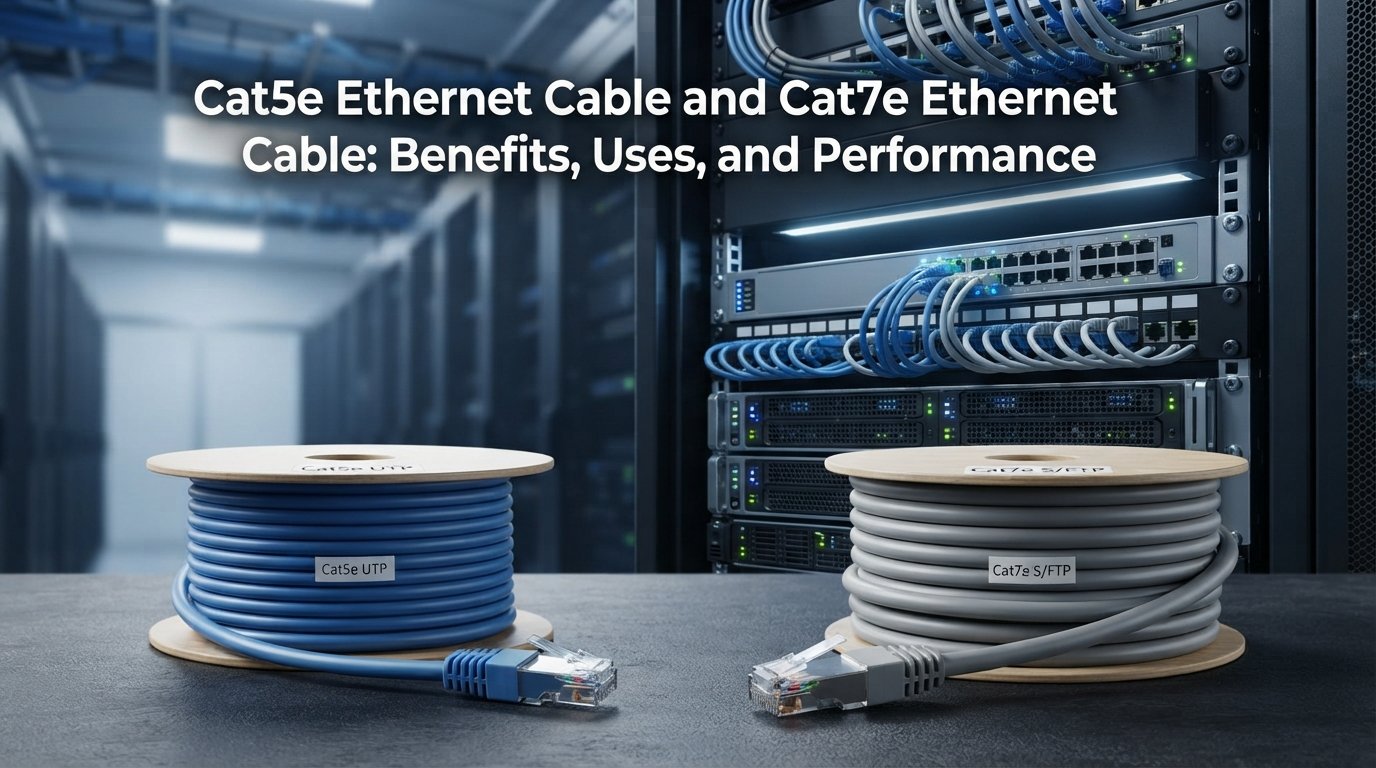
Whether you’re setting up a home office, wiring a small business, or planning a larger network installation, the cable you choose plays a bigger role than most people realize. A network is only as reliable as its weakest link, and in a lot of cases, that weak link is outdated or poorly matched cabling.
Two options that come up often when people compare their choices are Cat5e Ethernet cable and Cat7e Ethernet cable. Each has its own strengths, and neither is automatically “better” than the other it really comes down to what your network needs to do. This article walks through what each cable type offers, where it tends to make the most sense, and how to think about choosing between them for your own project.
What Is a Cat5e Ethernet Cable?
Cat5e, short for Category 5 enhanced, has been a workhorse in network cabling for years. It was designed as an improvement over the original Cat5 standard, reducing crosstalk and signal interference between the internal wire pairs. That improvement made it a dependable, well-tested choice for everyday Ethernet networking.
It’s still one of the most widely used cable types today, largely because it strikes a good balance between performance and affordability.
Speed and Bandwidth
Cat5e is built to support standard network speeds commonly used in homes, offices, and small business environments. It handles everyday tasks like web browsing, file sharing, video calls, and general internet traffic without issue.
Compatibility
One of the quiet advantages of Cat5e is how compatible it is with existing equipment. Most routers, switches, and network devices are designed to work seamlessly with Cat5e cabling, which makes it easy to integrate into networks that are already up and running.
Cost-Effectiveness
Cat5e Ethernet cable tends to be more budget-friendly than higher-tier options, which makes it appealing for large installations where a lot of cable runs are needed — think office buildings or multi-room homes.
Installation
Cat5e is generally easier to work with. It’s more flexible than heavier-duty shielded cables, which simplifies routing through walls, conduits, and tight spaces during installation.
Common Network Applications
Cat5e shows up in a wide range of everyday setups, from home networks to small offices, and it remains a practical choice for straightforward Ethernet networking needs.
What Is a Cat7e Ethernet Cable?
The term “Cat7e” is where things need a little more explanation. Unlike Cat5e, Cat6, Cat6a, and Cat7 which are recognized categories with defined specifications from standards bodies Cat7e is not a formally recognized industry standard in the same way. It’s a term used by some manufacturers and vendors in the marketplace to describe cabling that builds on Cat7-style shielding and construction techniques.
That doesn’t mean the cable itself lacks value. It simply means that “Cat7e” specifications, ratings, and performance claims can vary from one manufacturer to another. Because of that, it’s always worth checking the manufacturer’s documentation and specifications before making assumptions about what a particular Cat7e Ethernet cable is rated to do.
High-Performance Networking
Cables marketed under the Cat7e label are generally positioned as a higher-performance option within a manufacturer’s product line, often intended for environments where users want extra headroom in their network infrastructure.
Shielded Cable Designs
Many Cat7e products use shielded designs, such as individually shielded pairs wrapped in an overall shield. This construction is intended to help manage interference more effectively than typical unshielded cabling.
Interference Protection
Shielded designs like these can be useful in environments where electromagnetic interference (EMI) is more of a concern — for example, near heavy electrical equipment, industrial machinery, or dense cable runs.
Demanding Network Environments
Because of their construction, Cat7e-labeled cables are often chosen for network setups where users want additional protection and durability built into the infrastructure from the start.
Importance of Checking Manufacturer Specifications
Since “Cat7e” isn’t standardized the way other categories are, it’s a good habit to review the manufacturer’s spec sheet for details on shielding type, conductor material, and intended use before selecting a cable for a specific project.
Cat5e Ethernet Cable and Cat7e Ethernet Cable: Performance Explained
It’s tempting to boil network performance down to the cable alone, but that’s not really how networking works in practice.
Speed and bandwidth are influenced by the cable, yes, but they’re also shaped by the routers, switches, and network interface cards (NICs) the cable connects to. A high-quality cable paired with older networking hardware won’t perform any better than what that hardware allows.
Signal quality and interference protection depend on the cable’s construction shielded versus unshielded as well as how and where the cable is installed. Running cable near power lines or fluorescent lighting, for instance, can affect performance regardless of the cable category.
Network reliability and stability come down to the full picture: cable quality, connector quality, termination technique, and how carefully the installation was done. A well-installed Cat5e Ethernet cable network can outperform a poorly installed Cat7e Ethernet cable network, simply because installation quality matters that much.
The takeaway here is that cabling is one important piece of a larger system, not the whole story.
Benefits of Cat5e Ethernet Cable
- Cost-effective networking — a practical option for projects with a lot of cable runs or tighter budgets.
- Easy installation — flexible and straightforward to route through typical residential or office spaces.
- Reliable everyday performance — well-suited to standard internet use, file sharing, and general connectivity.
- Wide range of applications — works across homes, offices, and many common business setups.
Benefits of Cat7e Ethernet Cable
- High-performance networking — often positioned by manufacturers as a step up for users wanting more headroom.
- Protection against interference — shielded designs (where applicable) can help in environments with more electrical noise.
- Strong infrastructure for demanding networks — a reasonable fit for setups that call for more robust cabling.
- Long-term network planning — some users choose Cat7e-labeled cabling as part of building out infrastructure meant to last, though it’s worth confirming specific specs with the manufacturer first.
Common Uses of Cat5e Ethernet Cable
Cat5e continues to show up in a wide variety of everyday settings, including:
- Home networks and home offices
- General office and small business networking
- VoIP phone systems
- Network printers
- IP cameras and basic surveillance setups
- Standard Ethernet connections between routers, switches, and devices
Its combination of affordability and reliability makes it a sensible default for a lot of common networking needs.
Common Uses of Cat7e Ethernet Cable
Cat7e-labeled cabling is often considered for environments where extra shielding or a higher-performance profile is desired, such as:
- Business and commercial network installations
- Environments with more electrical equipment or potential interference
- Structured cabling projects where users want additional shielding
- Network infrastructure built with future upgrades in mind
As always, it’s worth reviewing the specific manufacturer’s specifications to confirm the cable is a good match for the intended environment.
How to Choose the Right Ethernet Cable for Your Network
There’s no single “correct” cable for every situation. A few questions can help point you in the right direction:
- What network speed do you actually need right now?
- What are your current and future bandwidth requirements?
- What does the installation environment look like — walls, conduit, open spaces, outdoor runs?
- Will the cable be indoors, outdoors, or both?
- Is EMI or signal interference a realistic concern in your space?
- What kind of cable construction fits the job — UTP or shielded?
- Solid or stranded conductors — solid is common for in-wall runs, stranded for patch cables and flexibility.
- What jacket rating do you need — plenum, riser, or standard PVC, depending on local code and where the cable runs?
- What conductor material does the cable use?
- What does your budget allow for, especially across larger installations?
Working through these questions before buying cable in bulk can save a lot of time and rework later.
Why Cable Quality Matters for Network Performance
Not all cables labeled the same category perform the same way, which is why quality matters as much as category.
- Pure copper vs. copper-clad aluminum (CCA): Pure copper conductors generally offer better conductivity and long-term reliability compared to CCA alternatives.
- Quality connectors: Poor connectors can introduce signal loss even when the cable itself is well made.
- Proper termination: Careful, consistent termination practices help preserve the cable’s intended performance.
- Correct installation: Following best practices during installation protects the investment you’ve already made in good cabling.
- Avoiding excessive bends and pulling: Tight bends and excessive pulling force can damage internal wire pairs, even if the damage isn’t visible from the outside.
- Cable testing after installation: Testing confirms that runs are performing as expected before you consider the job finished.
Choosing Quality Ethernet Cables from BN Cables
When it comes to sourcing cabling for a project whether it’s a handful of patch cables or a full building installation working with a supplier that offers consistent, well-made products makes the process easier.
BN Cables offers a range of networking cables and connectivity solutions, including bulk Ethernet cable options for larger installations, along with Cat5e, Cat6, Cat6a, and other cabling categories to fit different project requirements. Having access to multiple cable types in one place makes it simpler to plan a network around actual needs rather than settling for whatever happens to be available.
For anyone comparing a Cat5e Ethernet cable against a Cat7e Ethernet cable for an upcoming project, working with a supplier who can walk through specifications and answer questions directly is genuinely useful — especially given how much manufacturer terminology can vary at the higher end of the market.
Installation Tips for Better Ethernet Performance
A good cable can still underperform if the installation isn’t handled carefully. A few practical tips:
- Plan cable lengths in advance to avoid excessive slack or cables that are stretched too tight.
- Avoid sharp bends, which can stress the internal wiring and affect signal quality over time.
- Keep reasonable separation from power cables to reduce the chance of electrical interference.
- Use quality connectors and keystone jacks, since weak links at either end can undercut an otherwise solid cable run.
- Terminate connections properly, following consistent wiring standards throughout the installation.
- Test cables after installation to confirm each run is performing the way it should before calling the project complete.
Taking a little extra time on these details tends to pay off in fewer troubleshooting headaches down the road.
Final Thoughts
Both Cat5e Ethernet cable and Cat7e Ethernet cable have a place in modern networking. Cat5e remains a dependable, cost-effective choice for everyday connectivity across homes, offices, and small businesses. Cat7e-labeled cabling, while not a formally standardized category, is often positioned by manufacturers as a higher-performance, more heavily shielded option for environments that call for it.
The right choice ultimately depends on your specific network requirements — speed, environment, equipment, budget, and how the installation will be handled. Taking the time to think through those factors, rather than assuming one cable type is universally “better,” will lead to a network that actually fits your needs.
If you’re planning a project and want to compare options, BN Cables is a good place to look at Cat5e, Cat6, Cat6a, and other Ethernet cabling solutions, and to find the right fit for your specific installation.