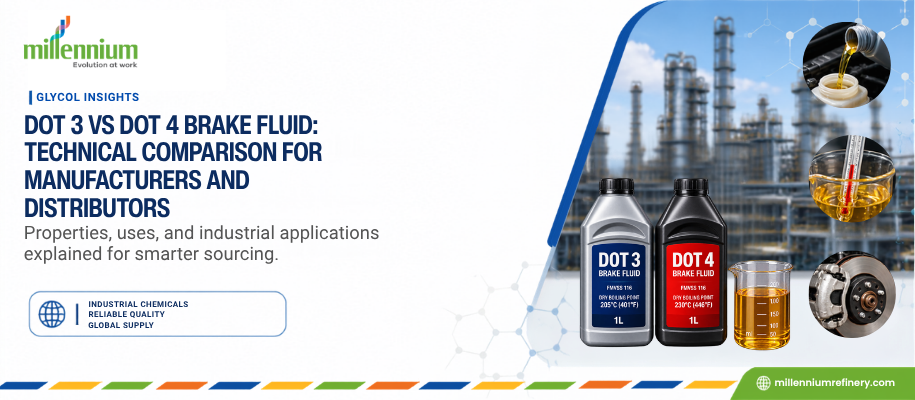
Brake fluid is a critical component in automotive braking systems, helping transfer hydraulic pressure from the brake pedal to the braking components. For manufacturers, distributors, and automotive suppliers, choosing the right specification is important for performance, safety, and compatibility. Among the most commonly used glycol-based brake fluids are DOT 3 and dot 4 brake fluid.
Although both fluids are designed for hydraulic braking systems, they differ mainly in boiling points, moisture resistance, performance under demanding conditions, and application requirements. Understanding these differences helps manufacturers and distributors select suitable products for different vehicle and market requirements.
DOT 3 Specifications
DOT 3 brake fluid is generally glycol-ether based and is widely used in conventional hydraulic braking systems. It offers reliable braking performance under normal operating conditions and is commonly found in passenger vehicles and light-duty applications.
One of the important characteristics of DOT 3 is its boiling point. Fresh DOT 3 fluid typically has a minimum dry boiling point of around 205°C (401°F), while its minimum wet boiling point is approximately 140°C (284°F) under FMVSS 116 specifications.
Because brake fluid is hygroscopic, it can gradually absorb moisture from the atmosphere. As water content increases, the boiling point decreases, which can affect performance during heavy braking or high-temperature operation.
For manufacturers, DOT 3 can be an economical option where the braking system does not experience particularly high thermal loads. Distributors may also find demand for DOT 3 in older vehicles and standard automotive applications.
However, product selection should always follow the vehicle manufacturer’s specified brake-fluid grade rather than relying only on boiling-point differences.
DOT 4 Specifications
Dot 4 brake fluid is also generally based on glycol ethers but is formulated to provide higher boiling performance than DOT 3. This makes it suitable for applications where braking systems experience greater heat and more demanding operating conditions.
Under FMVSS 116, DOT 4 brake fluid has a minimum dry boiling point of approximately 230°C (446°F) and a minimum wet boiling point of approximately 155°C (311°F).
The higher boiling point gives DOT 4 greater resistance to vapor formation when the brake system becomes hot. This can be particularly important during repeated braking, high-speed driving, heavy loads, or applications where brake temperatures can rise significantly.
For manufacturers and distributors, DOT 4 can therefore provide a higher-performance option for modern vehicles and demanding automotive applications. Depending on the formulation, manufacturers may also develop DOT 4 products with additional characteristics such as improved low-temperature performance, corrosion protection, and extended service performance.
Technical Comparison
The primary difference between DOT 3 and DOT 4 is their minimum boiling-point requirements. DOT 4 generally offers higher dry and wet boiling points, providing greater thermal margin under demanding braking conditions.
| Property | DOT 3 | DOT 4 |
|---|---|---|
| Typical chemistry | Glycol ether based | Glycol ether based |
| Minimum dry boiling point | 205°C / 401°F | 230°C / 446°F |
| Minimum wet boiling point | 140°C / 284°F | 155°C / 311°F |
| Heat resistance | Moderate | Higher |
| Typical use | Standard braking systems | More demanding braking systems |
| Moisture absorption | Hygroscopic | Hygroscopic |
The actual performance of a commercial product can vary depending on its formulation and quality. Manufacturers should therefore test finished brake fluids against the applicable standards and specifications before commercialization.
Another important consideration is compatibility. Although DOT 3 and DOT 4 fluids are both glycol-based and can be compatible in many systems, users should always follow the vehicle or equipment manufacturer’s recommendations. Brake fluids should not be selected simply because one grade has a higher boiling point.
For manufacturers, quality control should include testing of boiling point, viscosity, water content, corrosion characteristics, and compatibility with system materials. Proper packaging and storage are also important because exposure to moisture can influence brake-fluid performance.
Industrial Applications
DOT 3 and DOT 4 brake fluids are primarily associated with automotive hydraulic braking systems, but their commercial markets can vary depending on vehicle type and regional requirements.
DOT 3 is commonly positioned for conventional passenger vehicles, light-duty vehicles, and older braking systems that specify this grade. Its cost-effectiveness and established use make it relevant for aftermarket distributors and automotive service markets.
DOT 4 is increasingly important for applications requiring higher thermal performance. It is commonly specified in many modern passenger vehicles and can be relevant to vehicles operating under heavier braking conditions.
For distributors, offering both grades can help address different customer requirements. Clear labeling, technical documentation, batch traceability, and appropriate packaging are particularly important when supplying automotive workshops, retailers, vehicle manufacturers, and bulk buyers.
Manufacturers supplying international markets should also pay attention to the relevant regulatory and industry requirements. Products should be tested and labeled according to the standards applicable to their intended markets.
If you are looking for More information about brake-fluid specifications, performance requirements, or bulk supply considerations, reviewing the applicable technical standards and manufacturer documentation is recommended. Buyers can also Read more about formulation, packaging, and quality-control requirements before selecting a supplier.
The Bottom Line
DOT 3 and DOT 4 brake fluids both play an important role in hydraulic braking systems, but DOT 4 generally provides higher minimum boiling-point performance and is better suited to applications exposed to greater thermal demands. DOT 3 remains a practical choice for systems specifically designed for that specification.
For manufacturers and distributors, the best choice depends on vehicle requirements, applicable standards, operating conditions, formulation quality, and customer demand. Rather than treating DOT 4 as universally better, suppliers should ensure that the brake fluid specification matches the braking system and the manufacturer’s requirements.
Reliable sourcing, consistent formulation, laboratory testing, and proper technical documentation are essential for delivering dependable brake-fluid products to automotive markets.