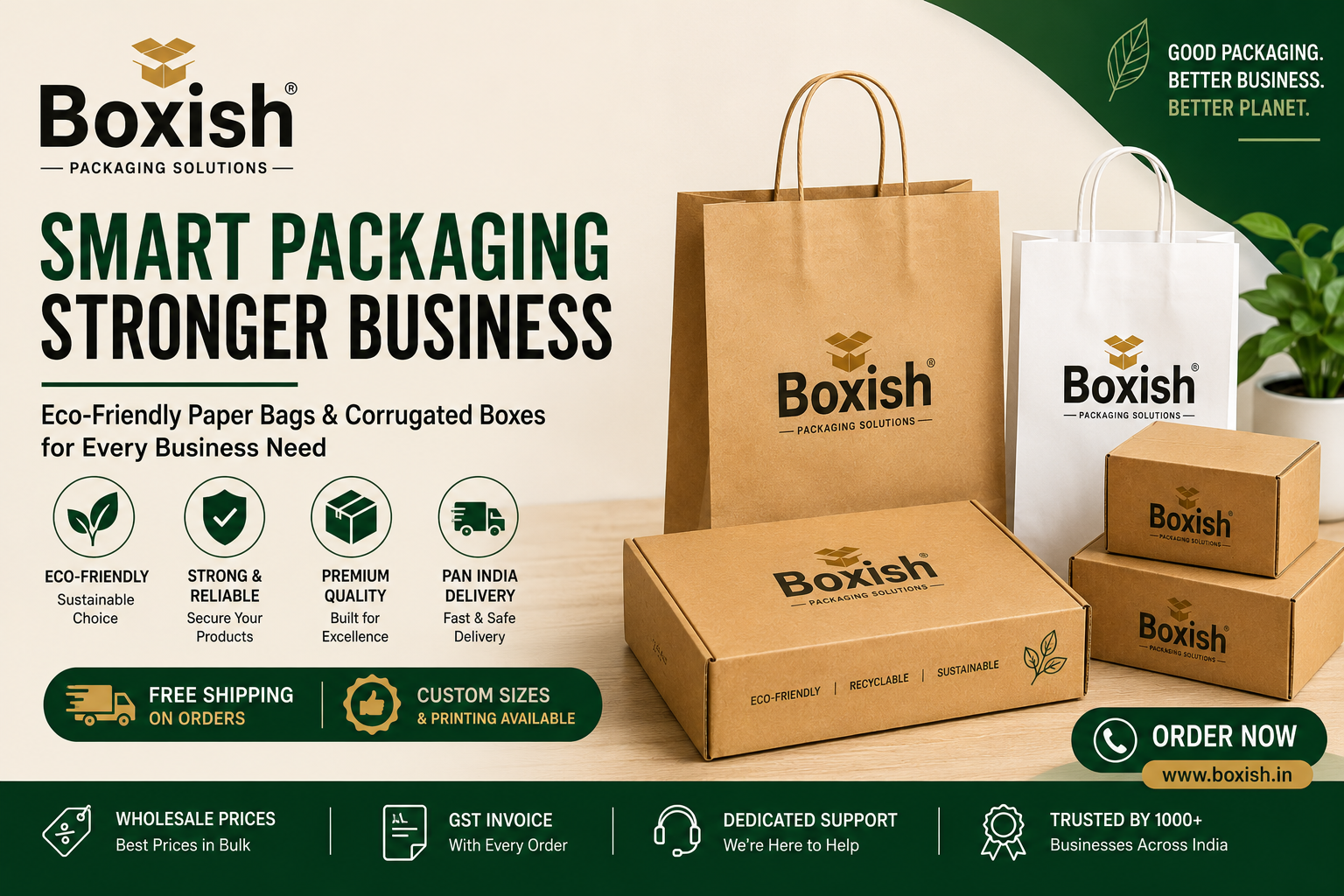
Paper bags may look simple, but manufacturing a strong and attractive bag involves several carefully controlled steps. The quality of the paper bag size, GSM, printing method, handle design, adhesive, folding, and final inspection all affect the performance of the finished product.
From retail stores and clothing brands to bakeries, restaurants, gift shops, and other businesses, paper bags are used for carrying products while also providing an opportunity for brand presentation.
Understanding how paper bags are made can help businesses choose the right material, construction, size, and quality when purchasing packaging in bulk.
This guide explains the complete paper bag manufacturing process, from selecting raw materials to producing the finished bag.
What Are Paper Bags Made From?
Paper bags are primarily made from paper, with kraft paper being one of the most commonly used materials. The paper is selected according to the required strength, appearance, size, and application.
Several factors influence the choice of paper:
-
Paper GSM
-
Paper quality
-
Brown or white finish
-
Required load-bearing capacity
-
Bag dimensions
-
Printing requirements
-
Handle type
-
Intended product
-
Moisture and storage conditions
For lightweight retail products, a particular paper specification may be sufficient, while heavier products require stronger paper and suitable bag construction.
Step 1: Selecting the Right Paper
The manufacturing process begins with selecting the appropriate paper.
Kraft paper is widely used because it provides a combination of strength, flexibility, and a natural appearance. White paper can also be selected when businesses require a cleaner or brighter surface for branding and product presentation.
The GSM, or grams per square meter, is an important consideration. Higher GSM generally indicates a heavier paper, although actual bag strength also depends on construction, dimensions, paper quality, and other factors.
Manufacturers select the paper according to the intended use rather than simply choosing the thickest available material.
For example, a small bag carrying lightweight clothing may require a different specification from a larger bag designed to carry multiple retail products.
Step 2: Preparing the Paper
Once the paper has been selected, it is prepared for conversion into bags.
Large paper rolls or sheets are checked for quality before entering production. The material may be inspected for:
-
Surface defects
-
Thickness consistency
-
Moisture condition
-
Color consistency
-
Paper strength
-
Printing suitability
Proper preparation is important because defects in the raw material can affect the appearance and performance of the finished bag.
The paper is then positioned in the manufacturing equipment according to the required bag specifications.
Step 3: Cutting the Paper to Size
The next stage involves cutting or feeding the paper according to the required bag dimensions.
A paper bag needs specific measurements for its:
-
Width
-
Height
-
Side gusset
-
Bottom section
-
Handle area
Manufacturers use machinery and controlled measurements to maintain consistency across large production quantities.
Accurate sizing is particularly important for businesses ordering bags in bulk because inconsistent dimensions can affect product fit and customer experience.
Step 4: Printing the Design
If the bags require branding, printing is normally completed during the manufacturing process.
Businesses can add elements such as:
-
Company logo
-
Brand name
-
Tagline
-
Website
-
Contact information
-
Social media details
-
Promotional messages
-
Product-related graphics
Depending on the order and production method, manufacturers may use suitable printing techniques for the required design.
The printing stage needs careful alignment because the design must appear in the correct position after the paper is folded into the final bag shape.
For retail businesses, this stage is particularly important because the finished bag can become an extension of the brand identity.
Step 5: Creating the Bag Shape
After cutting and printing, the flat paper is converted into the basic three-dimensional bag structure.
The paper is folded along predetermined lines to create the front, back, sides, and bottom of the bag.
The folding process determines the final shape and dimensions of the product.
Depending on the design, the bag may have:
-
Flat sides
-
Side gussets
-
A flat bottom
-
A block bottom
-
Different opening styles
Accurate folding ensures that the bag maintains its intended shape and can stand or carry products properly.
Step 6: Applying Adhesive
Adhesive is used to join different sections of the paper bag.
The manufacturer applies adhesive to specific areas where the paper needs to be connected. These can include the side seam and bottom construction.
The amount and placement of adhesive are important. Too little adhesive can weaken the joint, while excessive adhesive may affect the appearance or production efficiency.
Industrial production equipment helps maintain consistent adhesive application across large quantities.
Step 7: Forming the Bottom
The bottom is one of the most important parts of a paper bag because it supports the weight of the product.
During this stage, the lower portion of the bag is folded and sealed according to its design.
A properly constructed bottom helps distribute the load and reduces the risk of the bag opening during normal use.
Manufacturers consider factors such as:
-
Product weight
-
Bag dimensions
-
Paper GSM
-
Bottom construction
-
Adhesive strength
-
Intended application
A bag designed for lightweight items may have different bottom construction from one intended for heavier retail products.
Step 8: Making and Attaching Handles
Not every paper bag has the same handle design. Depending on the application, manufacturers may produce bags with different handle options.
Common handle styles include:
Twisted Paper Handles
Twisted paper handles are made by twisting paper strands into a stronger handle structure. They are commonly used for retail and shopping bags.
Flat Paper Handles
Flat handles provide a simple and clean appearance and can work well for different retail applications.
Handleless Paper Bags
Some bags are designed without handles and are intended to be folded, carried directly, or used with other packaging arrangements.
Handle attachment is an important stage because the handle must remain securely connected to the bag during normal carrying.
Step 9: Folding and Final Assembly
After the main sections have been formed and the handles attached where required, the bag goes through final folding and assembly.
The manufacturer ensures that:
-
Side seams are properly sealed
-
Bottom sections are correctly formed
-
Handles are positioned correctly
-
Printed designs are aligned
-
Bag dimensions remain consistent
The bag is then shaped into its final form.
Step 10: Quality Inspection
Quality control is an essential part of paper bag manufacturing.
Finished bags are inspected to identify production defects before they are packed for delivery.
Quality checks may include:
Size Inspection
The dimensions of the bag are checked against the required specifications.
Printing Inspection
Printed logos, graphics, and text are checked for alignment, clarity, and consistency.
Handle Inspection
Handles are checked to ensure they are properly attached and suitable for the intended load.
Bottom Inspection
The bottom construction is examined to make sure the bag has been properly sealed.
Appearance Inspection
The finished bags are checked for visible defects, stains, wrinkles, printing problems, or other issues.
Quality control helps maintain consistency, especially when producing large quantities for businesses.
Step 11: Counting and Packing
After quality inspection, the finished bags are counted and packed according to the customer’s order.
Bulk orders may be organized into bundles or cartons for easier handling and transportation.
Proper packing helps protect the bags from:
-
Dust
-
Moisture
-
Physical damage
-
Excessive compression
-
Handling during transportation
The packaged bags are then prepared for dispatch.
Step 12: Storage and Delivery
Before delivery, finished paper bags should be stored in suitable conditions.
Because paper can be affected by moisture, storage areas should ideally be clean and dry.
Manufacturers and suppliers also need to consider how the bags are packed during transportation. Proper protection helps ensure that the products reach the customer in usable condition.
For businesses purchasing large quantities, appropriate storage at the customer’s warehouse is equally important.
Different Types of Paper Bags and How Their Manufacturing Can Differ
Not every paper bag is manufactured in exactly the same way. The basic process remains similar, but construction and finishing can change according to the intended application.
Brown Kraft Paper Bags
Brown kraft bags have a natural appearance and are commonly used for retail, takeaway, grocery, and other packaging applications.
Their manufacturing focuses on selecting suitable kraft paper and creating the required bag dimensions and construction.
White Paper Bags
White paper bags provide a cleaner and brighter surface for printing and product presentation.
They are commonly used by retailers, boutiques, bakeries, gift businesses, and brands that want a more polished packaging appearance.
SOS Paper Bags
SOS bags are designed with a self-opening square or block-style bottom. Their construction allows them to stand more easily, making them useful for food, grocery, and takeaway applications.
The bottom structure is an important part of their manufacturing process.
Paper Bags With Handles
Handle bags require an additional manufacturing stage for producing and attaching the handle.
The handle material and attachment method should be selected according to the expected carrying load.
Designer and Printed Paper Bags
Designer bags can include customized graphics, colors, branding, and finishing elements.
Their manufacturing requires greater attention to printing quality, color consistency, alignment, and overall appearance.
Why GSM Matters in Paper Bag Manufacturing
GSM stands for grams per square meter and is commonly used to describe paper weight.
It is an important specification, but GSM alone does not determine the complete performance of a bag.
A bag’s strength can also depend on:
-
Paper quality
-
Bag dimensions
-
Construction
-
Handle attachment
-
Bottom design
-
Adhesive
-
Product weight
-
Manufacturing accuracy
Therefore, businesses should not choose paper bags based only on GSM. The complete construction should match the intended application.
How Custom Paper Bags Are Manufactured
Businesses often require packaging that reflects their brand rather than using plain bags.
Custom manufacturing can include changes to:
-
Bag size
-
Paper color
-
GSM
-
Handle style
-
Printing
-
Logo placement
-
Artwork
-
Bag construction
-
Quantity
The process generally starts with the customer’s specifications and artwork. The manufacturer then prepares the production setup according to the required dimensions and design.
Before large-scale production, specifications should be confirmed carefully to avoid errors in size, printing, or construction.
How Paper Bags Support Business Branding
A paper bag is not only a carrying container. For many businesses, it can also serve as a physical branding tool.
When customers carry a printed bag outside a store, the logo and business information can become visible to other people.
This can help businesses create greater brand recognition through everyday customer interactions.
Retailers can use branded bags to create consistency between their:
-
Store design
-
Product packaging
-
Website
-
Logo
-
Marketing materials
-
Customer experience
The bag therefore becomes part of the overall packaging and branding strategy.
Where Are Paper Bags Commonly Used?
Paper bags are used across many industries.
Retail Stores
Clothing, footwear, accessories, cosmetics, bookstores, and general retail businesses can use paper bags for customer purchases.
Restaurants and Cafés
Suitable paper bags can be used for takeaway orders and selected food applications.
Bakeries
Bakeries may use paper packaging for bread, pastries, dry snacks, and other suitable products.
Gift Shops
Designer and customized paper bags can improve the presentation of gift purchases.
Events and Promotional Activities
Businesses can use printed bags to distribute promotional materials, products, or event merchandise.
E-commerce Businesses
Paper bags can complement other shipping and packaging formats for certain products and customer-facing applications.
Paper Bags and Other Packaging Formats
Paper bags are often only one part of a business’s overall packaging system.
For shipping products, a corrugated box can provide the structural protection needed during transportation. Paper bags can then be used for retail purchases or customer-facing packaging.
For products requiring a more structured presentation, folding boxes can provide a compact and customizable packaging format.
Food businesses may use a pizza box for the primary packaging of pizzas and a suitable carry bag for transporting multiple takeaway items.
Using different packaging formats for different applications can help businesses improve both functionality and presentation.
What Makes a Good Paper Bag?
A high-quality paper bag should be appropriate for its intended application.
Important characteristics include:
-
Correct paper GSM
-
Suitable dimensions
-
Strong construction
-
Properly sealed seams
-
Reliable bottom construction
-
Secure handles where applicable
-
Clear and accurate printing
-
Consistent production quality
-
Appropriate packaging for storage and transportation
The strongest or thickest bag is not necessarily the best choice. The goal is to select a bag that provides the right balance between performance, appearance, and cost.
How Businesses Should Choose Paper Bags
Before placing a bulk order, businesses should consider the following:
1. Identify the Product
Understand what will be carried inside the bag and how much it weighs.
2. Select the Right Size
The bag should accommodate the product without excessive empty space or forcing the product inside.
3. Choose Appropriate Paper Quality
Select paper based on product weight, intended use, appearance, and handling requirements.
4. Decide on Handles
Choose handleless, flat-handle, or twisted-handle construction depending on the application.
5. Plan the Branding
If the bag will represent your business, prepare the logo, artwork, colors, and required information before production.
6. Order According to Demand
Bulk purchasing can help businesses maintain consistent packaging availability, but inventory should be based on realistic consumption.
7. Check Samples
Whenever possible, businesses should evaluate samples before placing large customized orders.
Common Mistakes Businesses Make When Buying Paper Bags
Businesses sometimes focus too heavily on price and overlook other important specifications.
Common mistakes include:
-
Choosing the wrong bag size
-
Using insufficient paper strength
-
Ignoring handle quality
-
Not checking bottom construction
-
Ordering without reviewing printed artwork
-
Buying more stock than the business can store
-
Selecting packaging without considering the product weight
-
Comparing suppliers only on price
A better approach is to compare the complete specification and expected performance.
Final Thoughts
Paper bag manufacturing involves much more than simply cutting and folding paper. The process includes selecting the right paper, preparing the material, cutting, printing, folding, applying adhesive, forming the bottom, attaching handles, assembling the bag, performing quality checks, and packing the finished products.
Every stage can influence the final product’s appearance, strength, consistency, and usability.
For businesses, understanding this process makes it easier to choose the right paper bags for retail, food, gifting, promotional activities, and other applications. Instead of selecting packaging based only on appearance or price, businesses should consider paper quality, GSM, dimensions, construction, handles, printing, product weight, and expected usage.
A well-manufactured paper bag can provide practical carrying functionality while also supporting a consistent and professional brand experience.
Frequently Asked Questions
1. What material is used to make paper bags?
Paper bags are primarily made from paper, with kraft paper being a commonly used material. Different paper qualities, colors, and GSM specifications can be selected according to the intended application.
2. How are paper bags manufactured?
Paper bags are generally manufactured through a series of steps including paper selection, preparation, cutting, printing, folding, adhesive application, bottom formation, handle attachment, final assembly, quality inspection, and packing.
3. What is GSM in paper bags?
GSM means grams per square meter and indicates the weight of the paper. It is an important specification, but bag strength also depends on construction, dimensions, paper quality, handles, and other factors.
4. Can paper bags be customized?
Yes. Businesses can customize paper bags with different sizes, colors, printing designs, logos, handle styles, and other specifications depending on manufacturing capabilities and order requirements.
5. How are paper bag handles attached?
Depending on the bag design, handles can be attached using suitable adhesive, reinforcement, or mechanical construction. The attachment method should be appropriate for the expected carrying load.
6. Are paper bags suitable for heavy products?
Paper bags can be designed for different load requirements, but businesses should select suitable paper quality, dimensions, bottom construction, and handle design according to the product weight.
7. Why is quality control important in paper bag manufacturing?
Quality control helps identify problems with dimensions, printing, handles, seams, bottom construction, and overall appearance. It is particularly important for businesses purchasing paper bags in bulk.
8. Can printed paper bags be used for business branding?
Yes. Printed paper bags can display logos, brand names, taglines, websites, contact information, and promotional designs, allowing packaging to contribute to brand visibility and customer experience.