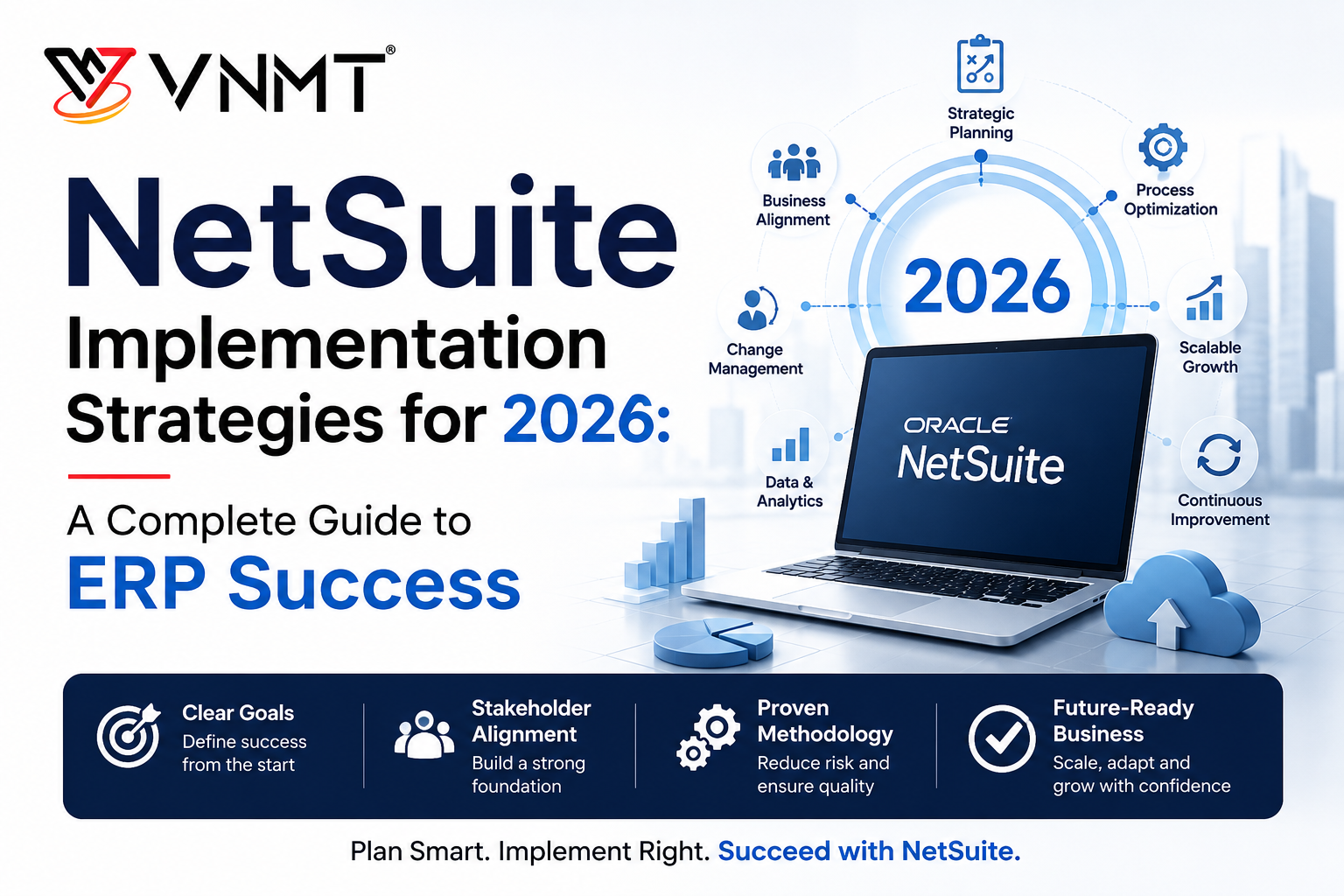
Getting an ERP system up is not limited to flipping a switch. Instead, it is a journey that touches every corner of your business. When it comes to NetSuite, you are not just installing software; you reshape how your data flows, how your teams work, and how decisions are made. By 2026, organizations that execute their NetSuite implementation effectively from the outset gain a competitive advantage that others struggle to match. The landscape keeps shifting with the latest automation tools and AI capabilities that looked impossible just a few years ago.
Begin with Strategy, Not Software
Many implementations fail because teams rush to configure screens before mapping out what they are actually trying to achieve. Your NetSuite implementation best practices 2026 plan is required to answer difficult questions first.
Build Your Implementation Team the Right Way
Your implementation holds the capability to make or break your deployment. For this, you require an executive sponsor who actually turns up, not a stakeholder who authorizes the budget but does not remain engaged in the process. Someone who holds key meetings, makes tough calls when departments don’t agree, and breaks through political roadblocks.
Your project manager needs to be ruthless about scope. Following ERP implementation best practices means you are saying no to requests that don’t fit with the core objectives. And here is what has changed for 2026: get in touch with someone who has knowledge of AI in ERP implementation. Not a data scientist necessarily, but someone who knows when automation opportunities exist.
Get Data Migration Right from the Beginning
Organizations underestimate the complexity until they are three weeks from go-live, when they realize their customer master file is an utter disaster. NetSuite data migration best practices start with the assessment of current data quality. Plan your data migration in phases. Begin with master data, vendors, customers, employees, and items. When that becomes stable, you can move to open transactions.
Prioritize Configuration Over Customization
Excessive customization introduces long-term technical complexity and enhances maintenance obligations. Before developing custom code or scripts, companies should critically assess whether an adjustment to internal processes could attain the expected outcome. In many cases, inefficiencies stem from outdated workflows rather than system limitations. The built-in configuration capabilities of NetSuite, including saved searches, form customization, and workflows, can address the majority of functional needs without additional coding. Well-documented and structured custom components are quite easy to handle and can be maintained through the course of time.
Implement Rigorous Testing Procedures
Extensive testing is important for implementation success. User acceptance (UAT) should involve actual end users instead of completely relying on the project team. Representatives from operations, sales, and finance must validate real-world scenarios reflective of regular responsibilities.
Testing exercises should include complex transactions, including processing multi-line orders with tax considerations, conducting month-end financial close activities, and fabricating management reports. Every identified issue, whether a technical defect, a challenge, or a functional gap, must be systematically evaluated. Critical issues should be resolved before go-live, while minor limitations should be presented with defined workarounds. It is important to have a transparent assessment of risks and readiness.
Strengthen Change Management Practices
Technical deployment alone does not assure adoption. Effective change management ensures that employees understand the purpose and its impact. It is crucial to keep the communication timely, consistent, and clearly conveyed. In addition, training programs are required to be comprehensive and ongoing. Providing advanced training to these team members helps build a strong and lasting internal support system within the organization.
Strategic Planning to Go-Live
Meticulous planning is required for the transition to live operations. It is important for the organization to select the dates vigilantly, avoiding high-volume business periods, including month-end cycles. A moderate transaction window enables teams to address unavoidable challenges without extensive operational pressure. Maintaining temporary parallel access to the legacy can help users reference historical data during the transition. Moreover, expanded support availability during the post-launch period is essential. Establishing a centralized issue-resolution process assists in faster identification and relief from operational disruptions.
Thoughtful Integration of Artificial Intelligence
By 2026, NetSuite has expanded its capabilities to support improved forecasting and greater automation across key business processes. Features within the platform help streamline routine activities such as invoice processing, expense approvals, and inventory management, enabling teams to reduce manual effort and focus on more strategic work.
Within NetSuite environments, these tools can strengthen demand planning, improve visibility into cash flow, and help identify unusual transactions or operational exceptions. This allows finance and operations teams to respond more quickly and maintain better control over daily workflows.
At the same time, the value of these capabilities depends largely on the quality of the underlying data. Organizations implementing NetSuite should therefore focus on maintaining accurate records, consistent data structures, and clear process governance so that automated insights remain reliable and useful.
Monitor Emerging Cloud ERP Trends
The ERP landscape continues to grow. Composable architectures gain prominence, enabling organizations to integrate specialized applications through APIs while maintaining NetSuite as the central financial system of record. This approach improves flexibility without compromising data integrity.
Mobile accessibility has become a standard expectation, particularly for operational teams, including warehouse personnel. Mobile workflows are tested with the same diligence applied to desktop processes. In addition, ESG reporting and sustainability tracking are increasingly integral to focus on reporting needs. It is crucial for organizations to plan for relevant data capture from the outset to ensure seamless compliance and reporting capabilities.
Two additional developments are influencing ERP strategy in 2026:
- AI-enabled process automation and forecasting: Modern ERP platforms are embedding intelligent tools that can automate repetitive activities, flag irregular transactions, and assist with demand forecasting. When supported by reliable data, these capabilities help companies shift toward more proactive and insight-driven decision-making.
- Greater emphasis on industry-focused ERP capabilities: Businesses are increasingly favoring ERP systems that offer configurations tailored to their specific sector. Pre-built workflows and reporting structures aligned with industry practices can shorten implementation timelines and improve operational alignment.
Post-Implementation Optimization
The conclusion of the go-live phase marks the beginning of continuous improvement. Structured governance processes must define how enhancement requests are analysed. Quarterly system reviews can identify optimization opportunities and consider alignment with evolving business objectives. With NetSuite introducing regular platform updates, internal super users stay consistently trained and informed to ensure that new features are adopted and used efficiently.
In the absence of proper engagement, system performance may stagnate despite platform advancements.
Final Words
A successful NetSuite implementation in 2026 needs planning, operational flexibility, and sustained organizational commitment. There could be a shift in timelines, budgets might expand, and user resistance might emerge. However, with strategic execution, organizations attain measurable efficiency gains. This leads to systematic processes, automated reporting, and manual reconciliation being replaced by data-driven decision-making. A thoroughly planned implementation strategy, framed on robust data governance, proactive change management, and structured customization, elevates ERP deployment beyond a typically technical project. NetSuite becomes a driving force for recurring improvement and operational excellence.
Do not let ERP implementation challenges delay your progress. With expert execution, NetSuite can redefine how your business functions. To engage with reliable advisors, reach out to reliable NetSuite providers.
Author: Mrudul Modh
Do visit: https://www.vnmtsolutions.com/