Why Long-Term Landlords Have Started Looking at Smart Sensors
Smart property sensors built their initial reputation in short-term vacation rentals where the operational case was obvious: protect properties from party damage, monitor energy waste between guests, and document compliance with platform rules. Long-term rental landlords were a slower adoption category for understandable reasons. Long-term tenants are different from vacation guests in their privacy expectations, their property usage patterns, and their relationships with landlords. Approaches that worked for vacation rentals could not transfer directly to long-term rental contexts without thoughtful adaptation.
Several factors have changed the calculus for long-term landlords over the past several years. Privacy-first sensor design has matured to the point where monitoring no longer requires invasive surveillance. The categories of monitoring most useful in long-term contexts, including environmental safety and infrastructure protection, do not require detailed tracking of tenant behavior. Property protection benefits, particularly around water leaks, fire safety, and HVAC efficiency, apply just as strongly to long-term rentals as to short-term ones. The combination has produced growing interest from long-term landlords who previously assumed sensors were not relevant to their operations.
What Long-Term Sensor Monitoring Actually Looks Like
Smart sensors in long-term rentals focus on environmental safety and infrastructure protection rather than the behavioral monitoring associated with short-term vacation rentals. Smoke and elevated particulate matter monitoring provide fire safety information that complements required smoke alarms. Carbon monoxide monitoring adds a second layer of life safety. Humidity monitoring identifies conditions that lead to mold and water damage. Temperature monitoring catches HVAC failures before they become dangerous in extreme weather. Water leak detection through external sensors reveals plumbing issues before they cause major damage.
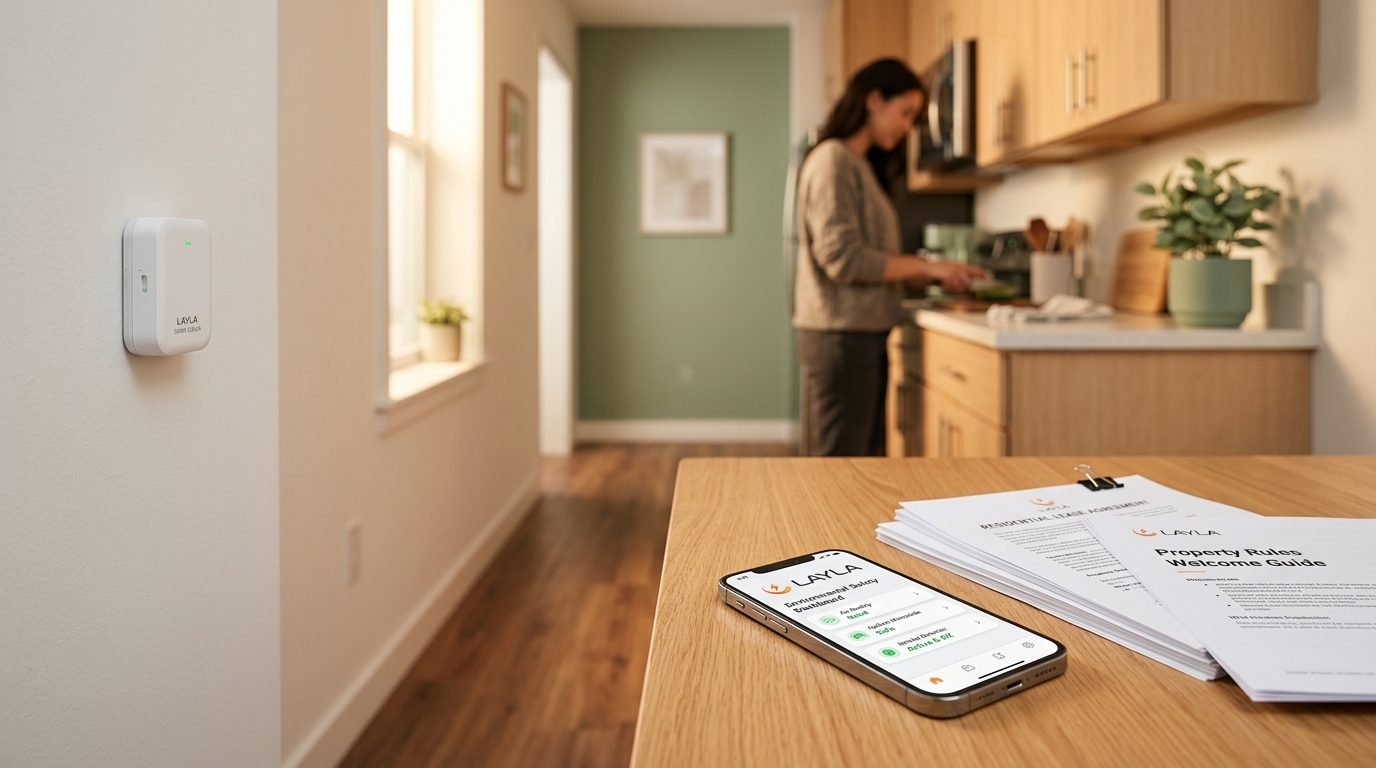
None of this monitoring requires detailed tracking of tenant behavior. The sensors capture environmental data about the property itself, not personal data about the people living in it. Privacy-first design means there are no cameras, no audio recording, no tracking of specific tenant movements through the property. The landlord receives information about the building, not surveillance of the tenants. This distinction matters legally, ethically, and practically. Long-term rental laws in many jurisdictions impose strict limits on landlord surveillance of tenants, and properly designed sensor systems stay well within those limits while still providing meaningful property protection.
The Specific Risks Long-Term Rentals Face
Long-term rentals face a different risk profile than short-term ones, with some risks larger and others smaller. Party damage from unauthorized gatherings is much rarer in long-term contexts. Slow-developing issues like mold from chronic humidity, gradual water damage from undetected leaks, and infrastructure failures from aging systems are more significant in long-term contexts because they have longer to develop without intervention.
A water leak in a vacation rental is usually discovered within hours by guests who experience it directly. The same leak in a long-term rental may go unreported for weeks if the tenant fails to notice it, fails to report it, or actively tries to handle it themselves. By the time the landlord learns about the issue, damage to floors, walls, and adjacent units may already be significant. Continuous monitoring catches these issues early enough to prevent the major damage that long-term concealment produces. The financial case is genuinely strong in this category alone, and the case strengthens further when other risks are considered. Layla’s environmental monitoring addresses exactly the risk categories most relevant to long-term landlords without crossing into tenant surveillance.
HVAC Efficiency in Long-Term Rentals
HVAC efficiency in long-term rentals presents an interesting case because the dynamics differ from vacation rentals. In vacation rentals, hosts pay all energy costs and benefit directly from efficiency gains. In long-term rentals, the cost responsibility usually falls on tenants, which weakens the landlord’s direct financial incentive for efficiency improvements. The relevant landlord interest shifts from cost savings to property protection: HVAC systems that run inefficiently fail earlier than well-managed systems, and HVAC failures during extreme weather create exactly the kinds of property damage discussed above.
Smart sensor visibility into HVAC patterns helps landlords identify systems that are failing or about to fail before catastrophic breakdown. Patterns showing the system running constantly without achieving target temperatures suggest equipment that is no longer adequate. Patterns showing rapid temperature fluctuations may indicate failing thermostats or compromised duct systems. Patterns showing the system unable to maintain temperatures during weather extremes indicate capacity problems that warrant upgrade before failure. None of this requires monitoring tenant behavior, but all of it supports landlord property management decisions that protect the building’s infrastructure value.
Tenant Communication About Sensors
The tenant relationship around sensors deserves careful thought because it affects both legal compliance and tenant satisfaction. Most jurisdictions require landlords to disclose monitoring devices in rental agreements, including environmental sensors that fall short of cameras or audio recording. Honest disclosure framed properly is rarely a problem with prospective tenants. Most tenants accept environmental monitoring readily once they understand what is and is not being monitored.
The framing that works best emphasizes tenant safety and property protection rather than tenant surveillance. Smoke detection helps protect the tenant’s life. Carbon monoxide monitoring does the same. Humidity monitoring protects the tenant from mold conditions that affect their health. Temperature monitoring catches HVAC failures before tenants face dangerous conditions in extreme weather. Water leak detection prevents damage that would disrupt the tenant’s living situation. Each of these benefits accrues to the tenant as much as to the landlord, which makes the conversation natural rather than adversarial. Landlords using Layla’s privacy-first approach can clearly explain that no cameras, audio, or tenant-tracking exist in the system, building trust rather than anxiety.
Insurance and Compliance Implications
Insurance providers covering long-term rental properties have shown growing interest in environmental monitoring similar to the trend in short-term rental insurance. Landlords with documented continuous monitoring may qualify for premium discounts, and claim outcomes tend to be better when documentation shows the landlord took reasonable steps to detect and prevent damage. The documentation requirements are similar to those discussed in short-term rental insurance contexts, including device specifications, installation locations, and maintenance records.
Compliance considerations also matter in long-term rental contexts. Building codes increasingly require certain forms of monitoring in multi-unit buildings, including carbon monoxide detection in residential units. Local rental regulations sometimes mandate specific environmental standards that ongoing monitoring helps document. Landlords proactive about compliance through monitoring tend to face fewer regulatory issues than landlords who wait for inspections to identify gaps. The compliance benefits combine with insurance and risk management benefits to make a strong case for monitoring in long-term portfolios.
The Quiet Shift Toward Long-Term Rental Sensors
The adoption curve for sensors in long-term rentals has been quieter than in short-term ones, but it is real and accelerating. Professional property management companies operating long-term portfolios have led much of the adoption because their economics support investment in monitoring infrastructure. Individual landlords with smaller portfolios are following as awareness builds and as device costs continue to drop. The trajectory mirrors what happened with short-term rentals a few years earlier, with similar drivers and similar adoption barriers.
Landlords considering whether to add monitoring to their long-term portfolios benefit from starting small. Adding sensors to a single property to evaluate the actual operational benefit costs little and reveals quickly whether the broader rollout makes sense. Most landlords who pilot in this way find that the monitoring becomes part of how they manage properties within a few months, with the initial pilot expanding to additional units once the operational benefit becomes clear. The quiet shift is happening one landlord at a time, and the cumulative effect across the industry will eventually make smart monitoring standard rather than exceptional in long-term rentals just as it has become in short-term ones.
Frequently Asked Questions
Q1: Are smart sensors legal in long-term rentals?
A: Yes when properly disclosed and limited to environmental monitoring without cameras or audio recording. Specific laws vary by jurisdiction.
Q2: How do tenants typically respond to disclosed environmental sensors?
A: Most tenants accept environmental monitoring once they understand it covers safety and property protection rather than tenant behavior tracking.
Q3: What categories of monitoring matter most in long-term rentals?
A: Smoke, carbon monoxide, humidity, temperature, and water-related humidity changes are particularly valuable for catching slow-developing issues.
Q4: Do insurance providers offer discounts for long-term rental monitoring?
A: Some do. Landlords should ask their specific insurance provider about available discounts for documented continuous monitoring.
Q5: Should I tell prospective tenants about Layla sensors?
A: Yes. Disclosure in the lease agreement is standard practice and usually required. Honest framing emphasizes safety and property protection.