On most projects I have reviewed, the wall is designed to a clear sound rating, the door is chosen for appearance, and the gap around that door is left to chance. That gap is usually where the privacy is lost. A solid-core door can be a good performer, yet an unsealed edge lets sound pass as if the door were barely there. Getting the hardware specification right is one of the cheapest ways to protect an acoustic design.
Why Acoustic Privacy Matters in Hospitality, Healthcare, and Corporate Interiors
Noise complaints rarely come from loud events. They come from ordinary sound, such as a conversation in a hallway, a television next door or a phone call in a meeting room, that should have stayed on the other side of the door.
In hotels, that sound affects sleep and reviews. In healthcare, it affects patient confidentiality, since consultation rooms need conversations to stay private. In offices, it affects focus and the confidentiality of HR meetings or client calls.
Standards describe this performance with the Sound Transmission Class (STC) rating, a single number showing how well an assembly blocks airborne sound. Higher is better. The important point is that the rating belongs to the whole assembly, which includes the frame, leaf, threshold, perimeter seals, gasketing and door sweeps or bottoms. Weakness in any one piece limits the rest.
I once worked on a boutique hotel renovation (details withheld) where guests complained about corridor noise despite new solid-core doors. The doors had roughly a half-inch of clearance below them and nothing at the jambs. After adding drop seals and perimeter gasketing, the complaints dropped sharply, even though the doors themselves never changed.
How Automatic Door Bottoms Work (Surface-Mounted vs. Mortised Applications)
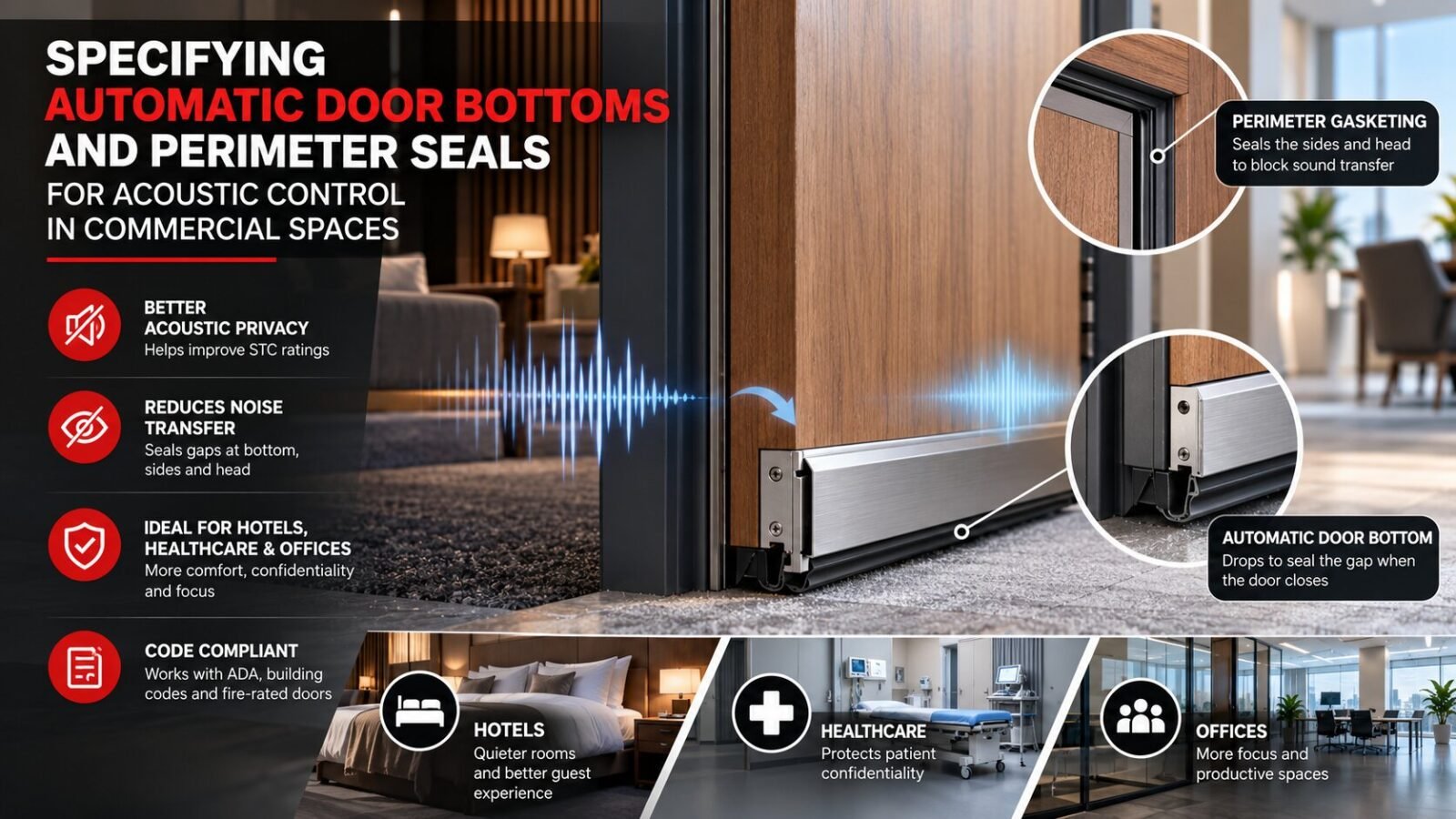
An automatic door bottom is a spring-loaded seal built into the base of a door. It stays retracted while the door swings, then drops against the floor or threshold when the door closes. One government technical guide explains that these units are adjustable and used when a higher degree of sound control is required, since the seal drops automatically to close the bottom gap. Compared with a fixed sweep, it avoids dragging on the floor and wearing out.
There are two main installation styles:
- Surface-mounted: fastened to the face of the door. It is easy to retrofit, needs no machining and suits existing openings, though it is visible.
- Mortised: set into a routed channel in the bottom edge of the door. It gives a cleaner appearance and is preferred on new, higher-end installations, but it must be planned before the door is fabricated.
The size of the gap matters. The bottom clearance is often the largest leak in the assembly. One industry guide states that the gap beneath a standard commercial door can account for over half of the sound passing through it. That is a vendor-side estimate, so treat it as a rule of thumb, but it matches what I see in the field.
Sealing the Threshold Gap Without Compromising Barrier-Free Access
Closing the gap cannot come at the expense of accessibility. In the United States, the ADA limits thresholds to 1/2 inch in height, with a bevelled edge required above 1/4 inch. Canadian projects must meet the accessibility provisions of the applicable provincial building code, so confirm those limits before ordering.
Fire ratings add another constraint. NFPA 80 limits the clearance under a fire door to 3/4 inch, and any door bottom on a fire-rated door must be listed for that use. Flooring finishes also matter. A thick carpet installed after hardware can shrink the gap enough to stop the seal from dropping, so coordinate final floor height with the hardware schedule.
A reminder for specifiers: acoustic hardware must be coordinated with accessibility, fire and flooring requirements at the same time. Resolving them one by one is how conflicts appear on site.
Pairing Perimeter Gasketing with Automatic Door Bottoms for Maximum STC Ratings
A door bottom does nothing for the sides and head of the door. Perimeter gasketing, usually silicone or rubber bulb seals set into the frame, closes the remaining joints. Together, the two components address every edge. One supplier estimates that well-fitted gasketing and a drop seal can add roughly 3 to 10 STC points to a standard solid-core door system. The range is wide because slab construction, frame rigidity and installation quality all influence the result, so I would not promise a specific number without a tested assembly.
The sequence of installation also affects results. The guidance I follow is to install the perimeter seals first, the automatic door bottom second and the threshold last, so each part can be adjusted before the next one is added.
For pairs of doors, a meeting-stile astragal seals the joint between leaves. And remember that seals cannot rescue a door that was never designed for sound. Standard doors without a rating will always limit what hardware can achieve.
When the Design Calls for Sliding or Pocket Doors
Designers often want a sliding or pocket door to save space in guest suites, bathrooms and closets. These openings are a different acoustic problem. A curved pocket door hides its leaf in the wall and seals poorly along its edges, while an exposed sliding door rides on a sliding door track that needs running clearance, which leaves gaps. Neither type typically reaches the sound performance of a gasketed swing door. If privacy is the priority, consider a swing door or discuss brush seals, overlaps and rated sliding systems with the hardware supplier early.
Frequently Asked Questions About Commercial Acoustic Weatherstripping
What is an automatic door bottom?
It is a seal mounted at the base of a door that stays raised while the door moves and drops against the floor when the door closes.
Do I need perimeter seals if I install an automatic door bottom?
Yes. A door bottom only closes the lower gap. Sound still passes through the jambs and head unless they are gasketed.
Can acoustic seals be used on fire-rated doors?
Only if the products are listed for that application and the clearances comply with NFPA 80 or the applicable Canadian standard.
Will acoustic hardware meet accessibility requirements?
It can, provided the threshold height and edge profile follow the applicable code. Always verify before purchasing.
How much will an STC rating improve?
Improvement depends on the door, the frame and installation. Hardware can add several points, but the final rating must be confirmed by testing on the full assembly.