Most contamination problems I have seen did not begin with a careless operator or a missed cleaning schedule. They began on a drawing, months or years earlier, in a joint that nobody thought twice about. A weld left rough, a corner left sharp or a lap joint that traps moisture can hold product residue through every wash cycle. For plant managers and quality teams, that is a hard lesson, because the flaw is invisible during normal inspection.
Cross-Contamination Often Starts at a Weld
A sanitary system cleans because its surfaces let it clean. If a surface has pits, ridges or gaps, residue settles in them and microbes find shelter. In a food plant, that means pathogens or allergen carryover. In a pharmaceutical facility, it can mean trace residue from one batch affecting the next.
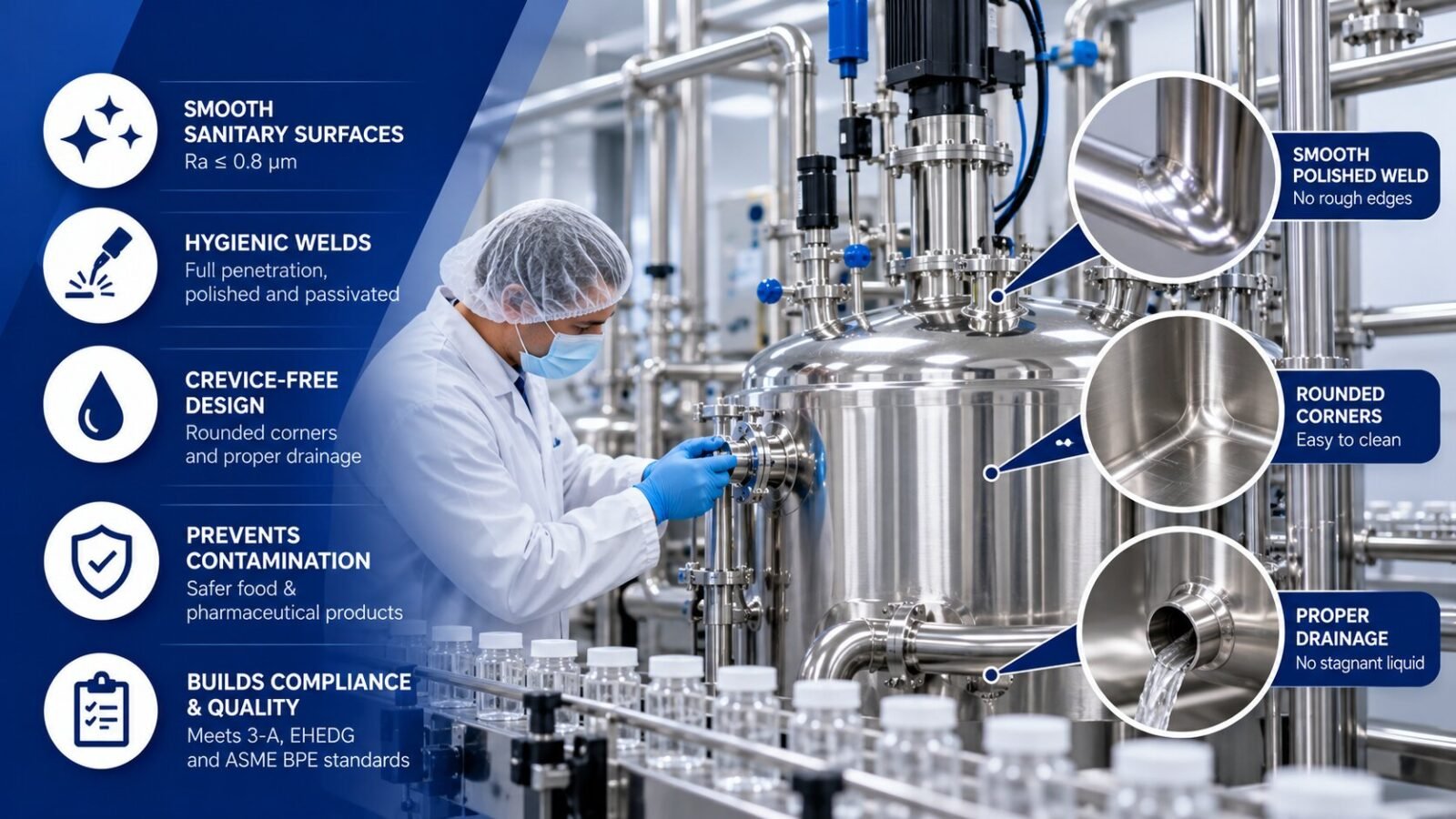
The industry has a measurable benchmark for this. Food safety references note that the American 3-A Sanitary organization and the EHEDG specify a maximum roughness of Ra = 0.8 µm for food contact surfaces. Ra is the average height of the tiny peaks and valleys on a surface, and 0.8 µm works out to roughly 32 microinches, the callout you often see on North American drawings. Pharmaceutical specifications are frequently tighter, so it is worth confirming the exact figure for your process.
One caution, though. Ra is an average, so it can hide problems. A surface can post a good number and still contain isolated deep scratches. As one technical source puts it, a surface with a low Ra can still carry a few deep, isolated scratches that act as bacterial harborage sites. That is why finish measurements need to be paired with visual inspection and cleaning validation.
Hygienic Welds: Where Finish and Geometry Meet
The weld is usually the weakest point in the finish. Base sheet is often already smooth, since cold-rolled stainless sheet typically measures between 0.2 and 0.5 µm Ra and needs no further treatment. The weld seam, however, is where heat, filler and handling can leave porosity, undercut and roughness.
In my experience, a hygienic weld needs four things:
- Full penetration and continuous seams. Intermittent or “tack” welds leave gaps behind, where liquid and residue can sit.
- Grinding and polishing to match the parent surface. The seam should blend into the surrounding metal and feel uniform under a gloved hand.
- Passivation. This chemical treatment removes free iron from the surface and restores stainless steel’s protective layer, which reduces corrosion that could roughen the surface later.
- Documented inspection. A weld that has been ground flush but never inspected is still a guess.
The takeaway: a weld is only hygienic when it is smooth, complete and verified, not just when it looks tidy from a few feet away.
Crevice-Free Design Starts Before Fabrication
Even a perfect finish cannot rescue a bad geometry. Cleaning fluid has to reach every surface and then drain away. The design choices that matter most are simple to state but easy to overlook:
Internal corners should be generously rounded, because sharp corners collect soil. Surfaces should slope toward drains, so liquid does not pool. Hollow tubes and frames should be sealed, since an open end is a hidden chamber. And metal-to-metal contact should be avoided where possible, because it creates narrow spaces that cleaning solutions cannot flush. A recent hygienic design webinar summed up one of the most common culprits: metal-to-metal lap joints create persistent capillary spaces. Capillary spaces pull liquid in and hold it there, so a lap joint can stay wet long after the surrounding surface has dried.
A Case From the Floor
A seasoning plant I worked near (I will keep details private) kept getting positive swab results around the same mixer, despite a rigorous cleaning routine. The team replaced chemicals, extended wash times and retrained operators. Nothing changed. A closer look with a borescope, a small inspection camera, showed the cause: a support gusset had been fitted with a short intermittent weld, leaving a narrow crevice where product accumulated.
The fix was a redesigned bracket with a continuous weld, ground and polished flush. Swab results normalized within weeks. The lesson is that when cleaning keeps failing, the fix is often in the geometry, not the procedure.
Standards Worth Knowing
You do not need to memorize every document, but you should know which ones shape the conversation:
- 3-A Sanitary Standards cover surface finish and design for dairy and food equipment.
- EHEDG guidelines focus on cleanability and hygienic engineering, and provide testing methods for validating a design.
- ASME BPE addresses equipment for bioprocessing and pharmaceutical use, including finish and weld requirements.
- cGMP requirements expect equipment surfaces not to be reactive, additive or absorptive, so they do not alter the product.
These documents share a single idea: equipment should be designed so that cleaning is reliable and verifiable, not a hope.
How Buyers Can Raise the Bar
Procurement teams hold more influence over hygiene than they sometimes realize. When evaluating pharmaceutical manufacturing equipment suppliers, ask for surface finish data, weld inspection records and material certificates, not just a general statement of compliance. When reviewing food and beverage processing equipment, ask how the design drains, how the welds are finished and how cleaning is validated.
Material and fabrication choices matter as well. Custom stainless steel work lets you specify exact radii, drainage angles and seam placement for your process, instead of adapting your process to a standard frame. Reliable metal fabrication also depends on shop discipline: controlled welding procedures, clean tooling that avoids cross-contaminating stainless with carbon steel, and traceable inspection.
Make Cleanability a Design Requirement
Sanitary design rewards early attention. A crevice found on a drawing costs a revision. The same crevice found after installation costs downtime, retesting and sometimes product. If you take one step after reading this, make it a habit: require cleanability criteria in every equipment specification, and verify them before the machine arrives. A facility that designs out its hiding places spends far less effort chasing contamination later.