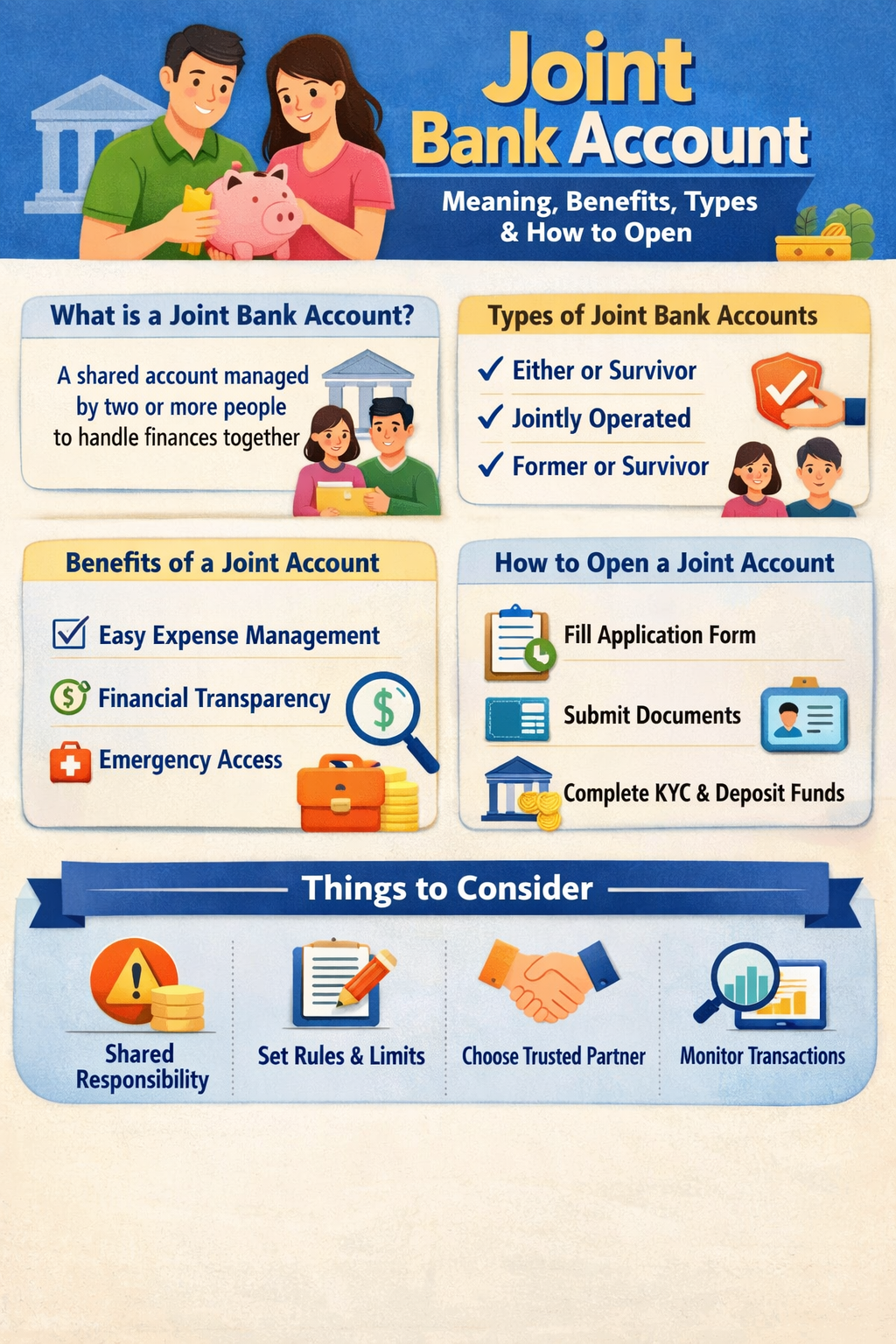
A shared bank account is a financial account that is run by two or more people. Most married couples, family members or business partners use it to share expenses, savings and dealings. With growing financial collaboration, joint accounts have become a popular and practical banking solution.
What is Joint Bank Account?
A joint bank account enables two or more people to use one bank account. Depending on the operating instructions of the account, every individual is able to deposit money, withdraw money and monitor the transactions. It makes it easy to manage common financial obligations such as rental, bills, investments or daily costs.
Types of Joint Bank Accounts
The various kinds of joint accounts can make you select the appropriate one:
1. Either or Survivor
Any account holder is free to run the account in this type. When one of the holders dies the other gains complete possession.
2. Jointly Operated Account
Transactions will have to be approved by all account holders. This one is the best to use when one wants to have the highest level of security and shared decision making.
3. Former or Survivor
The account is managed by the primary account holder and only after the demise of the primary account holder the secondary account holder is granted access.
Advantages of a Joint Bank Account.
There are a number of benefits of a joint bank account:
Easy Expense Management: Ideal to manage common expenses such as rent, groceries, and bills.
Transparency in Finances: Transactions are easily monitored by all those holding the transaction.
Convenience: Money can be accessed by any holder without delays.
Improved Budgeting: Aids in planning and saving jointly.
Emergency Access: All holders have access to funds in case of dire need.
Disadvantages of Joint Bank Accounts
Despite its benefits, there are some risks to consider:
- Shared Responsibility: All holders are liable for overdrafts or debts
- Reduced Privacy: Every transaction is visible to all account holders
- Potential Disputes: Misuse or disagreements can lead to conflicts
Who Open a Joint Bank Account?
A joint bank account is ideal for:
- Married couples managing household finances
- Parents and children for financial assistance
- Business partners handling company expenses
- Roommates sharing rent and utilities
How to Open a Joint Bank Account
It is easy to open a joint bank account. Follow these steps:
- Choose a bank and the type of joint account
- Fill out the application form with all account holders’ details
- Submit required documents:
- Identity document (Aadhaar, PAN, passport)
- Address proof
- Passport-size photos
- Complete KYC verification
- Insert the lowest amount (where necessary)
Most banks have gone online and allowed the opening of accounts more quickly.
Key Tips Before Opening a Joint Bank Account
- Determine the mode of operation.
- Establish predetermined levels of expenditure and regulations.
- Keep in touch with co-holders.
- Monitor transactions frequently
- Choose a trusted co-account holder
Conclusion
Shared finances are a clever and effective method of controlling a joint bank account. It encourages transparency, simplifies the management of expenses and makes funds easily available. Nonetheless, it also involves trust, effective communication, and fiscal discipline. Knowing its types, advantages and disadvantages, you will be able to make a good choice and utilize a joint account.
Visit us: accountingbyte.com