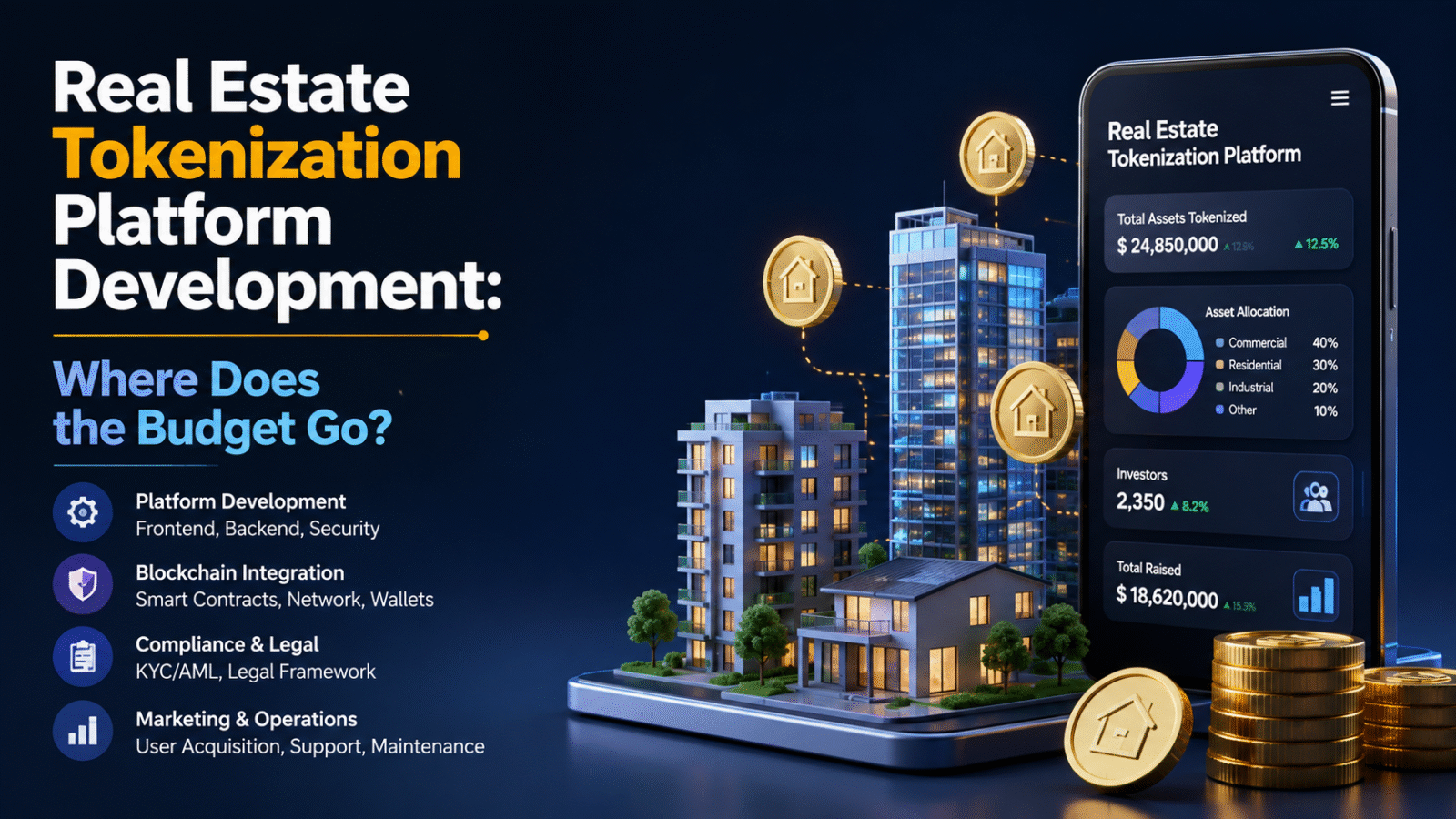
Real estate tokenization has gained attention among property owners, investment firms, developers, and digital asset businesses because blockchain can represent property ownership or economic interests through digital tokens. However, launching a real estate tokenization platform involves much more than creating tokens and placing them on a blockchain. The budget usually covers business planning, legal work, platform design, blockchain integration, smart contracts, investor features, security, testing, and post-launch maintenance.
For businesses planning real estate tokenization platform development, understanding where the money goes can make budgeting easier. The final cost depends on the platform model, property type, blockchain network, compliance requirements, number of features, user groups, and development approach. A simple platform for a single property can require a very different budget from a marketplace supporting multiple properties and secondary trading.
This article explains the major areas that influence the cost of real estate tokenization development and what businesses should consider before starting the project.
Business Planning and Platform Research
The first budget area is business and market research. Before development begins, the business model needs to be defined. The platform may focus on residential properties, commercial buildings, hotels, rental portfolios, land, or other real estate assets.
Research may cover the target investors, property owners, expected transaction volume, token structure, revenue model, geographic market, and competing platforms. Businesses may also study Top real estate tokenization companies and Best real estate tokenization companies to understand commonly offered features and user experiences.
This stage can reduce unnecessary development work because the platform requirements become more specific before technical work starts.
Legal and Regulatory Expenses
Legal work can represent a significant portion of the budget because real estate tokenization can involve securities, investment contracts, property ownership structures, investor restrictions, taxation, and financial regulations.
The legal framework depends heavily on the country where the property, platform operator, and investors are located. Legal specialists may review token ownership structures, investor agreements, property documentation, KYC and AML requirements, data protection rules, and token transfer restrictions.
A real estate tokenization company entering several markets may need legal guidance for each jurisdiction. These expenses should be considered separately from software development because regulatory requirements can influence how the entire platform operates.
Property Assessment and Asset Structuring
Before a property is represented through blockchain tokens, the underlying asset needs an appropriate ownership and investment structure. Depending on the business model, a legal entity may hold the property while tokens represent shares, economic rights, revenue participation, or another defined interest.
Property valuation, documentation, ownership verification, financial analysis, and investor documentation can add to the project budget. A real estate asset tokenization company may also require systems for storing property information, valuation reports, legal documents, rental records, and financial statements.
The more complex the asset structure, the more planning may be required before token issuance.
UI and UX Design
The platform interface also affects development expenses. Investors need to understand property information, token prices, ownership details, investment terms, distributions, transaction history, and portfolio performance.
The design process can include investor dashboards, property listing pages, token purchase screens, wallet interfaces, administrative panels, verification screens, and reporting sections.
A platform serving professional investors may require a different interface from one targeting individual investors. The number of user roles and screens directly influences design and development time.
Blockchain Network Selection
Blockchain selection is another major budget consideration. The development team may evaluate networks based on transaction fees, transaction speed, ecosystem support, smart contract capabilities, wallet compatibility, and regulatory requirements.
The choice can influence token standards, smart contract development, transaction processing, wallet integration, and maintenance requirements.
Some businesses may use a public blockchain, while others may consider permissioned infrastructure for specific business requirements. The decision should be made after reviewing the expected transaction model and compliance framework rather than simply selecting a network based on popularity.
Smart Contract Development
Smart contracts handle many blockchain-based functions within a tokenization platform. Depending on the business model, contracts may manage token issuance, transfers, ownership records, investment limits, distribution rules, whitelisting, and other conditions.
Real estate token development may require several contracts rather than one contract. For example, separate contracts can manage token issuance, investor permissions, payment processing, and distribution mechanisms.
The budget depends on contract complexity and the number of functions required. Smart contract testing and auditing should also receive their own budget allocation because contract errors can create financial and operational risks.
Token Issuance and Management
The token management system is another expense area. Administrators may need to create tokenized assets, define supply, establish token pricing, assign investor restrictions, pause transfers, update permitted wallets, and manage distributions.
The platform may also require token lifecycle functions covering issuance, allocation, transfers, redemption, and retirement.
If multiple property assets will be listed, the platform may require an administrative system that allows authorized users to manage each tokenized property separately. This increases development requirements compared with a platform supporting only one asset.
Investor Onboarding and KYC
Real estate investment platforms commonly require investor verification before allowing certain activities. The platform may therefore include registration, identity verification, document submission, investor classification, wallet verification, and compliance checks.
Third-party KYC and AML services can be integrated into the platform. Their usage fees may be separate from the software development budget.
The platform may also need different permissions for verified investors, administrators, property owners, brokers, and compliance teams. These permission levels add development work.
Wallet and Payment Integration
Investors need a method to hold and transfer tokens. Wallet integration can therefore become an important part of the development budget.
The platform may support external wallets, custodial wallets, or a combination of both. Payment options can include cryptocurrency, stablecoins, bank transfers, or other approved payment methods depending on the regulatory structure.
Payment gateway integration, transaction monitoring, wallet verification, deposit processing, withdrawals, and transaction records can all contribute to development costs.
Property Marketplace Development
If the business plans to operate a marketplace, additional functionality will be required. Property owners may need to submit assets, while investors can browse available offerings and review investment information.
Marketplace functions can include property listings, token availability, pricing, investment limits, investor eligibility, transaction records, search filters, portfolio views, and notifications.
A marketplace model generally requires more development work than a platform used only for issuing tokens for a single property.
Secondary Trading Features
Some businesses may want investors to trade eligible tokens after the initial offering. This introduces another layer of development and regulatory considerations.
A secondary market can include buy and sell orders, trading restrictions, price information, transaction history, wallet verification, and settlement processes.
Not every real estate tokenization platform requires secondary trading. Businesses should decide whether this function is necessary because adding trading functionality can significantly increase both development and compliance expenses.
Backend and Database Development
The backend manages user accounts, property records, investor information, transactions, compliance data, token information, notifications, and administrative functions.
Database architecture also matters. The system may need to store large amounts of property documentation and transaction data while maintaining suitable access controls.
A real estate tokenization development company may use cloud infrastructure for hosting, databases, storage, monitoring, and application services. Monthly infrastructure expenses should be separated from the initial development budget.
Admin Dashboard
The administrator dashboard gives the business control over platform operations. It may include user management, property management, token issuance, compliance status, transactions, payments, reports, notifications, and platform settings.
Different administrators may require different permissions. For example, a compliance officer may access verification information while a property manager handles asset listings.
The number of administrative functions has a direct effect on development time and cost.
Security Testing and Smart Contract Audits
Security should receive a separate budget allocation. A tokenization platform can handle property data, investor information, financial transactions, and digital assets, so security testing should cover both blockchain and traditional application components.
Testing can include vulnerability assessments, smart contract audits, penetration testing, authentication checks, access-control reviews, API testing, and transaction validation.
Smart contract audits are especially important because contract logic can directly affect token balances and ownership-related records.
Testing and Quality Assurance
Testing covers more than checking whether buttons work. The platform needs to be evaluated across different user roles, devices, browsers, blockchain transactions, payment scenarios, and failure conditions.
Quality assurance teams may test registration, KYC, property listings, token purchases, wallet connections, transfers, distributions, admin controls, notifications, and reporting.
Testing before launch can identify functional problems before investors begin using the platform.
Cloud Infrastructure and Deployment
Hosting costs depend on the platform’s traffic, data storage, blockchain services, monitoring requirements, and third-party integrations.
A small platform may begin with a modest cloud setup, while a larger marketplace may require multiple application services, databases, storage systems, monitoring tools, backups, and security controls.
Businesses should also budget for ongoing infrastructure expenses rather than treating hosting as a one-time development cost.
Post-Launch Maintenance
Development does not end when the platform goes live. Software updates, security patches, blockchain changes, bug fixes, monitoring, third-party API updates, and new feature releases may create recurring expenses.
Regulatory changes can also require modifications to investor onboarding, token transfer rules, reporting, and compliance processes.
A long-term maintenance agreement with a real estate tokenization development company can help businesses manage these recurring technical requirements.
What Factors Increase the Development Budget?
Several factors can raise the total budget for real estate tokenization platform development:
- Number of supported blockchain networks
- Number of tokenized property types
- Complexity of the ownership structure
- Legal and regulatory requirements
- Number of investor and administrator roles
- KYC and AML integrations
- Payment and wallet integrations
- Marketplace functionality
- Secondary trading features
- Smart contract complexity
- Security and audit requirements
- Mobile application development
- Multi-language and multi-currency support
- Third-party service integrations
- Ongoing maintenance requirements
A platform with basic property token issuance will normally require fewer resources than a marketplace offering property discovery, investment, trading, portfolio management, and multiple payment methods.
Estimated Budget Structure
The budget can be viewed through several broad categories rather than focusing only on coding expenses.
|
Business research and planning |
Low to Medium |
|
Legal and compliance |
Medium to High |
|
Property and asset structuring |
Medium |
|
UI/UX design |
Medium |
|
Blockchain integration |
Medium |
|
Smart contracts |
Medium to High |
|
Token management |
Medium |
|
KYC and AML |
Medium |
|
Wallet and payment integration |
Medium |
|
Marketplace |
Medium to High |
|
Secondary trading |
High |
|
Backend development |
Medium to High |
|
Admin dashboard |
Medium |
|
Security audits |
Medium to High |
|
Testing |
Medium |
|
Cloud infrastructure |
Ongoing |
|
Maintenance |
Ongoing |
These categories provide a practical way to estimate where the budget may go. The exact amount should be calculated after preparing the platform specification and identifying the regulatory market.
How to Control Development Costs
Businesses can manage spending by defining the first release carefully. Instead of launching every possible function, the initial version can focus on property listings, investor registration, compliance checks, token issuance, wallet connectivity, investment processing, and basic administration.
The business can then add features based on user demand and operating requirements. Choosing a suitable blockchain, limiting unnecessary integrations, preparing detailed technical specifications, and conducting legal planning early can also reduce avoidable development work.
Working with an experienced real estate tokenization development company can help businesses estimate technical requirements before development begins. Comparing several vendors based on technical experience, security practices, previous projects, development methodology, and maintenance support can provide a better basis for vendor selection.
Why the Development Partner Matters
The development partner can influence both the initial budget and long-term platform expenses. A vendor handling only blockchain coding may not cover compliance-related workflows, investor interfaces, property management, wallet integration, and post-launch support.
A real estate tokenization company with experience across blockchain, real estate workflows, smart contracts, and investor platforms may be better suited for projects requiring several connected systems.
Businesses should review the vendor’s previous tokenization work, technical approach, security process, support model, and ability to handle future platform updates before signing a development agreement.
Final Thoughts
Real estate tokenization platform development involves several cost areas, and software coding is only one part of the overall budget. Legal preparation, asset structuring, smart contracts, blockchain integration, investor onboarding, wallets, payments, security, testing, cloud infrastructure, and maintenance can all influence the final investment. Businesses planning real estate tokenization should first define the property model, target investors, regulatory market, token structure, and required platform functions. A detailed project specification can then provide a more realistic budget instead of relying on a generic development estimate. Blockchain App Factory provides Real estate tokenization development services covering platform planning, token development, smart contracts, blockchain integration, investor features, and related technical requirements for businesses entering the tokenized real estate market.
FAQs
1. What is real estate tokenization platform development?
Real estate tokenization platform development involves creating software that represents eligible real estate interests through blockchain-based tokens and provides functions for issuance, investor onboarding, transactions, asset management, and related activities.
2. What are the biggest expenses in a real estate tokenization platform?
Legal and regulatory work, smart contracts, blockchain development, investor onboarding, security, marketplace functions, payment integration, and ongoing maintenance can account for significant portions of the budget.
3. Does blockchain selection affect the development cost?
Yes. Different blockchain networks have different technical requirements, transaction models, development tools, and infrastructure considerations. These differences can influence both initial development and ongoing expenses.
4. Is a secondary marketplace necessary?
No. A platform can begin with token issuance and investment functions without secondary trading. Whether secondary trading is appropriate depends on the business model and applicable regulations.
5. Why are smart contract audits included in the budget?
Smart contracts can control important token functions. An audit can identify potential logic and security issues before contracts are used in production.
6. How does KYC affect platform development?
KYC adds registration, identity verification, document handling, investor status, and compliance workflows. Third-party verification services may also introduce separate usage fees.
7. Can a business start with an MVP?
Yes. An MVP can focus on a limited property type, selected investor features, token issuance, compliance workflows, wallet integration, and administration. Additional functions can be introduced later based on business requirements.
8. What does a real estate tokenization development company usually handle?
Depending on the agreement, the development partner may handle platform design, blockchain integration, smart contracts, token creation, backend systems, investor interfaces, wallet integration, testing, deployment, and maintenance.
9. What is the difference between real estate tokenization and real estate token development?
Real estate tokenization refers to the process of representing eligible real estate interests through digital tokens. Real estate token development focuses more specifically on creating the token and its supporting smart contract and technical functions.
10. How should businesses estimate their platform budget?
Businesses should first define the property model, jurisdiction, token structure, investor type, blockchain network, required features, compliance workflow, security requirements, and post-launch support. These details allow a development team to prepare a more realistic project estimate.