A treadmill can count steps. A basic fitness app can log sets and reps. Neither one can tell you that your knee is caving inward on a squat, or that your lower back is rounding on a deadlift, in the half-second before it happens. That’s the gap AI-powered personal trainer apps with real-time form correction are built to close, and it’s turning into one of the more technically interesting corners of fitness app development.
This piece walks through what actually goes into building one — the computer vision behind it, the architecture decisions that make real-time feedback possible, and the pitfalls that trip up teams who underestimate how hard “real-time” really is.

Real-time form correction only works if the feedback arrives fast enough to matter mid-rep, not after the set is already over.
Why Form Correction Is a Different Problem Than Tracking
Most fitness apps are fundamentally about logging — recording what happened after it happened. Form correction is about catching what’s happening right now, which means the software has to understand human movement well enough to spot a mistake in real time and communicate it before the rep is finished.
That distinction matters because it changes almost every technical decision downstream. A logging app can tolerate a few seconds of lag. A form-correction app can’t — by the time a warning appears three seconds late, the rep causing the problem is already over, and so is any chance to actually prevent an injury.
The Core Technology: Pose Estimation
The foundation of any AI-powered form correction feature is pose estimation — computer vision models that identify key points on the human body (joints, limbs, spine alignment) from camera input and track how they move through space.
A few things matter here specifically:
On-device vs. cloud processing. Running pose estimation on-device, using frameworks built for mobile hardware, keeps latency low enough for real-time feedback. Sending video to the cloud for analysis introduces round-trip delay that usually makes true real-time correction impractical, though cloud processing still has a place for more detailed post-workout analysis.
Model accuracy under real-world conditions. Lab-quality pose estimation demos rarely reflect how people actually work out — inconsistent lighting, loose clothing, unusual camera angles, other people or furniture in frame. Training and validating models against messy, real gym and home conditions is where a lot of the actual engineering effort goes.
Exercise-specific movement models. A squat and a deadlift stress completely different joints and require different reference angles for “correct form.” Building a general pose-tracking model is one project; building the exercise-specific logic that translates joint angles into meaningful feedback (“your knees are tracking too far forward”) is a separate, harder one.
Architecture Considerations for Real-Time Feedback
Getting the feedback loop fast enough requires some deliberate architectural choices:
- Edge inference for the pose detection itself, so the app isn’t waiting on a network round-trip mid-rep
- A lightweight rules or scoring engine that translates raw joint-angle data into specific, actionable cues rather than a raw data dump
- Audio and visual feedback channels built to interrupt without breaking concentration — a short vibration or a spoken cue tends to work better mid-set than a text popup nobody’s looking at
- Session buffering, so a full rep gets analyzed as a unit instead of triggering false alarms on a single noisy frame

The camera and the model working together in real time is the technical core of the product — everything else in the app supports that loop.
Beyond the Core Feature: What a Complete App Still Needs
Form correction is the differentiator, but it’s not the whole app. A production-ready build still needs:
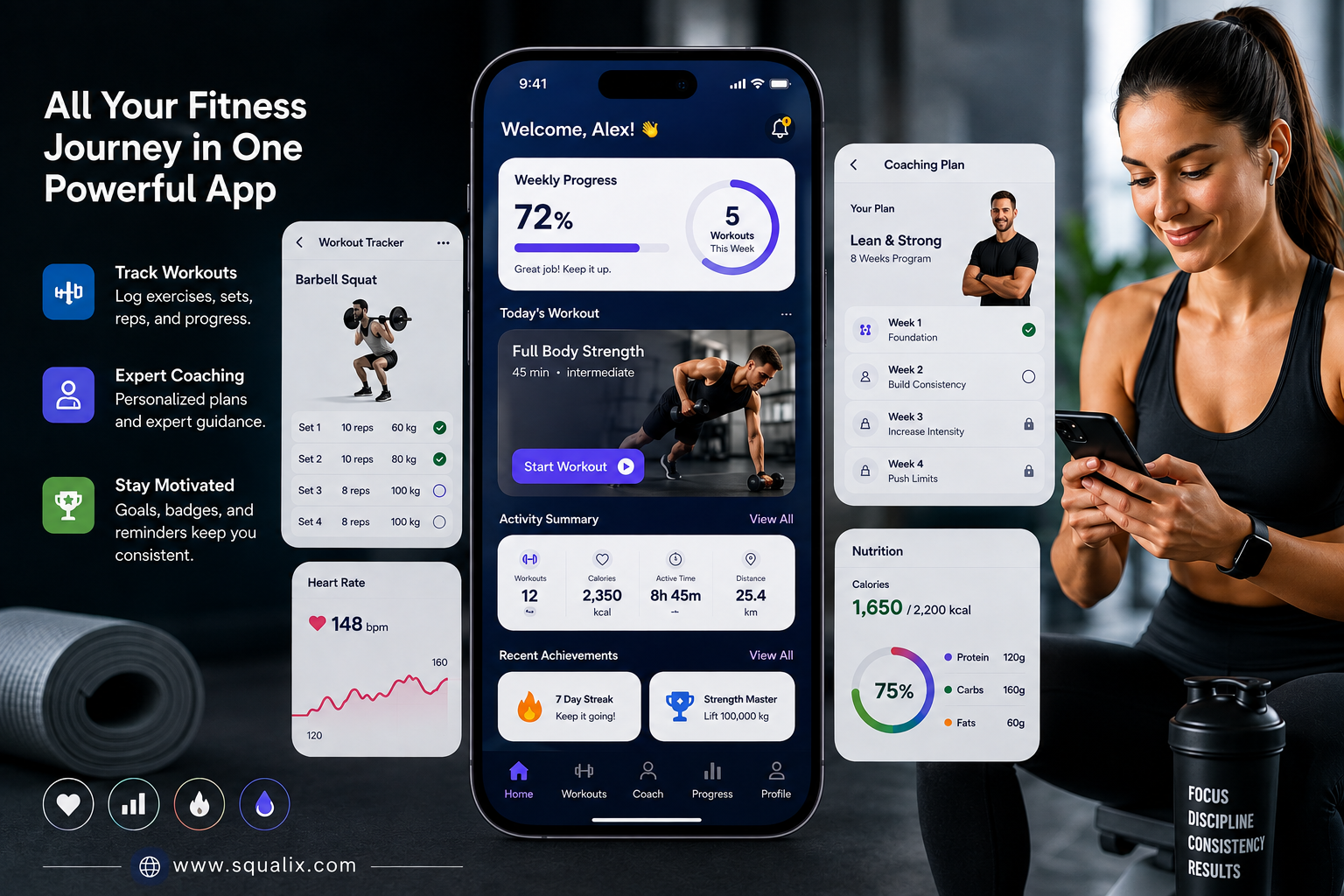
Personalized workout programming that adapts based on performance data and form quality over time, not just a static plan set on day one.
Progress tracking and analytics that turn raw rep and form data into something a user can actually act on — trends, not just numbers.
Wearable and device integration, since heart rate and recovery data add useful context that camera-based form tracking alone can’t provide.
Data privacy safeguards, given that video and body movement data is about as personal as fitness data gets. Clear consent flows and secure handling aren’t optional extras here.
A backend built to scale, typically on a Node.js and MongoDB stack, capable of handling growing volumes of session data, user profiles, and exercise libraries without buckling as the user base grows.
Common Mistakes Teams Make Building This
A few patterns show up repeatedly in form-correction apps that don’t land well with users:
Over-correcting. Flagging every minor deviation creates so much noise that people start ignoring the feedback altogether. The best implementations flag what actually matters and stay quiet otherwise.
Ignoring camera setup friction. If getting the phone positioned correctly takes five minutes of trial and error before every workout, most people stop doing it after the first week.
Treating this as a one-time build. Movement models improve with more data and more exercise coverage over time. Teams that treat launch as the finish line tend to fall behind teams that keep refining the model against real usage.
Why Choose Web Squalix
Building an AI-powered personal trainer app with real-time form correction sits at the intersection of computer vision, mobile performance engineering, and genuine fitness domain knowledge — which is a narrower skill set than most app development shops actually have. Web Squalix approaches this kind of build the way the category demands: pose estimation and real-time feedback treated as the core architecture decision from day one, not a feature bolted onto a generic fitness app template.
That expertise extends across the wider fitness app development space too — personal trainer apps, workout tracking, nutrition, and wearable integrations — which means the AI-driven pieces of a build are designed to work alongside the rest of the product instead of sitting off to the side as a separate module. Combined with a Node.js and MongoDB backend built to handle real session data at scale, the result is a platform that holds up under actual daily workouts, not just in a demo video.
Support doesn’t stop at launch either. Movement models get better with more real-world data, and ongoing refinement, monitoring, and updates are treated as part of the build, not an afterthought once the app ships.
An app that can genuinely catch a bad rep before it becomes an injury is a hard thing to build well. Choosing a partner who understands why it’s hard is the first step toward actually shipping it.
learn more : https://www.squalix.com/fitness-app-development