Web applications have become the backbone of nearly every business interaction — from banking and healthcare to retail and logistics. But as digital transformation accelerates, so does the sophistication of cyberattacks. In 2026, securing a web application is no longer a one-time checklist item; it’s a continuous discipline that spans code, infrastructure, APIs, and human behavior.
This guide breaks down what modern web application security actually looks like today: the risks defined by the OWASP Top 10, how secure development lifecycles are evolving, and the authentication and API practices that separate resilient applications from vulnerable ones.

Why Web Application Security Matters More Than Ever in 2026
The attack surface for web applications has expanded dramatically. Organizations now run distributed microservices, expose dozens of APIs to partners and mobile clients, and rely on third-party integrations and AI-powered features that introduce new, less understood risks. A single misconfigured endpoint or an overlooked authentication flaw can expose customer data, disrupt operations, or trigger regulatory penalties.
A few forces are driving urgency this year:
- AI-assisted attacks are lowering the skill barrier for exploiting common vulnerabilities, allowing automated tools to probe applications at scale.
- API-first architectures mean more entry points into core systems than ever before, each requiring its own security controls.
- Regulatory pressure around data privacy (GDPR, HIPAA, and similar frameworks) is pushing security from an IT concern to a board-level priority.
- Remote and hybrid workforces have blurred traditional network perimeters, making identity and access management central to any security strategy.
The cost of getting this wrong isn’t just financial. Data breaches erode customer trust, damage brand reputation, and can take years to recover from. This is why security needs to be treated as a foundational part of product development, not an afterthought bolted on before launch.
Understanding the OWASP Top 10 Security Risks
The OWASP Top 10 remains the industry’s most trusted reference for identifying the most critical web application security risks. While the categories evolve slightly with each revision, the underlying themes have remained consistent and are more relevant than ever heading into 2026:
- Broken Access Control — Applications that fail to properly enforce what authenticated users are allowed to do, letting attackers access data or functions outside their permissions.
- Cryptographic Failures — Weak or missing encryption for sensitive data, both in transit and at rest, often due to outdated algorithms or poor key management.
- Injection Flaws — SQL, NoSQL, OS, and LDAP injection attacks that occur when untrusted input is not properly validated or sanitized.
- Insecure Design — Security gaps baked into the architecture itself, which no amount of later patching can fully fix.
- Security Misconfiguration — Default credentials, verbose error messages, unnecessary open ports, and unpatched systems left exposed.
- Vulnerable and Outdated Components — Using libraries, frameworks, or dependencies with known vulnerabilities.
- Identification and Authentication Failures — Weak session management, poor password policies, and missing multi-factor authentication.
- Software and Data Integrity Failures — Insecure CI/CD pipelines and unverified software updates that allow malicious code to slip into production.
- Security Logging and Monitoring Failures — Insufficient visibility into suspicious activity, delaying detection and response to breaches.
- Server-Side Request Forgery (SSRF) — Attacks that trick a server into making unauthorized requests to internal or external systems.
Understanding these categories isn’t just an academic exercise — it’s the starting point for any serious security audit. Development teams that map their codebase and infrastructure against this list consistently catch issues before they become incidents.

Secure Software Development Lifecycle (Secure SDLC)
Retrofitting security after an application is built is expensive and often incomplete. A Secure Software Development Lifecycle (Secure SDLC) embeds security checkpoints into every phase of development, rather than treating it as a final gate before release.
A modern Secure SDLC typically includes:
- Requirements and threat modeling — Identifying potential attack vectors and abuse cases before a single line of code is written.
- Secure coding standards — Enforcing guidelines that prevent common vulnerabilities like injection flaws and insecure deserialization.
- Static and dynamic analysis (SAST/DAST) — Automated scanning tools integrated into the CI/CD pipeline to catch vulnerabilities early and continuously.
- Dependency and software composition analysis (SCA) — Continuously monitoring third-party libraries for known CVEs, since most modern applications are built on dozens of open-source packages.
- Peer code review with a security lens — Human reviewers trained to spot logic flaws that automated tools miss.
- Penetration testing before release — Simulated attacks against staging environments to validate that defenses actually hold up.
- Post-release monitoring and patch management — Security doesn’t end at deployment; ongoing monitoring and rapid patching are essential as new vulnerabilities are discovered.
Teams that adopt Secure SDLC practices don’t just reduce vulnerabilities — they also cut down on the cost and disruption of late-stage security fixes, since issues are caught when they’re cheapest to resolve.
Essential Security Best Practices Every Development Team Should Follow
Beyond frameworks and processes, there are concrete practices that consistently separate secure applications from vulnerable ones:
Authentication and access management
- Enforce multi-factor authentication (MFA) for all user and administrative accounts.
- Adopt modern authentication standards like OAuth 2.1 and OpenID Connect instead of custom-built login systems.
- Use short-lived access tokens with proper refresh token rotation rather than long-lived sessions.
- Apply the principle of least privilege across every role and service account.
API security
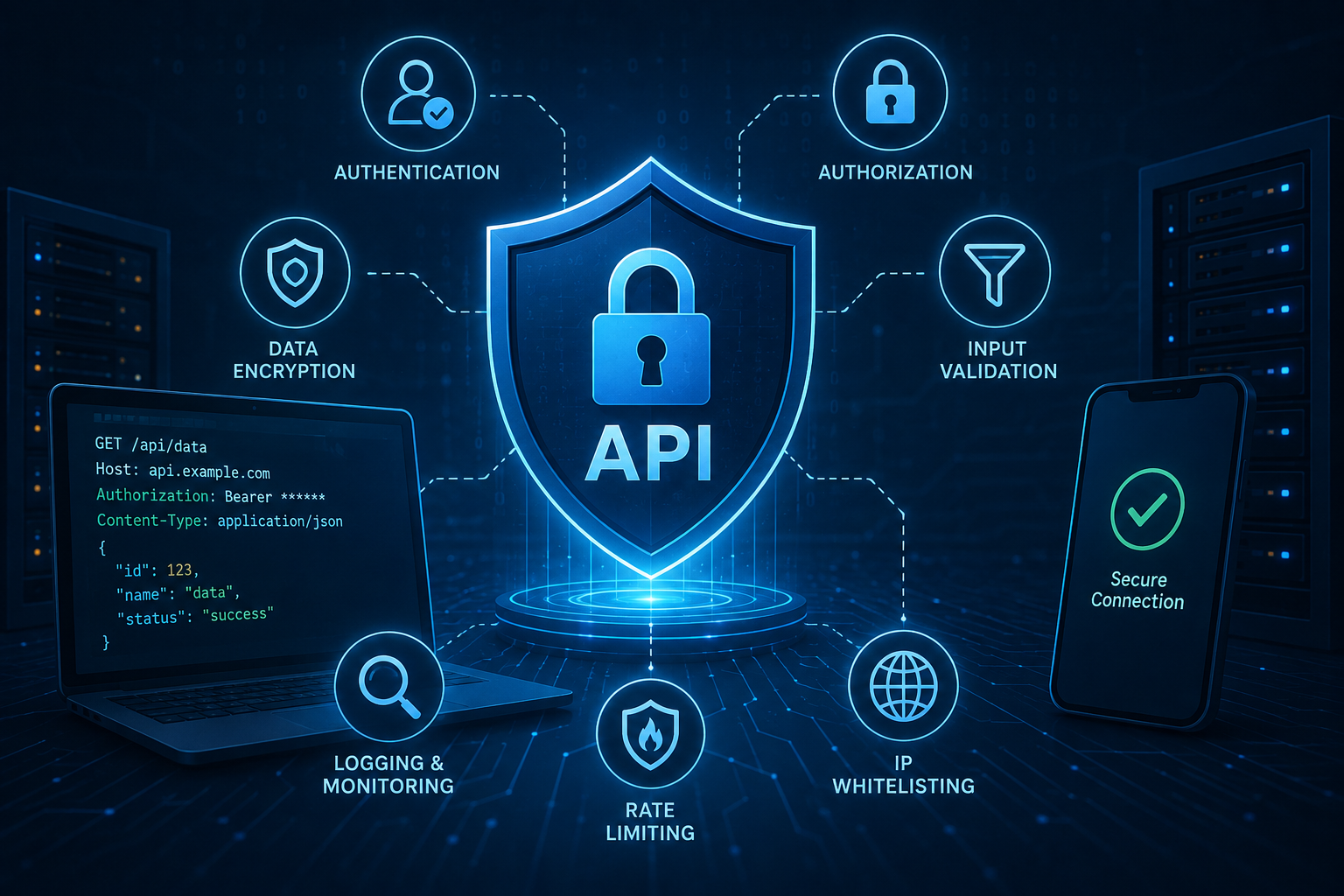
- Authenticate and authorize every API request — never assume internal APIs are inherently safe.
- Implement rate limiting and throttling to prevent abuse and denial-of-service attempts.
- Validate and sanitize all input at the API layer, not just in the frontend.
- Use API gateways to centralize security policies, logging, and monitoring across services.
- Version APIs carefully and deprecate old versions with known weaknesses.
Data protection
- Encrypt sensitive data both in transit (TLS 1.3) and at rest.
- Avoid storing sensitive data unnecessarily — minimize what you collect and retain.
- Use proper secrets management tools instead of hardcoding credentials or API keys.
Infrastructure and monitoring
- Automate dependency updates and vulnerability scanning as part of the CI/CD pipeline.
- Set up centralized logging with real-time alerting for anomalous behavior.
- Conduct regular security audits and penetration tests, not just once a year.
These practices aren’t theoretical — they’re the baseline expectations for any application handling real user data in 2026.

Common Web Application Security Mistakes Businesses Make
Even organizations with security budgets and dedicated teams make recurring mistakes:
- Treating security as a one-time project rather than an ongoing process, leading to configurations and dependencies that go stale.
- Over-relying on perimeter defenses like firewalls while neglecting application-layer vulnerabilities.
- Ignoring third-party and API risk, assuming vendors and partners have already handled security on their end.
- Weak session and password policies, including missing MFA or allowing indefinite session lifetimes.
- Insufficient logging and monitoring, which delays detection of a breach by weeks or months in many real-world incidents.
- Skipping security in the design phase, then trying to patch fundamental architectural flaws after launch.
- Underestimating insider risk and failing to enforce least-privilege access internally.
Most of these mistakes stem from treating security as a compliance checkbox rather than a core engineering discipline — a mindset shift that’s increasingly non-negotiable as attack sophistication grows.
Future Trends in Web Application Security
Looking ahead, several trends are shaping how organizations will need to approach security:
- AI-driven threat detection and response — Security tools increasingly use machine learning to detect anomalies and respond to attacks in real time, often faster than human analysts can react.
- Zero Trust architecture becoming standard — The assumption that no user or system is trusted by default, requiring continuous verification rather than one-time authentication.
- Passwordless authentication — Passkeys and biometric-based authentication are steadily replacing traditional passwords, reducing credential-based attacks.
- API security as a dedicated discipline — With APIs now often outnumbering traditional web pages as attack targets, specialized API security tooling is becoming standard rather than optional.
- Supply chain security — Greater scrutiny of open-source dependencies and CI/CD pipelines following high-profile software supply chain attacks.
- Privacy-by-design regulations — Expanding data protection laws are pushing security and privacy considerations earlier into the design process.
Organizations that stay ahead of these shifts — rather than reacting to them after an incident — will be far better positioned to protect their users and their business.
Conclusion
Web application security in 2026 demands more than a firewall and an annual audit. It requires a layered approach: understanding the OWASP Top 10, embedding security into the development lifecycle from day one, enforcing modern authentication standards, and treating API security as a first-class concern rather than an afterthought.
For businesses that don’t have deep in-house security expertise, partnering with an experienced development team can make the difference between reactive firefighting and proactive protection. Web Squalix works with organizations to build and harden secure web applications — from implementing Secure SDLC practices and modern authentication to designing resilient, well-monitored API architectures — so that security is built in rather than bolted on.